Table of Contents
- Army Chief Makes Historic Declaration
- What Does ‘Women in Indian Army Infantry’ Really Mean?
- The Condition: Societal Acceptance as a Gatekeeper
- Global Context: How India Compares to Other Nations
- Beyond Gender: The Army’s Broader Modernization Push
- Challenges and Opportunities Ahead
- Conclusion: A New Era for the Indian Army?
- Sources
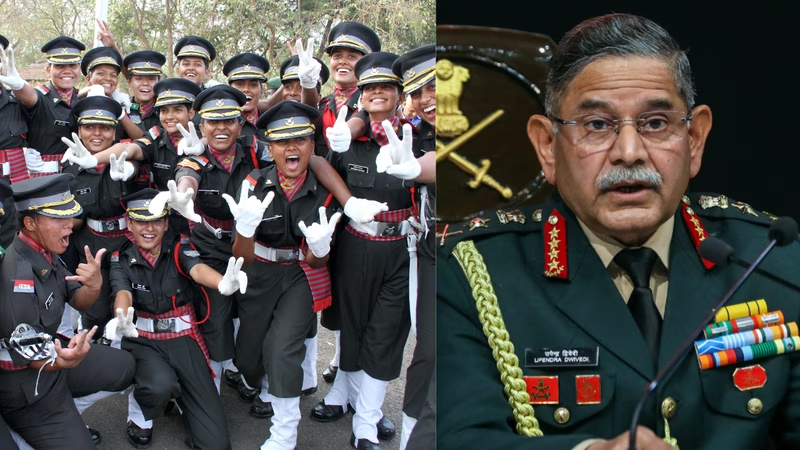
In what could be a turning point for gender equality in India’s armed forces, Army Chief General Upendra Dwivedi has announced that the Indian Army is operationally and institutionally ready to induct women into infantry roles—the frontline of ground combat . But there’s a catch: this historic step hinges not on military capability, but on societal acceptance. This nuanced stance reflects both progress and pragmatism in a nation where tradition and modernity often collide. The possibility of women in Indian Army infantry units isn’t just about uniforms or ranks; it’s about redefining courage, resilience, and national service in the 21st century.
Army Chief Makes Historic Declaration
Speaking at a press conference in New Delhi, General Dwivedi emphasized that the Army’s approach to gender integration is “sequential” and “based on operational requirements” . Women have already been commissioned into non-combat streams like medicine, law, and engineering. More recently, they’ve entered combat-support roles in artillery, armored corps, and air defense. The infantry—and its elite subunits like the Parachute Regiment (Special Forces)—remains the final frontier.
“We are ready,” the Army Chief stated plainly. “But it has to be a societal decision.” This framing shifts the responsibility from the military to the public, suggesting that institutional change must be matched by cultural evolution.
What Does ‘Women in Indian Army Infantry’ Really Mean?
The infantry is the backbone of any army. Infantry soldiers engage the enemy directly on the ground, often in extreme conditions—high-altitude warfare in Siachen, jungle operations in the Northeast, or desert patrols along the western border. The role demands exceptional physical endurance, mental toughness, and unwavering discipline.
General Dwivedi was clear: if women are inducted, they will face the exact same standards as their male counterparts—no exceptions. “There will be uniformity in standards,” he asserted . This commitment to meritocracy is crucial to maintaining unit cohesion and operational effectiveness.
The Condition: Societal Acceptance as a Gatekeeper
Why tie military policy to public opinion? In India, the armed forces enjoy immense respect, but they also operate within a deeply traditional social fabric. Concerns—often unspoken—about women’s safety in close-quarter, long-duration deployments, or the impact on unit dynamics, persist in certain quarters.
However, public sentiment may be shifting. A 2025 survey by the Centre for Policy Research found that over 68% of urban Indians support women in combat roles, while rural support stood at 52%—a significant increase from a decade ago . The success of women officers in previously male-dominated fields (like fighter pilots in the Air Force) has also helped normalize the idea.
Still, the Army is treading carefully. As one senior officer noted anonymously, “We don’t want to create a situation where our soldiers are fighting two battles—one against the enemy, and one against prejudice within their own ranks.”
Global Context: How India Compares to Other Nations
India is not alone in this deliberation—but it is lagging behind many peers:
- United States: Opened all combat roles to women in 2016, including infantry and special forces.
- Israel: Women have served in combat roles since the nation’s founding in 1948, including in infantry brigades.
- Canada & Australia: Fully integrated women into combat arms by the early 2000s.
- China: Began inducting women into frontline infantry units in 2017 as part of military reforms.
Even regional neighbors like Sri Lanka and Nepal have women in active combat duties. For a country of India’s stature, the delay is increasingly seen as an anomaly. To understand global best practices, the NATO website offers extensive resources on gender integration in defense forces.
Beyond Gender: The Army’s Broader Modernization Push
General Dwivedi’s comments on gender were part of a larger vision for a future-ready Indian Army. He highlighted three key pillars of modernization:
- Drone Warfare: Massive investment in surveillance and armed drones for reconnaissance and precision strikes.
- Advanced Weaponry: Indigenization of next-gen rifles, night-vision systems, and battlefield communication tech.
- Ammunition Self-Reliance: A strategic push to end import dependence for critical munitions by 2030 under the ‘Make in India’ initiative.
This transformation suggests the Army sees human capital—regardless of gender—as central to its future. Skilled, adaptable personnel will be as vital as hardware in hybrid warfare scenarios.
Challenges and Opportunities Ahead
If and when women enter the infantry, several challenges must be addressed:
- Infrastructure: Separate but equal living and hygiene facilities in remote outposts.
- Training Protocols: Physiological differences may require tailored fitness programs without compromising standards.
- Cultural Integration: Leadership must actively foster an inclusive ethos to prevent harassment or tokenism.
Yet the opportunities are immense: tapping into a wider talent pool, enhancing decision-making through diversity, and strengthening the Army’s image as a progressive national institution.
Conclusion: A New Era for the Indian Army?
The Army Chief’s message is clear: the institution is ready for women in Indian Army infantry. The ball is now in society’s court. As India grapples with questions of equality, security, and identity, this moment could become a litmus test for how modern the nation truly is. One thing is certain—the Indian Army isn’t waiting indefinitely. When the time comes, it will act. Until then, the conversation must continue. For more on defense policy evolution, see our deep dive on [INTERNAL_LINK:indian-army-modernization-strategy].
Sources
- Times of India – ‘Ready to induct women in infantry if there is societal acceptance’: Army chief
- Centre for Policy Research – Public Opinion on Women in Combat Roles (2025)
- Ministry of Defence, India – Annual Report 2025
- NATO – Gender Perspectives in Military Operations
- Brookings Institution – Global Trends in Women’s Military Service