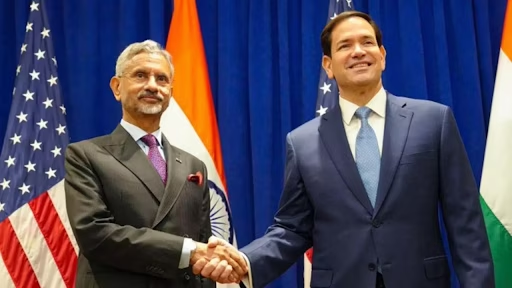
Jaishankar-Rubio Call: More Than Just Diplomatic Niceties
When diplomats describe a conversation as “good,” it’s often code for something far more consequential. The recent phone call between India’s External Affairs Minister Dr. S. Jaishankar and newly appointed US Secretary of State Marco Rubio was precisely that—a deceptively simple label for a discussion packed with strategic weight . Far from being a mere courtesy exchange, the Jaishankar Rubio call laid the groundwork for a more integrated and resilient partnership between the world’s oldest and largest democracies. With global power dynamics shifting rapidly, this dialogue signals a mutual commitment to move beyond rhetoric and into concrete action across multiple critical domains.
Table of Contents
- Key Agenda Items from the Call
- Why Critical Minerals Are a Game-Changer
- Defense and Nuclear Cooperation: A Deep Dive
- The Significance of Rubio’s New Role
- What This Means for the Indo-Pacific
- Conclusion: Building a Partnership for the 21st Century
- Sources
Key Agenda Items from the Call
The official readout from the Ministry of External Affairs confirmed that the ministers covered a wide array of bilateral and strategic issues. The core pillars of their discussion included:
- Trade and Economic Ties: Both sides acknowledged the need to resolve lingering trade barriers and expand market access for goods and services.
- Critical Minerals: A major focus, given their essential role in clean energy tech, electric vehicles, and defense systems. Securing a stable supply chain is now a top national security priority for both nations .
- Nuclear Energy Cooperation: Building on the landmark 2008 civil nuclear deal, they discussed advancing joint projects and technology sharing in the peaceful use of atomic energy.
- Defense Partnership: They reaffirmed their commitment to deepening military-to-military ties, co-production of defense equipment, and intelligence sharing.
- Energy Security: Collaboration on renewable energy sources and strategic petroleum reserves was also on the table.
Crucially, both leaders agreed to maintain “ongoing communication” on these matters, indicating this was just the first step in a sustained dialogue.
Why Critical Minerals Are a Game-Changer
The emphasis on critical minerals like lithium, cobalt, and rare earth elements is perhaps the most telling aspect of the Jaishankar Rubio call. These materials are the lifeblood of the 21st-century economy. China currently dominates the global supply chain for many of these minerals, giving it significant geopolitical leverage.
By partnering, India and the US aim to create an alternative, trusted supply network. India has vast untapped mineral reserves, while the US has the capital, technology, and refining expertise. A successful collaboration here would not only boost both economies but also reduce their strategic dependence on a single, often adversarial, source. This move is a direct response to the weaponization of economic interdependence seen in recent years.
Defense and Nuclear Cooperation: A Deep Dive
The defense relationship between India and the US has evolved from a cautious acquaintance to a full-fledged strategic partnership. The call reinforced key initiatives like the iCET (India-US Initiative on Critical and Emerging Technology), which aims to co-develop and co-produce advanced military hardware, including jet engines and munitions.
On the nuclear front, the conversation likely touched upon operationalizing the Westinghouse project to build six nuclear reactors in India. This would be a massive step forward in clean energy generation and a powerful symbol of trust, given the sensitivity of nuclear technology. For more on how tech partnerships are reshaping global alliances, see our feature on [INTERNAL_LINK:tech-alliances-and-global-power].
The Significance of Rubio’s New Role
Marco Rubio’s appointment as Secretary of State is itself a signal of the Biden administration’s (or a potential future administration’s) intent. Rubio is known as a staunch China hawk and a long-time advocate for a stronger US-India partnership as a counterbalance in the Indo-Pacific. His worldview aligns closely with India’s own strategic outlook.
His direct engagement with Jaishankar so early in his tenure underscores that India is not just another partner on the list—it’s a central pillar of America’s strategy to maintain a free and open Indo-Pacific region. This personal rapport at the leadership level can often accelerate bureaucratic processes and overcome political hurdles.
What This Means for the Indo-Pacific
The subtext of the entire Jaishankar Rubio call is the shared concern over regional stability, particularly in the face of an increasingly assertive China. By strengthening their economic, technological, and defense ties, India and the US are building a more robust framework to uphold a rules-based order in the Indo-Pacific.
This isn’t about forming an overt military alliance against any one country, but about creating a network of resilient, self-reliant democracies that can collectively deter coercion and ensure freedom of navigation. The Quad (comprising the US, India, Japan, and Australia) is the primary vehicle for this vision, and this bilateral call directly feeds into its success.
Conclusion: Building a Partnership for the 21st Century
The “good conversation” between Jaishankar and Rubio is a clear indicator that the India-US relationship has matured into a multi-faceted, action-oriented strategic partnership. It’s no longer just about shared democratic values; it’s about tangible collaboration on the very issues that will define the coming decades—supply chains, clean energy, defense innovation, and regional security. As both nations navigate an uncertain global landscape, this deepening bond offers a beacon of stability and a model for how democracies can work together to shape a better future.
Sources
- Times of India: ‘A good conversation’: Jaishankar holds call with US state secretary Rubio, discusses India-US trade, defence
- U.S. Department of State: Official Website
- Ministry of External Affairs, Government of India: Official Website