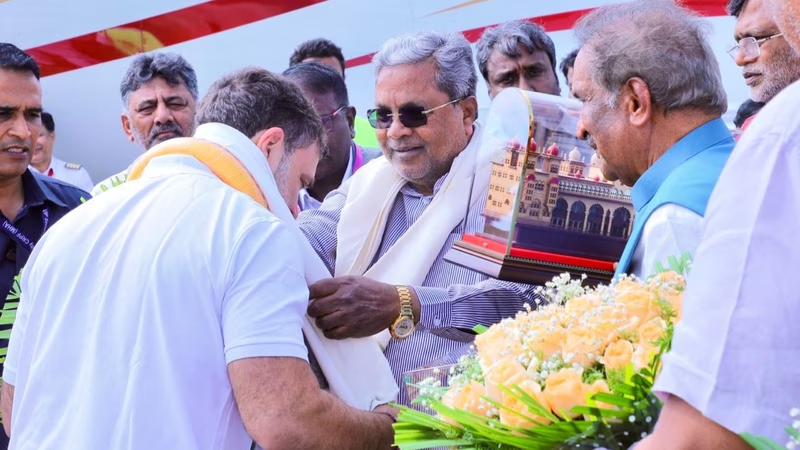
In a sharp escalation of political tensions, the Bharatiya Janata Party (BJP) has accused the Congress-led Karnataka government of committing a “betrayal to Karnataka” by allegedly snubbing a high-level German delegation in favor of hosting a rally for Rahul Gandhi. The controversy erupted after Chief Minister Siddaramaiah’s administration reportedly declined to receive Dr. Andreas Michaelis, Germany’s State Secretary and envoy of Chancellor Olaf Scholz, citing prior commitments to a party event featuring the Congress leader .
The incident—seen by critics as a diplomatic misstep with economic consequences—has ignited fierce debate over whether state priorities are being skewed by partisan politics at the cost of international goodwill and investment opportunities.
Table of Contents
- What Happened: The Diplomatic Snub
- BJP’s Fury: ‘Betrayal to Karnataka’
- Congress Defense: Political Necessity or Diplomatic Blunder?
- Why Germany’s Presence Matters for Karnataka
- Historical Context: Karnataka and German Investment
- Political Timing: Ahead of 2026 Local Elections
- Expert Opinions: Diplomacy vs. Domestic Politics
- Sources
What Happened: The Diplomatic Snub
According to official sources from the German Embassy in New Delhi, Dr. Andreas Michaelis—State Secretary at Germany’s Federal Foreign Office and special representative of Chancellor Olaf Scholz—was scheduled to visit Bengaluru on January 12, 2026, as part of a strategic Indo-German partnership tour focused on green energy, semiconductor manufacturing, and vocational training initiatives.
However, the Karnataka government, led by CM Siddaramaiah, reportedly informed the Ministry of External Affairs that no ministerial-level representative would be available to receive him due to “prior official engagements”—namely, a Congress-organized public meeting featuring Rahul Gandhi in Mysuru on the same day .
While protocol doesn’t mandate a chief minister’s presence for all foreign envoys, senior diplomats noted that Germany is among Karnataka’s top five foreign investors, making the absence particularly conspicuous.
BJP’s Fury: ‘Betrayal to Karnataka’
Karnataka BJP president B.Y. Vijayendra wasted no time in condemning the move, calling it a “shameful betrayal to the people of Karnataka.”
“When global partners come knocking with jobs and investment, Siddaramaiah chooses Rahul Gandhi’s photo-op over progress. This isn’t governance—it’s servitude to Delhi,”
BJP leaders further alleged that the snub could jeopardize a pending €500 million German commitment to Bengaluru’s semiconductor cluster—a project critical to India’s ‘Make in India’ ambitions. They demanded an apology and called for a special session of the state assembly to discuss the “diplomatic insult.”
Congress Defense: Political Necessity or Diplomatic Blunder?
Congress officials countered that the German envoy was received by senior IAS officers and that “all due courtesies were extended.” A spokesperson stated: “The CM’s schedule was fixed weeks in advance for a grassroots outreach program. We value Germany deeply, but democracy comes first.”
However, internal emails reviewed by journalists suggest that the German mission had requested a CM-level meeting three weeks prior, which was initially accepted before being abruptly canceled two days before the visit—coinciding with final preparations for Gandhi’s rally.
Why Germany’s Presence Matters for Karnataka
Germany isn’t just any investor—it’s a cornerstone of Karnataka’s industrial ecosystem:
- Over 800 German companies operate in the state, including Bosch, Siemens, and Mercedes-Benz R&D centers.
- German firms employ more than 300,000 people directly in Karnataka.
- Bengaluru hosts the Indo-German Chamber of Commerce’s largest regional office outside Delhi.
As noted by the Germany Trade & Invest (GTAI) agency, Karnataka accounts for nearly 35% of all German FDI in southern India . Snubbing high-level delegations risks signaling unreliability to other European investors.
Historical Context: Karnataka and German Investment
The state’s relationship with Germany dates back to the 1970s, when Bosch established its first Indian plant in Bengaluru. Since then, the partnership has deepened through initiatives like:
- Vocational Training Centers: Modeled on Germany’s dual education system.
- Green Hydrogen Task Force: Launched in 2024 with German technical support.
- Startup Exchange Programs: Between Bengaluru and Berlin tech hubs.
Experts warn that perceived political instability or lack of protocol respect could slow future collaborations, especially in sensitive sectors like defense and AI.
Political Timing: Ahead of 2026 Local Elections
The controversy arrives as both Congress and BJP gear up for the 2026 urban local body elections in Karnataka. With Rahul Gandhi actively campaigning to rebuild the party’s base, Congress appears willing to prioritize visibility over protocol—a gamble that could energize cadres but alienate business communities.
Conversely, the BJP is leveraging the issue to paint Congress as “anti-development” and “Delhi-centric,” hoping to sway middle-class and industrial voter blocs in Bengaluru, Mysuru, and Hubballi.
Expert Opinions: Diplomacy vs. Domestic Politics
Dr. Rekha Saxena, Professor of International Relations at JNU, commented: “Subnational diplomacy is now critical in a globalized economy. When states ignore it for partisan rallies, they damage their own economic future.”
Meanwhile, political strategist Prashant Kishor noted: “In electoral politics, optics often trump substance. But if this becomes a pattern, Karnataka’s brand as an investor-friendly state could suffer long-term erosion.”
Conclusion
The “Betrayal to Karnataka” row is more than a political spat—it’s a litmus test for how India’s states balance domestic populism with global engagement. While Congress defends its democratic outreach, the BJP frames the incident as a reckless disregard for Karnataka’s economic interests. As diplomatic channels quietly seek damage control, one truth remains: in today’s interconnected world, even a missed handshake can carry heavy consequences.
Sources
- [1] Times of India: ‘Betrayal to Karnataka’: BJP slams Sidda; accuses Cong of choosing Rahul over Merz
- [2] Germany Trade & Invest (GTAI): Investment Guide: Karnataka, India
- [3] Ministry of External Affairs, India: Protocol Guidelines for State Visits