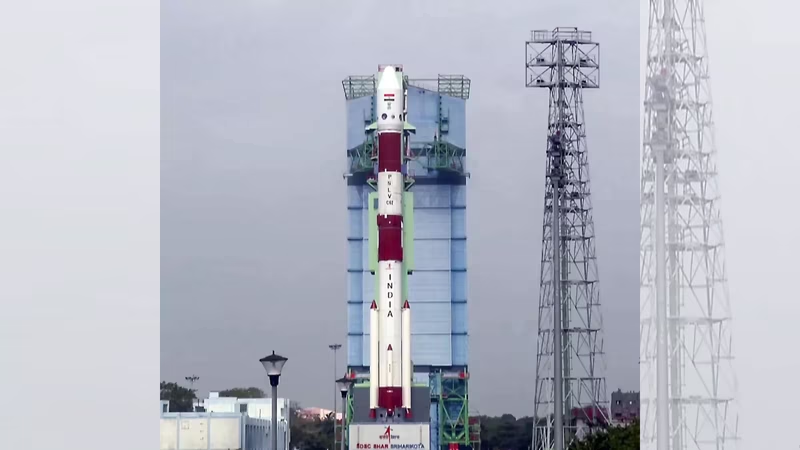
In a quiet but significant milestone for international space collaboration, India’s Polar Satellite Launch Vehicle (PSLV-C62) recently carried more than just satellites into orbit—it also launched a high-stakes scientific experiment from Spain: the **KID re-entry capsule**. While much of the spotlight focused on the primary payloads, experts say this compact, heat-shielded module could return with **groundbreaking data on atmospheric re-entry**, a critical frontier in spaceflight safety and sustainability.
Table of Contents
- PSLV-C62 Mission at a Glance
- What Is the KID Re-entry Capsule?
- Why Atmospheric Re-entry Data Is So Crucial
- The Growing Spain-ISRO Space Partnership
- Technical Design and Scientific Goals of KID
- Future Implications for Reusable Spacecraft
- Conclusion: A Small Capsule, Big Scientific Promise
- Sources
PSLV-C62 Mission at a Glance
Launched from the Satish Dhawan Space Centre in Sriharikota, the PSLV-C62 mission marked another reliable performance by ISRO’s workhorse rocket. The primary objective was to deploy a cluster of Earth observation and technology demonstration satellites into a precise sun-synchronous orbit . But tucked among these payloads was a less conspicuous yet highly sophisticated experiment: the **KID (Kinetic Impact Demonstrator) re-entry capsule**, developed by Spain’s National Institute for Aerospace Technology (INTA) .
This mission continues ISRO’s tradition of offering cost-effective rideshare opportunities to international partners—a service that has made the PSLV one of the most sought-after launch vehicles for small satellite operators worldwide.
What Is the KID Re-entry Capsule?
The KID capsule is not a typical satellite. It’s a **passive, unpowered module** designed for one purpose: to plunge back through Earth’s atmosphere at hypersonic speeds and survive the extreme heat and pressure of re-entry. Measuring just 30 cm in diameter and weighing under 10 kg, it’s equipped with advanced thermal sensors, accelerometers, and a GPS tracker to record real-time data during its descent .
Unlike crewed capsules like SpaceX’s Dragon or ISRO’s planned Gaganyaan, KID carries no recovery systems. Instead, it’s engineered to transmit data until the moment it impacts the ocean—after which scientists hope to recover it using its beacon signal.
Why Atmospheric Re-entry Data Is So Crucial
Mastering re-entry is one of the toughest challenges in aerospace engineering. As objects descend from orbit at speeds exceeding 7.8 km/s, they compress air molecules in front of them, generating temperatures hotter than the surface of the sun—often over 1,600°C. Understanding how materials behave under these conditions is essential for:
- Reusable launch systems: Ensuring boosters and fairings can safely return.
- Crew safety: Designing heat shields that protect astronauts during return.
- Space debris mitigation: Predicting how defunct satellites burn up—or survive—re-entry.
- Planetary exploration: Informing designs for Mars or Venus landers that must enter alien atmospheres.
Current models rely heavily on simulations and limited flight data. Real-world experiments like KID provide **invaluable validation** for these models.
The Growing Spain-ISRO Space Partnership
This isn’t the first collaboration between Spain and ISRO. In 2022, Spain’s INTA partnered with ISRO on a microgravity experiment aboard a sounding rocket. The KID capsule represents a deeper technical engagement, leveraging ISRO’s proven launch reliability and Spain’s expertise in thermal protection systems .
For European nations seeking affordable access to space without relying solely on ESA or commercial U.S. providers, ISRO has become an attractive alternative. The PSLV’s track record of over 50 successful missions makes it a trusted platform for high-value scientific payloads.
Technical Design and Scientific Goals of KID
The KID capsule features a cutting-edge **ablative heat shield** made from phenolic resin composites—a material that chars and erodes during re-entry, carrying heat away from the structure. Embedded within are fiber-optic sensors capable of measuring temperature gradients with millisecond precision .
Key scientific objectives include:
- Measuring actual heat flux vs. predicted models during peak heating phase.
- Testing new lightweight thermal protection materials for future micro-reentry vehicles.
- Validating trajectory prediction algorithms under real atmospheric turbulence.
If recovered, the physical condition of the capsule will offer post-flight insights no telemetry can provide—like erosion patterns and structural integrity.
Future Implications for Reusable Spacecraft
Data from the KID experiment could directly influence next-generation spacecraft design. For instance, ISRO is actively developing its own **Reusable Launch Vehicle (RLV)** program, which requires precise re-entry control. Similarly, private companies in Europe and India are exploring small satellite return services for sample retrieval or tech demos.
As the space economy shifts toward sustainability, mastering low-cost, reliable re-entry becomes as important as reaching orbit. The KID capsule, though small, is a step toward that future.
Conclusion: A Small Capsule, Big Scientific Promise
The PSLV-C62 mission may have flown under the radar compared to mega-constellation launches, but its Spanish passenger—the KID re-entry capsule—could yield outsized scientific returns. By turning a routine rideshare into a high-fidelity atmospheric probe, Spain and ISRO have demonstrated how international cooperation can turn even modest missions into powerful tools for discovery. If the capsule is successfully recovered, its data could shape the next decade of re-entry vehicle design across the globe.
Sources
- Times of India: PSLV-C62: KID re-entry capsule from Spain could have key data
- INTA (Instituto Nacional de Técnica Aeroespacial): Official Website – Re-entry Technology Programs
- ISRO PSLV Missions Archive: PSLV-C62 Mission Details
- ESA Atmospheric Re-entry Studies: European Space Agency Re-entry Research
- [INTERNAL_LINK:isro-reusable-launch-vehicle-rlv-update]
- [INTERNAL_LINK:future-of-space-debris-mitigation]