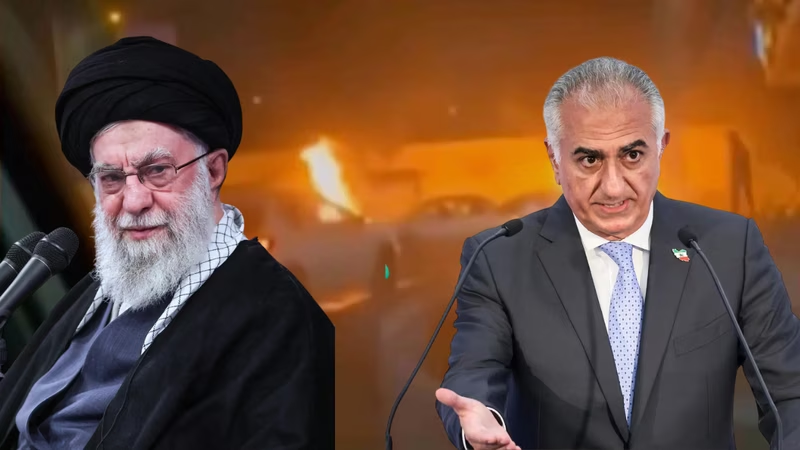
Tehran’s alleys are echoing with a phrase many thought buried in history: “Marg bar diktator!”—“Death to dictatorship!”
But here’s the twist: the dictator they’re denouncing isn’t the exiled Shah or his son Reza Pahlavi. It’s Ayatollah Ali Khamenei—the very leader who rose to power on the promise of freeing Iran from tyranny nearly half a century ago.
Welcome to Iran protests 2026, where history isn’t just repeating—it’s rewriting itself with chilling precision. Economic despair, generational fury, and a complete loss of faith in the system have ignited a nationwide uprising that mirrors the 1979 revolution in tone, scale, and ambition. Only this time, the revolutionaries aren’t demanding an Islamic Republic. They’re demanding its end.
Table of Contents
- Iran Protests 2026: The Spark That Ignited a Nation
- Echoes of 1979: How Today’s Revolt Mirrors the Past
- Why the Youth Are Leading the Charge
- Economic Collapse: The Real Engine of Unrest
- Reza Pahlavi and the Monarchist Resurgence?
- The Regime’s Response: Brutality and Fear
- International Reaction: Will the World Step In?
- Conclusion: Is This the End of the Islamic Republic?
- Sources
Iran Protests 2026: The Spark That Ignited a Nation
The current wave of unrest began in late December 2025, triggered by the catastrophic devaluation of the rial—now trading at over 1.47 million to the US dollar . But unlike past protests focused on specific grievances (like fuel prices or hijab laws), this movement is systemic. Protesters aren’t asking for reform; they’re chanting for regime change.
What makes the Iran protests 2026 uniquely dangerous for the regime is their breadth. From Tabriz to Shiraz, from university campuses to working-class neighborhoods, the revolt cuts across age, gender, and even religious lines. Women burn headscarves not just as symbols of oppression, but as emblems of a failed state .
Echoes of 1979: How Today’s Revolt Mirrors the Past
The parallels with the 1979 revolution are uncanny:
| 1979 Revolution | 2026 Uprising |
|---|---|
| Chants: “Death to the Shah” | Chants: “Death to the Dictator” (Khamenei) |
| Economic mismanagement under monarchy | Economic collapse under theocracy |
| Mass strikes by bazaar merchants & oil workers | Nationwide strikes by teachers, doctors, and factory workers |
| Exiled opposition figure (Khomeini) as unifying symbol | Exiled figures like Reza Pahlavi gaining traction |
Even the slogans have evolved full circle. Where Iranians once rejected Western-backed monarchy for an “Islamic government,” they now reject that same government for betraying its promises of justice, dignity, and self-reliance.
Why the Youth Are Leading the Charge
Over 60% of Iran’s population is under 35—and they’ve never known life before the Islamic Republic. Yet they bear the brunt of its failures: unemployment hovers near 30%, inflation erodes wages, and social freedoms are nonexistent.
Unlike their parents, who remember the chaos of the 1980s, this generation has global awareness. They see Dubai’s skyline, Turkey’s pop culture, and Europe’s freedoms—all while living under surveillance, censorship, and poverty. Their anger isn’t ideological; it’s existential. As one protester told BBC Persian: “We don’t want another revolution. We want a normal life.”
Economic Collapse: The Real Engine of Unrest
While ideology fuels the narrative, economics drives the momentum. Key factors include:
- Hyperinflation: Annual inflation exceeds 48%, with food prices up 70% in a year .
- Oil revenue crash: Brent crude at $60/barrel vs. Iran’s break-even need of $165 .
- Sanctions & isolation: U.S. “maximum pressure” and post-2025 Israel conflict have crippled trade.
- Corruption: Billions siphoned by IRGC-linked entities while public services crumble.
For ordinary Iranians, survival—not politics—is the daily struggle. And when survival is threatened, revolutions happen.
Reza Pahlavi and the Monarchist Resurgence?
Exiled Crown Prince Reza Pahlavi has seen a surge in online support, with hashtags like #RezaPahlavi trending globally. But experts caution against overstating his influence.
While he advocates for a secular, democratic Iran and has distanced himself from calls for monarchy restoration, his symbolic value lies in representing a pre-revolutionary era of stability—even if idealized. As one analyst notes, “He’s not the solution; he’s a placeholder for hope” .
Still, his interviews on international media and coordination with diaspora groups make him a thorn in Tehran’s side—a reminder that alternatives exist.
The Regime’s Response: Brutality and Fear
Khamenei’s regime has responded with predictable ferocity. Internet blackouts, mass arrests (over 10,000 reported), and live ammunition have become standard tools. Security forces, particularly the IRGC and Basij militias, show no sign of defection—yet.
But repression alone may not suffice. Unlike 2009 or 2019, this protest wave lacks a single leader or demand, making it harder to decapitate. It’s a hydra: cut off one head, two more emerge.
International Reaction: Will the World Step In?
The West faces a dilemma. While condemning violence, major powers avoid explicit calls for regime change, fearing chaos or empowering hardliners. The U.S. State Department urges “dialogue,” while the EU pushes for human rights investigations .
Yet behind closed doors, intelligence agencies monitor the situation closely. A collapsed Iran could reshape Middle Eastern alliances overnight—potentially ending the axis of resistance or triggering regional instability.
Conclusion: Is This the End of the Islamic Republic?
The Iran protests 2026 are more than a crisis—they’re a reckoning. The Islamic Republic promised justice, independence, and dignity. Instead, it delivered corruption, isolation, and despair.
Whether this leads to collapse, reform, or prolonged stalemate remains uncertain. But one thing is clear: the Iranian people have lost their fear. And in authoritarian regimes, fear is the only currency that matters.
As the graffiti on Tehran’s walls now reads: “1979 was our mistake. 2026 will be our correction.”
Sources
- [1] Reuters: Iran Rial Hits Record Low
- [2] Amnesty International: Iran Crackdown Report
- [3] BBC Persian: Interviews with Iranian Protesters
- [4] Trading Economics: Iran Inflation Data
- [5] Bloomberg: Oil Price Analysis
- [6] International Crisis Group: Iran Opposition Dynamics
- [7] U.S. Department of State: Official Statements on Iran
- [8] Original Article: Times of India – ‘Death to dictatorship’