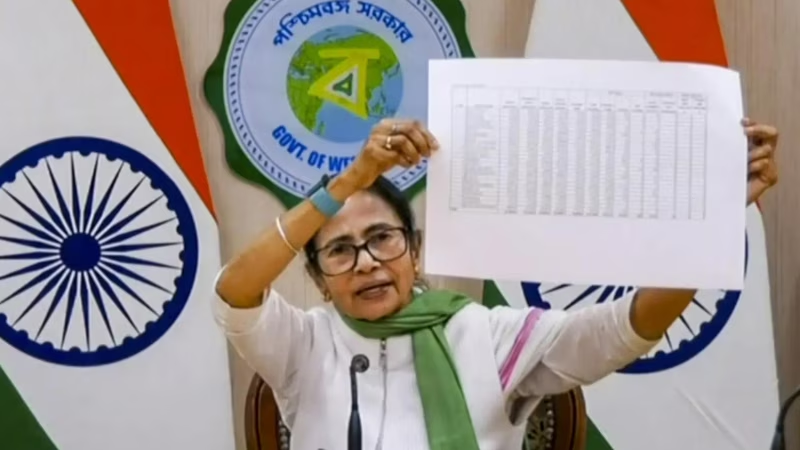
Political storm clouds are gathering over India’s democratic horizon. In a fiery public address, West Bengal Chief Minister Mamata Banerjee dropped a bombshell: the Election Commission (EC) has allegedly deleted **54 lakh genuine voters** from draft electoral rolls—and plans to remove **another crore**. She didn’t mince words, accusing the poll body of colluding with the BJP in what she calls a “BJP-EC nexus” designed to skew future elections.
The claims have ignited fierce debate across party lines, civil society, and legal circles. Are these deletions part of a routine data-cleaning exercise—or a systematic effort to disenfranchise millions? Let’s unpack the facts, the fears, and the high-stakes implications for India’s democracy.
Table of Contents
- What Did Mamatan Banerjee Actually Claim?
- The BJP-EC Nexus Allegation Explained
- How Voter List Revisions Work in India
- Evidence and Counterclaims
- AI and the Future of Electoral Rolls
- Booth-Level Agent Restrictions: A Democratic Red Flag?
- Historical Context: Past Voter Purge Controversies
- Conclusion: Is India’s Electoral Integrity at Risk?
- Sources
What Did Mamata Banerjee Actually Claim?
Speaking at a rally in Kolkata on January 10, 2026, Banerjee alleged that:
- Approximately **54 lakh (5.4 million)** names were unilaterally removed from draft electoral rolls in West Bengal without notice to affected citizens.
- Many of those deleted were **genuine voters**, including women who changed surnames after marriage—a common reason for mismatches in official records.
- The EC is using **AI-powered tools** to auto-delete entries based on algorithmic flags, bypassing human verification.
- There’s a **plan to delete another 1 crore (10 million)** voters nationwide ahead of the 2029 general elections.
- The EC has also **restricted the number of booth-level agents** parties can deploy, reducing transparency during polling.
She framed this as not just administrative error—but a deliberate, politically motivated act aimed at weakening opposition strongholds like West Bengal .
The BJP-EC Nexus Allegation Explained
The phrase “BJP-EC nexus” has become a rallying cry for opposition parties since 2014. Critics argue that the EC, once seen as fiercely independent, has grown increasingly aligned with the ruling party’s interests—especially in contentious states like Bengal, Tamil Nadu, and Punjab.
Key points fueling this perception include:
- Timely enforcement of Model Code of Conduct against opposition leaders, but perceived leniency toward BJP figures.
- Rapid approval of BJP’s internal organizational changes (e.g., state unit appointments).
- Lack of transparency in appointing Election Commissioners since the 2022 Supreme Court ruling that gave the PM-led committee decisive power .
While the EC denies any bias, the optics matter—especially when voter rolls are being altered at scale.
How Voter List Revisions Work in India
Voter lists are updated annually through a process called the **Electoral Roll Revision Program**. The goal is to add new eligible voters (18+), remove duplicates, and delete deceased or migrated individuals.
The standard procedure involves:
- Publication of draft rolls for public feedback.
- A 15–30 day window for objections or claims.
- Verification by Booth Level Officers (BLOs).
- Final publication after corrections.
However, Banerjee claims this process was bypassed. According to her, deletions happened **without notices**, leaving citizens unaware until they tried to check their status online .
Evidence and Counterclaims
The Election Commission has not issued a detailed rebuttal yet, but sources within the body insist the deletions are part of a **national de-duplication drive** using Aadhaar and other databases to clean “ghost voters.”
Independent fact-checkers note:
- Large-scale deletions aren’t unprecedented—Karnataka saw 42 lakh removals in 2023, later partially reversed after public outcry .
- Women changing surnames **are disproportionately affected** by automated systems that don’t cross-reference marriage certificates or family links.
- No official document confirms a plan to delete “1 crore more”—this appears to be Banerjee’s extrapolation.
Still, the lack of proactive communication from the EC fuels suspicion. As the Association for Democratic Reforms (ADR) warns, “Voter list integrity requires both accuracy **and** inclusivity” .
AI and the Future of Electoral Rolls
Banerjee’s warning about AI tools isn’t far-fetched. The EC has been piloting **AI-based facial recognition and biometric matching** to detect duplicate entries. While efficient, such systems risk false positives—especially for marginalized groups with poor documentation.
Global precedents are cautionary: In the U.S., algorithmic voter purges in Georgia and Wisconsin led to thousands of eligible voters being turned away on election day . India must tread carefully to avoid similar democratic erosion.
Booth-Level Agent Restrictions: A Democratic Red Flag?
Beyond voter deletion, Banerjee highlighted a quieter but equally significant change: the EC’s move to **limit booth-level agents** per party from two to one in many constituencies.
Why does this matter? Booth agents monitor voting, challenge impersonation, and ensure EVM integrity. Reducing their number weakens oversight—especially in high-stakes or remote booths. This change, if widespread, could undermine the very transparency the EC claims to uphold.
Historical Context: Past Voter Purge Controversies
This isn’t the first time voter list revisions sparked national controversy:
- 2019 Assam NRC: Nearly 2 million people excluded from citizenship list—many later reinstated by courts.
- 2023 Delhi Rolls: AAP accused EC of deleting 7 lakh voters before municipal polls.
Each incident deepens public anxiety about who gets to vote—and who decides.
Conclusion: Is India’s Electoral Integrity at Risk?
Mamata Banerjee’s allegations about the BJP-EC nexus may carry political motives, but they raise legitimate concerns about procedural fairness, transparency, and the use of unchecked technology in democracy’s core function: voting.
If genuine voters—especially women and the poor—are being purged without recourse, it’s not just a West Bengal issue. It’s a national emergency for electoral justice. The EC must respond with data, dialogue, and due process—not silence.
As citizens, we must demand accountability. Because in a democracy, every name on that list isn’t just a number—it’s a voice.
Sources
- [1] Times of India: Original Report on Mamata’s Allegations
- [2] Supreme Court of India: Judgment on EC Appointment Process (2023)
- [3] The Hindu: Karnataka Voter Deletion Reversal (2023)
- [4] Association for Democratic Reforms (ADR): Electoral Integrity Reports
- [5] Brennan Center for Justice: U.S. Voter Purge Analysis