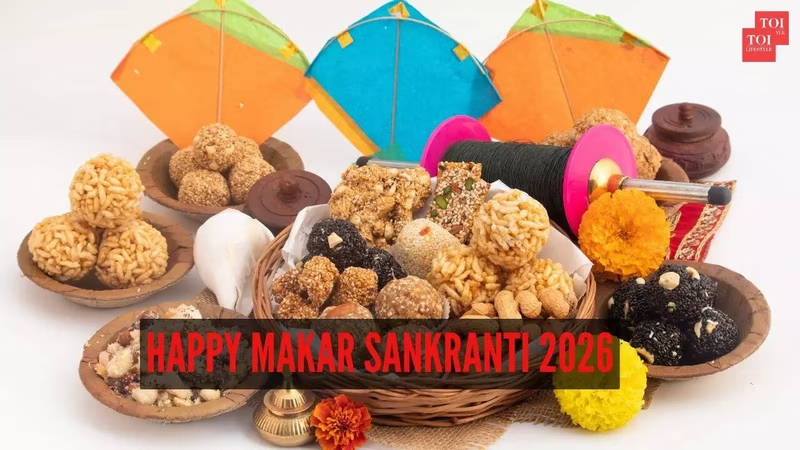
It’s that time of year again. Your social feeds are about to explode with colorful images, animated GIFs, and a barrage of Makar Sankranti wishes. But in the rush to copy-paste a generic message, are we losing sight of what this ancient festival is really about?
In 2026, Makar Sankranti falls on Wednesday, January 14th . It’s more than just a date on the calendar; it’s a celestial event, a harvest celebration, and a spiritual turning point woven into the fabric of India for millennia. Let’s move past the surface-level greetings and explore the rich tapestry that makes this day so special.
Table of Contents
- What is Makar Sankranti 2026? The Date and Core Significance
- One Festival, Many Names: A Pan-India Celebration
- The Science Behind Uttarayan: Why the Sun’s Journey Matters
- More Than Just Sweets: The Symbolism of Traditional Foods
- Meaningful Wishes for Makar Sankranti 2026 (That Go Deeper)
- Conclusion: Celebrating with Intention
- Sources
What is Makar Sankranti 2026? The Date and Core Significance
Makar Sankranti 2026 marks the precise moment the Sun enters the zodiac sign of Capricorn, or ‘Makara’ . This event signals the end of the winter solstice period and the beginning of ‘Uttarayan’—the Sun’s six-month-long northward journey. In a land historically tied to agriculture, this shift is monumental. It heralds the end of the harsh winter and the promise of a new harvest, making it a natural time for gratitude, community, and hope for prosperity.
Unlike most Indian festivals that follow the lunar calendar and change dates yearly, Makar Sankranti is a solar event, which is why it’s celebrated around January 14th or 15th every year . This consistency itself is a testament to its astronomical roots.
One Festival, Many Names: A Pan-India Celebration
Calling it just “Makar Sankranti” doesn’t do justice to its nationwide celebration. This single astronomical event is embraced with unique regional fervor across the subcontinent:
- Gujarat & Rajasthan: Celebrated as Uttarayan, it’s a massive kite-flying festival symbolizing a reach towards the heavens .
- Tamil Nadu: A four-day extravaganza known as Pongal, where the first rice of the season is cooked in milk and offered to the Sun God .
- Punjab: The eve is celebrated as Lohri with bonfires, singing, and dancing, followed by Maghi on Sankranti day .
- Assam: Known as Magh Bihu or Bhogali Bihu, featuring community feasts and traditional games .
- Uttar Pradesh, Bihar & Jharkhand: Often called Khichdi or Sakraat, where a simple dish of rice and lentils is a key ritual offering [[12], [18]].
This incredible diversity under a single cosmic event showcases the beautiful cultural mosaic of India. [INTERNAL_LINK:indian-harvest-festivals] can offer more insights into these regional variations.
The Science Behind Uttarayan: Why the Sun’s Journey Matters
The term ‘Uttarayan’ isn’t just poetic; it’s deeply scientific. After the winter solstice (around December 21st), the Sun’s apparent path in the sky begins to move northward each day . By January 14th, this shift is pronounced enough to be marked as a new season in many traditional calendars.
In Ayurveda and ancient Indian sciences, Uttarayan is considered a period of ‘receptivity and grace,’ a time ideal for spiritual practices and new beginnings [[32], [33]]. The increasing daylight is seen as a metaphor for the victory of light over darkness, knowledge over ignorance. Understanding this astronomical basis adds a layer of awe to the celebrations, connecting us to the very rhythm of our planet.
More Than Just Sweets: The Symbolism of Traditional Foods
Those ubiquitous til-gud (sesame-jaggery) ladoos are far from just a sweet treat. Every traditional food on this day carries deep symbolism:
- Sesame Seeds (Til): Represent warmth, resilience, and longevity, crucial for surviving the winter [[21], [30]].
- Jaggery (Gur): Symbolizes sweetness, prosperity, and the binding of relationships. The phrase “Til-gul ghya, god god bola” (Eat sesame-jaggery, speak sweetly) is a direct call for harmony .
- Khichdi: A simple, wholesome dish of rice and lentils, representing balance, nourishment, and the bounty of the harvest .
- Pongal: The act of cooking the new rice until it overflows from the pot is a joyous declaration of abundance and gratitude .
These aren’t just recipes; they are edible philosophies passed down through generations.
Meaningful Wishes for Makar Sankranti 2026 (That Go Deeper)
Now, armed with this deeper understanding, your Makar Sankranti wishes can carry more weight. Instead of a generic “Happy Sankranti,” consider these heartfelt messages:
- “As the Sun begins its journey north, may your life be filled with increasing light, warmth, and new opportunities. Happy Makar Sankranti 2026!”
- “May the sweetness of jaggery and the strength of sesame fill your year with harmony, health, and unbreakable bonds. Wishing you a blessed Sankranti!”
- “On this day of gratitude for the harvest, I’m thankful for a friend like you. May your fields—of work, love, and life—overflow with abundance. Happy Makar Sankranti!”
- “Let’s embrace the spirit of Uttarayan: a time for growth, positivity, and letting go of the old. Have a transformative Makar Sankranti!”
- “Sending you warm wishes on Makar Sankranti! May this festival of light banish all shadows from your path and lead you to a prosperous new season.”
Conclusion: Celebrating with Intention
Makar Sankranti 2026 is a powerful reminder of our connection to nature, our community, and the cosmos. It’s a festival that transcends religion, uniting the nation in a shared moment of hope and thanksgiving. So, this year, while you share your wishes and fly your kites, take a moment to reflect on the profound science, culture, and spirituality that make this day truly auspicious. That’s a celebration worth sharing.
Sources
- Times of India. “Happy Makar Sankranti 2026: Top 50 wishes, messages…” https://timesofindia.indiatimes.com/…
- Date and Significance: [[1], [2], [6]]
- Regional Names: [[12], [13], [16]]
- Traditional Foods: [[21], [23], [26], [30]]
- Science of Uttarayan: [[32], [33], [40]]
- National Institute of Ayurveda. “Seasonal Regimens (Ritucharya).” https://nia.nic.in/