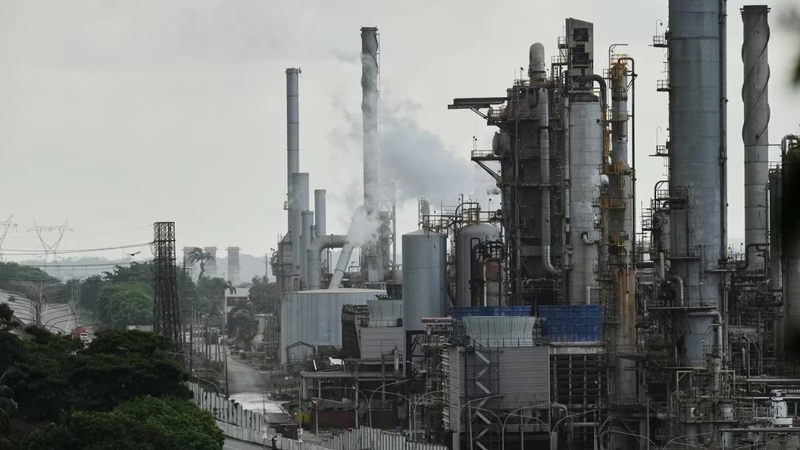
When news broke of fresh unrest in Caracas—complete with military standoffs and political purges—the immediate fear was predictable: could this trigger another oil price shock? After all, Venezuela sits atop the world’s largest proven oil reserves. But here’s the surprising truth: the **Venezuela oil crisis** is unlikely to ripple through global markets or rattle Indian boardrooms. And there’s a very good reason why.
While Venezuela’s turmoil makes headlines, its actual influence on the global oil supply has dwindled to near irrelevance. Once a top-three exporter, it now contributes less than 1% of the world’s daily crude—a shadow of its former self. For India, which imports over 85% of its oil needs, this means minimal direct exposure and zero cause for panic. In fact, analysts confirm that Indian refiners haven’t imported a single barrel of Venezuelan crude in over two years .
Table of Contents
- Why the Venezuela Oil Crisis Won’t Move Markets
- India’s Strategic Insulation from Venezuelan Turbulence
- How Much Oil Does Venezuela Really Produce?
- Global Oil Supply: Who Really Matters Today?
- Historical Context: When Venezuela Did Shake Markets
- What If Sanctions Ease? Could Venezuela Bounce Back?
- Implications for Indian Energy Policy
- Conclusion: No Storm in the Oil Tank
- Sources
Why the Venezuela Oil Crisis Won’t Move Markets
Despite its vast reserves, Venezuela’s oil industry is in shambles. Years of underinvestment, U.S. sanctions, mismanagement, and brain drain have slashed production from a peak of 3.5 million barrels per day (bpd) in the late 1990s to just **750,000 bpd** in early 2026 . To put that in perspective, that’s less than what Norway or Kazakhstan produces—and barely registers against global demand of 103 million bpd.
Even if production halts completely tomorrow—which is unlikely—the gap could be filled overnight by spare capacity in Saudi Arabia, the UAE, or even U.S. shale. As the International Energy Agency (IEA) notes, “Venezuela is no longer a swing producer; it’s a marginal player” .
India’s Strategic Insulation from Venezuelan Turbulence
India’s energy security strategy has deliberately avoided overreliance on any single source—especially politically volatile ones. Key facts:
- No recent imports: Indian refiners like Reliance and Nayara Energy last bought Venezuelan oil in 2021–2022, before U.S. secondary sanctions made transactions too risky .
- Diversified basket: India now sources crude primarily from Iraq, Saudi Arabia, Russia, and the U.S.—all stable or strategically managed suppliers.
- Rupee trade buffers: Bilateral payment mechanisms with Russia and others reduce forex volatility during geopolitical shocks.
As a result, even if Brent crude spikes temporarily on headline fears, India Inc. faces no supply crunch or cost surge tied to Venezuela.
How Much Oil Does Venezuela Really Produce?
Let’s break down the numbers (Q1 2026 estimates):
| Country | Daily Production (bpd) | Global Share |
|---|---|---|
| Saudi Arabia | 12.0 million | 11.6% |
| United States | 13.3 million | 12.9% |
| Russia | 10.8 million | 10.5% |
| Venezuela | 0.75 million | 0.7% |
Source: International Energy Agency (IEA)
With such a tiny footprint, Venezuela simply lacks the leverage to sway global pricing—even during internal chaos.
Global Oil Supply: Who Really Matters Today?
Markets now watch three key players:
- OPEC+ Core (Saudi Arabia & Russia): Control over 40% of global supply; their production cuts or hikes move markets instantly.
- United States: Shale output can ramp up within months, acting as a price cap.
- Iran: Holds significant spare capacity; any nuclear deal could flood the market.
Venezuela isn’t on that list—and won’t be for years, even under optimistic recovery scenarios.
Historical Context: When Venezuela Did Shake Markets
In the early 2000s, Venezuela was a force. Its 2002–03 oil strike slashed output by 90%, helping push Brent above $35/barrel (high for the era). But today’s market is larger, more diversified, and better insulated. The 2019 U.S. sanctions on PDVSA caused only a brief 2% price bump—proof of diminished relevance .
What If Sanctions Ease? Could Venezuela Bounce Back?
Some speculate that a U.S. policy shift could revive Venezuelan output. But experts are skeptical:
- Oil fields are degraded; restoring production requires $20B+ in investment.
- Skilled workforce has fled; technical expertise is scarce.
- Political instability deters major energy firms like Shell or TotalEnergies.
Even in a best-case scenario, meaningful output recovery would take 5–7 years—too slow to impact current market dynamics.
Implications for Indian Energy Policy
This episode reinforces India’s smart diversification strategy. Rather than chasing cheap but risky barrels, New Delhi has prioritized:
- Long-term contracts with reliable suppliers
- Strategic petroleum reserves (now at 13 days of consumption)
- Accelerated renewable transition to cut oil dependence by 2047
[INTERNAL_LINK:india-energy-security-strategy] remains focused on resilience—not opportunism.
Conclusion: No Storm in the Oil Tank
The **Venezuela oil crisis** may dominate diplomatic cables, but it won’t dent your petrol pump price or corporate bottom lines in India. Thanks to collapsed production and strategic disengagement, Venezuela’s turmoil is a regional tragedy—not a global energy threat. For India Inc., the message is clear: stay diversified, stay vigilant, but don’t lose sleep over Caracas.
Sources
- Times of India: Venezuela crisis likely to have limited impact on global oil prices
- OPEC Monthly Oil Market Report (January 2026)
- International Energy Agency (IEA): Global Oil Supply Dashboard
- U.S. Energy Information Administration (EIA) – Historical Venezuela Production Data
- Ministry of Petroleum and Natural Gas, India – Import Statistics 2024–2026