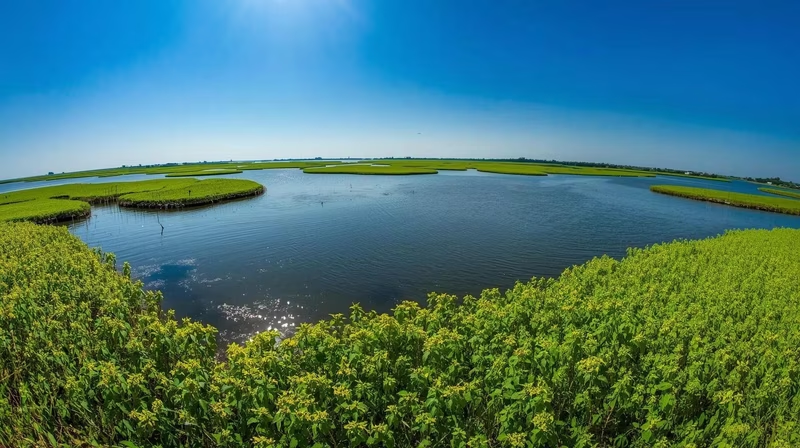
Imagine a national park that doesn’t sit on solid ground—but floats on water. Not a myth, not a sci-fi concept, but a real, living ecosystem drifting gently on the surface of India’s largest freshwater lake. Welcome to **Keibul Lamjao National Park**, the world’s only **floating national park**, nestled in the heart of Manipur’s Loktak Lake .
This isn’t just a quirky geographical footnote. It’s a fragile sanctuary for one of Earth’s rarest mammals—the brow-antlered Sangai deer—and a testament to nature’s ingenuity. Yet, despite its global uniqueness, this floating marvel faces existential threats from pollution, hydroelectric projects, and climate change. If we don’t act soon, this wonder might vanish before most travelers even learn it exists.
Table of Contents
- What Is the Floating National Park?
- The Magic of Phumdis: Nature’s Floating Islands
- Home of the Sangai Deer: India’s Living Gem
- Where Is It Located? How to Reach Keibul Lamjao
- Why This Floating Wonder Is Under Threat
- Conservation Efforts and Eco-Tourism: Hope for the Future
- Best Time to Visit and Travel Tips
- Conclusion: A Call to Save India’s Floating Miracle
- Sources
What Is the Floating National Park?
Established in 1977, **Keibul Lamjao National Park** spans approximately 40 square kilometers within Loktak Lake in Manipur’s Bishnupur district. Unlike any other protected area on Earth, it’s not anchored to bedrock—it rests entirely on **phumdis**, heterogeneous masses of soil, vegetation, and organic matter at various stages of decomposition that float on the lake’s surface .
During the dry season (November–March), these phumdis stabilize and form a spongy, grassy terrain capable of supporting wildlife. In monsoon, they rise with the water level, creating a dynamic, ever-shifting landscape. This unique biome earned Keibul Lamjao its designation as a Ramsar Wetland of International Importance in 2002 .
The Magic of Phumdis: Nature’s Floating Islands
Phumdis aren’t just debris—they’re complex ecosystems. Up to 30% of their structure lies submerged, acting like natural filters that purify lake water. The upper layer supports reeds, grasses, and shrubs, which in turn feed herbivores like the Sangai.
Locally, communities have lived alongside phumdis for centuries, even building floating huts called *phumshangs*. But modern pressures are destabilizing this balance. The Ithai Dam, built for hydroelectric power, has disrupted natural water fluctuations, causing phumdis to thin and fragment—a direct threat to the park’s integrity .
Home of the Sangai Deer: India’s Living Gem
The star resident of the **floating national park** is the **Sangai deer** (*Rucervus eldii eldii*), also known as the “dancing deer” for its delicate gait on unstable ground. Once thought extinct in 1951, it was rediscovered in Keibul Lamjao in 1953. Today, fewer than 300 individuals remain in the wild .
Endemic to this floating habitat, the Sangai has evolved hooves adapted to soft, marshy terrain. Its survival is entirely tied to the health of the phumdis—if they disappear, so does the deer. Recognized as Manipur’s state animal, the Sangai is a powerful cultural symbol and a flagship for conservation.
Where Is It Located? How to Reach Keibul Lamjao
Keibul Lamjao lies about 53 km south of Imphal, Manipur’s capital. Visitors typically:
- Fly into Imphal’s Bir Tikendrajit International Airport (connected to Delhi, Kolkata, and Guwahati).
- Drive or hire a taxi to Moirang town (approx. 1.5 hours).
- Take a boat from Moirang Jetty to the park’s watchtowers and viewing zones.
Note: Entry requires prior permission from the Manipur Forest Department. Guided eco-tours are strongly recommended to minimize disturbance.
Why This Floating Wonder Is Under Threat
Despite its protected status, the park faces multiple crises:
- Water Pollution: Agricultural runoff and sewage degrade water quality, harming phumdi formation.
- Ithai Dam Operations: Constant high water levels prevent phumdis from rooting and regenerating.
- Invasive Species: Water hyacinth chokes native vegetation, altering the ecosystem.
- Climate Change: Erratic rainfall disrupts seasonal cycles vital for phumdi stability.
UNESCO has flagged Loktak Lake as “in danger,” urging urgent intervention .
Conservation Efforts and Eco-Tourism: Hope for the Future
Several initiatives aim to rescue this unique habitat:
- The **Loktak Development Authority** works on phumdi restoration and community engagement.
- NGOs like Wetlands International support sustainable livelihoods for local fishers to reduce pressure on the lake .
- Eco-tourism models promote low-impact visits, with homestays in nearby villages offering cultural immersion.
[INTERNAL_LINK:sustainable-tourism-in-northeast-india] could be key to long-term preservation.
Best Time to Visit and Travel Tips
November to March is ideal—dry weather stabilizes phumdis, and wildlife sightings peak. Bring binoculars, wear muted colors, and respect silence to avoid startling animals. Avoid plastic; carry reusable bottles. Always hire licensed local guides—they’re stewards of this fragile place.
Conclusion: A Call to Save India’s Floating Miracle
India’s **floating national park** is more than a tourist curiosity—it’s a living laboratory of adaptation and resilience. But its future hangs in the balance. By supporting responsible tourism, advocating for policy reform, and raising awareness, we can ensure that Keibul Lamjao—and the dancing Sangai—continue to float through generations. Don’t just visit; protect.
Sources
- Times of India: India has the world’s only floating national park
- Ramsar Sites Information Service: Loktak Lake Ramsar Designation
- Manipur State Forest Department – Keibul Lamjao Management Plan
- International Union for Conservation of Nature (IUCN): Rucervus eldii Red List Assessment
- UNESCO World Heritage Centre – Tentative List: Loktak Lake
- Wetlands International – South Asia Program Reports