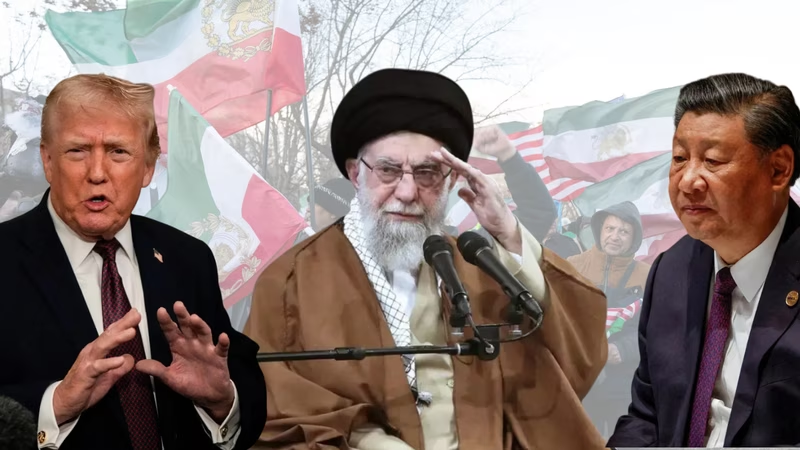
Just when the world thought the US-China trade war had cooled into an uneasy truce, a political grenade has been tossed from Mar-a-Lago. Former President Donald Trump has reignited tensions with a bold—and potentially explosive—proposal: impose a 25% tariff on *any* nation that continues to trade with Iran. The move, framed as a hardline tactic to pressure Tehran amid internal unrest, is less about Iran and more about sending a message to Beijing. And it’s working—China is rattled.
As Iran’s largest trading partner, importing over $15 billion in oil and goods annually , China stands to lose the most. But the ripple effects could destabilize supply chains across Asia and Europe, putting countries like India, Japan, South Korea, and Turkey in a diplomatic and economic bind. Is this a strategic masterstroke or a reckless gamble that could trigger a new phase of global trade conflict? Let’s break it down.
Table of Contents
- What Is the 25% Tariff Threat, Exactly?
- Why Iran—and Why Now?
- How China Could Be Hit Hardest
- The Domino Effect on India, Japan, South Korea, and Turkey
- Could This Upend the US-China Trade Truce?
- Historical Context: Trump’s Past Trade Tactics
- What Investors and Businesses Should Watch
- Conclusion: A New Trade Frontier—or Empty Rhetoric?
- Sources
What Is the 25% Tariff Threat, Exactly?
The 25% tariff threat isn’t a formal policy—yet. But in a recent campaign rally and follow-up statements, Trump declared that if re-elected, his administration would levy a 25% import duty on *all goods* from any country that engages in significant trade with Iran . This goes far beyond traditional sanctions; it’s a secondary boycott with global reach.
Unlike targeted sanctions that freeze assets or ban specific exports, this proposal uses trade tariffs as a geopolitical weapon. The goal? To isolate Iran economically by making it too costly for its partners to do business with Tehran—even indirectly.
Why Iran—and Why Now?
Iran is experiencing heightened internal unrest, including protests over water shortages, inflation, and political repression. Hardliners in Washington see this as a window to accelerate regime pressure. Trump, who withdrew the U.S. from the Iran nuclear deal (JCPOA) in 2018, has long favored “maximum pressure” over diplomacy .
But timing matters. With the 2024 U.S. election looming, Trump is appealing to his base by projecting strength on foreign policy. Targeting Iran also indirectly pressures China—a dual win in his playbook. As he told supporters: “If you trade with our enemies, you’re not our friend.”
How China Could Be Hit Hardest
China isn’t just *a* partner of Iran—it’s *the* lifeline. Despite U.S. sanctions, China imported nearly 27 million tons of Iranian crude oil in 2023 alone, often disguised as Malaysian or Emirati shipments . Beyond energy, Chinese firms invest heavily in Iran’s infrastructure under the Belt and Road Initiative.
A 25% tariff on all Chinese exports to the U.S.—which totaled $427 billion in 2023 —would be catastrophic for manufacturers, tech firms, and retailers. Even the *threat* has already spooked markets. The Shanghai Composite dipped 1.8% following Trump’s remarks, while yuan-denominated bonds saw increased volatility.
The Domino Effect on India, Japan, South Korea, and Turkey
While China is the bullseye, others are in the blast radius:
- India: Imports discounted Iranian oil for energy security. A tariff could force New Delhi to choose between U.S. strategic ties and affordable energy.
- Japan & South Korea: Both rely on Middle Eastern oil and maintain cautious trade with Iran. U.S. pressure could disrupt their energy diversification plans.
- Turkey: Already under U.S. scrutiny for Russian and Iranian dealings, Ankara could face compounded economic strain.
These nations may seek exemptions—but history shows Trump rarely grants them without major concessions.
Could This Upend the US-China Trade Truce?
Absolutely. The Phase One trade deal signed in 2020 remains fragile. While both sides have avoided new tariffs recently, trust is thin. If Trump enacts the 25% tariff threat, China will likely retaliate—not just with tariffs on U.S. agriculture or aircraft, but by accelerating de-dollarization and deepening ties with Russia and Iran.
This isn’t just about trade balances; it’s about strategic decoupling. As Brookings Institution analysts note, “Using tariffs as foreign policy tools blurs the line between economics and national security—in dangerous ways” .
Historical Context: Trump’s Past Trade Tactics
This isn’t new. During his first term, Trump imposed sweeping tariffs on steel (25%) and aluminum (10%) using Section 232 of the Trade Expansion Act—citing “national security.” He later targeted $370 billion of Chinese goods under Section 301 .
Those moves triggered a two-year trade war that raised consumer prices and hurt U.S. farmers. Yet they also forced negotiations. The question now: is this latest threat a negotiating ploy—or a prelude to a broader economic realignment?
What Investors and Businesses Should Watch
Markets hate uncertainty. Key indicators to monitor:
- U.S. election polls: Trump’s lead influences policy credibility.
- China’s oil imports from Iran: Any reduction signals preemptive compliance.
- WTO or G7 responses: Multilateral pushback could dilute the threat.
- Supply chain shifts: Companies may accelerate “China+1” strategies.
For now, [INTERNAL_LINK:global-trade-risk-strategies] are more critical than ever.
Conclusion: A New Trade Frontier—or Empty Rhetoric?
Trump’s 25% tariff threat is equal parts strategy and spectacle. If implemented, it could fracture the US-China truce, destabilize global energy markets, and force allied nations into impossible choices. But if it remains campaign rhetoric, it still achieves one goal: keeping adversaries off-balance. Either way, the world must prepare for a future where trade is no longer just about commerce—but about control.
Sources
- Times of India: 25% tariff threat: Trump’s Iran move rattles Xi
- U.S. Department of State – Iran Sanctions Archive
- International Energy Agency (IEA) – 2023 Oil Trade Report
- U.S. Census Bureau – U.S.-China Trade Data 2023
- Brookings Institution: The Weaponization of Trade Policy
- Office of the U.S. Trade Representative (USTR) – Section 301 Actions