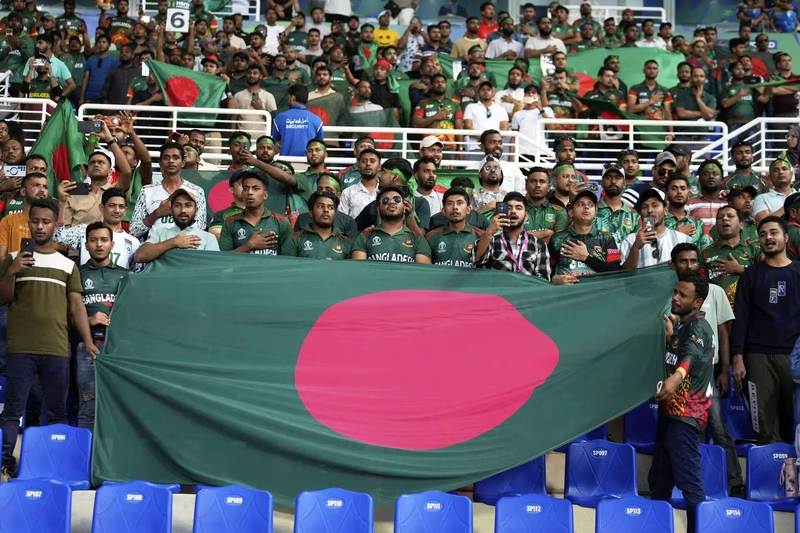
The road to the 2026 T20 World Cup has hit a dramatic and unexpected detour. In a move that sent shockwaves through the global cricket community, Bangladesh’s Sports Advisor, Asif Mahmud, publicly announced that his country’s national team would refuse to participate in the tournament if it is held in India . The reason? Alleged serious security concerns stemming from what he claimed was an official ICC risk assessment. But within hours, the International Cricket Council (ICC) issued a powerful and unambiguous rebuttal, directly contradicting Bangladesh’s narrative and confirming that the event will proceed as planned in India . This clash of statements has now become the biggest off-field story in world cricket.
Table of Contents
- The Explosive Allegation: Bangladesh’s Boycott Declaration
- The ICC’s Official Rebuttal: Setting the Record Straight
- Decoding the T20 World Cup Hosting Landscape
- Historical Context: India-Bangladesh Cricket Tensions
- What Happens If Bangladesh Pulls Out?
- Conclusion: A Test of Diplomacy and Sporting Integrity
- Sources
The Explosive Allegation: Bangladesh’s Boycott Declaration
Speaking to the media, Bangladesh’s Sports Advisor Asif Mahmud made a series of extraordinary claims. He stated that Bangladesh would not send its team to India for the upcoming T20 World Cup, declaring they would play “anywhere but India” . His justification rested on two key points:
- An alleged independent security assessment commissioned by the ICC had reportedly flagged significant risks for visiting teams in India.
- These risks were supposedly linked to India’s general elections, with the advisor suggesting the ICC had even recommended a postponement of the polls—a claim that quickly spiraled into a major political talking point .
This announcement was more than just a sporting decision; it was a direct challenge to the ICC’s authority and a potential geopolitical flashpoint between two neighboring cricketing nations.
The ICC’s Official Rebuttal: Setting the Record Straight
The ICC responded with remarkable speed and clarity. In an official statement, the global cricket body categorically denied the core of Bangladesh’s claims. The council confirmed that its own independent risk and security assessments have “not identified any specific or credible threats to any participating team or officials” related to the T20 World Cup in India .
Critically, the ICC addressed the two most inflammatory points head-on:
- No Security Advisory:** The ICC explicitly stated that it has not advised any member board to alter their travel plans, squad selection, or participation due to security concerns in India.
- No Election Postponement Link:** The council firmly denied any involvement or recommendation regarding the scheduling of India’s national elections, calling such reports “factually incorrect” .
The message was unequivocal: the tournament is on, the venues are safe, and all full-member nations, including Bangladesh, are expected to fulfill their commitments.
Decoding the T20 World Cup Hosting Landscape
The 2026 edition of the T20 World Cup is a landmark event. It will be the first time the tournament expands to 20 teams, making it the largest in its history. India, as the host, is investing heavily in infrastructure and logistics to ensure a world-class experience. For the ICC, having a successful event in its biggest market is non-negotiable for the sport’s commercial and developmental future .
[INTERNAL_LINK:t20-world-cup-format-changes-2026] Any disruption, especially from a full-member nation like Bangladesh, would be a severe blow to the tournament’s credibility and financial viability.
Historical Context: India-Bangladesh Cricket Tensions
This incident doesn’t occur in a vacuum. The cricketing relationship between India and Bangladesh has been fraught with intense rivalry and occasional diplomatic friction. From the infamous 2007 World Cup upset to heated exchanges on social media after close matches, the stakes are always high .
Domestic political pressures in Bangladesh may also be influencing this strong public stance. Taking a hard line on India can be a popular move domestically, and using a high-profile platform like international cricket serves that purpose effectively.
What Happens If Bangladesh Pulls Out?
If Bangladesh were to follow through on its threat, the consequences would be severe and far-reaching:
- ICC Sanctions:** The ICC could impose heavy fines, deduct crucial championship points, or even suspend Bangladesh’s membership, barring them from all international cricket.
- Financial Ruin:** The Bangladesh Cricket Board (BCB) would lose millions in ICC funding and broadcast revenue share.
- Fan Backlash:** Millions of passionate Bangladeshi fans would be devastated at missing out on the sport’s biggest T20 stage.
- Tournament Integrity:** The absence of a top-10 ranked team would significantly diminish the competition’s quality and global appeal.
Conclusion: A Test of Diplomacy and Sporting Integrity
The “Anywhere but India” controversy is a critical juncture for international cricket. It tests the ICC’s ability to manage its member nations and uphold its authority. It also tests Bangladesh’s commitment to the spirit of the game versus domestic political expediency. While security is a legitimate and paramount concern, the ICC’s firm, evidence-based rebuttal suggests the current situation does not warrant a boycott. The hope now is for cooler heads to prevail, allowing the focus to return to where it belongs: the thrilling cricket of the T20 World Cup.