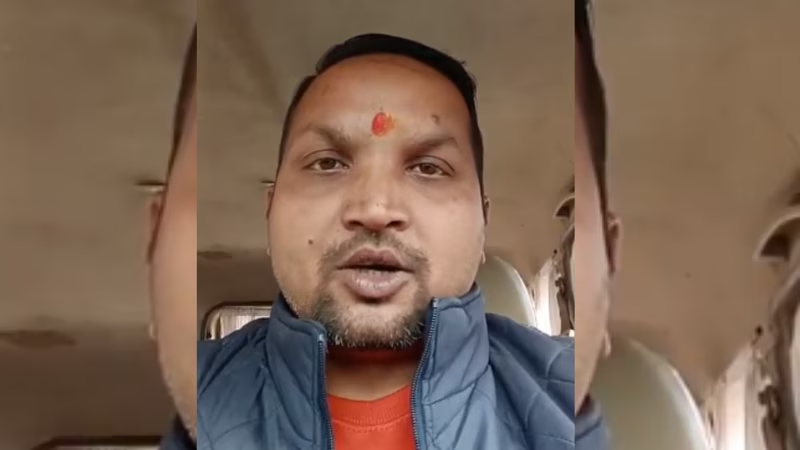
A viral video has sent shockwaves across India, capturing a moment of brazen defiance against law enforcement. In the heart of Rampur, Uttar Pradesh, a man identified as Bajrang Dal member Suraj Patel was filmed inside a police station, hurling abuses at officers and issuing a chilling threat: he would burn the entire station down. This isn’t just a case of a heated argument; it’s a direct challenge to the state’s authority that has ignited a national conversation about vigilantism and accountability.
Table of Contents
- The Incident Unfolds: What Exactly Happened?
- Who is Suraj Patel and the Bajrang Dal?
- Legal Repercussions: FIR and Investigation
- Public and Political Backlash
- Broader Implications for Law and Order
- Conclusion: A Test for India’s Democratic Institutions
- Sources
The Incident Unfolds: What Exactly Happened?
The trouble began when Suraj Patel arrived at the Kemri police station in Rampur, demanding to meet an individual who had been recently arrested . When the police officers on duty denied his request, citing protocol, Patel’s demeanor reportedly shifted dramatically. What followed was a disturbing display of aggression.
Caught on camera, Patel can be heard shouting, “Mujhe maar kar dikhao” (Show me by beating me) and, more alarmingly, “I will set the police station on fire, these bastards have turned it into a drama” . His threats were not whispered in a corner but were made openly, in the very space meant to uphold the law. The audacity of the act—threatening to burn down a government building while standing inside it—left many stunned.
Who is Suraj Patel and the Bajrang Dal?
Suraj Patel has been identified in media reports as a local leader or worker of the Bajrang Dal, a prominent Hindu nationalist organization. Founded in 1984 in Ayodhya, the Bajrang Dal is the youth wing of the Vishva Hindu Parishad (VHP) and is known for its militant stance on various social and religious issues . The group has been involved in numerous controversies over the years, ranging from attacks on religious minorities to moral policing .
Analysts often describe the Bajrang Dal as one of the most aggressive factions within the larger Sangh Parivar (family of Hindu nationalist organizations) . Its history includes involvement in significant communal events, such as the Ram Janmabhoomi movement and, more darkly, the 2002 Gujarat riots . Understanding this background is crucial to contextualizing the gravity of Patel’s actions, which some see as symptomatic of a larger culture of impunity.
Legal Repercussions: FIR and Investigation
In response to the public outcry and the clear evidence from the video, the Rampur police have taken formal action. An FIR (First Information Report) has been registered against Suraj Patel for his abusive language and criminal threats . The charges are serious and could include sections related to criminal intimidation, insulting the modesty of a public servant, and potentially even sedition, given the nature of the threat against a state institution.
Interestingly, following the registration of the FIR, Patel submitted a written apology and also released a video expressing regret for his outburst . While an apology is a step towards accountability, it does not erase the legal consequences of his actions. The police are now tasked with a thorough investigation to determine the full context and ensure that justice is served without fear or favor. This case will be a critical test of whether the legal system can hold powerful individuals accountable.
Public and Political Backlash
The video of the incident spread like wildfire on social media, drawing condemnation from citizens across the political spectrum. Many saw it as a stark example of how certain groups feel they can operate above the law. The hashtag #RampurPoliceThreat trended for hours, with users demanding strict action.
While no major political party has issued an official statement at the time of writing, the incident has become a flashpoint in the ongoing debate about law and order in Uttar Pradesh. Opposition parties are likely to use this event to question the state government’s ability to maintain peace and control its own affiliates. For the ruling party, it presents a delicate balancing act between maintaining its support base and upholding the rule of law.
Broader Implications for Law and Order
This incident in Rampur is more than just an isolated act of a single individual. It raises profound questions about the state of our democratic institutions:
- Erosion of Police Authority: When a citizen can openly threaten to destroy a police station, it signals a dangerous erosion of the police’s authority and the public’s respect for it.
- Culture of Impunity: The swift apology after a public backlash suggests a pattern where actions are only regretted when they become politically inconvenient, not because they are inherently wrong.
- Need for Institutional Integrity: The police force must be empowered to act independently and impartially, free from any external pressure or influence from powerful groups.
For a healthy democracy, the state’s monopoly on the legitimate use of force is sacrosanct. Any challenge to this principle, no matter how small it may seem, must be dealt with firmly and decisively.
Conclusion: A Test for India’s Democratic Institutions
The Bajrang Dal member’s threat in Rampur is a stark reminder that the health of a democracy is measured not just by its elections, but by how it handles its everyday crises of authority and accountability. The coming days will be crucial. Will the legal process run its course without interference? Will this incident lead to a broader introspection about the relationship between civil society groups and the state? The answers to these questions will tell us a lot about the future of law and order in India. One thing is certain: citizens are watching, and they demand a state that is both strong and just.