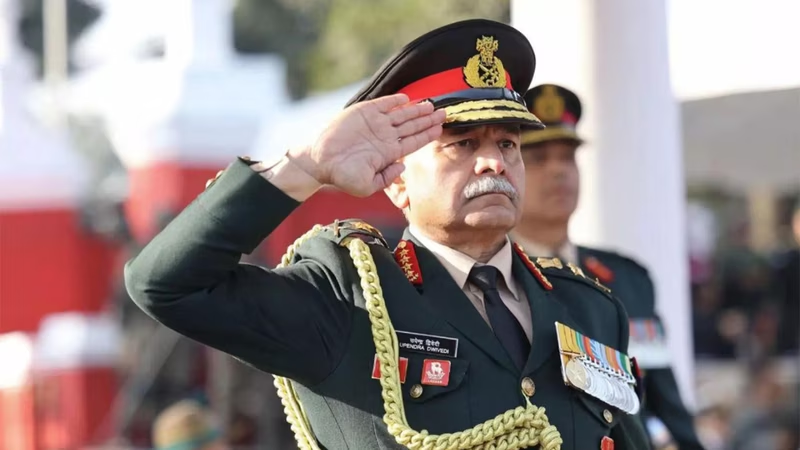
The gloves are off. In a rare public disclosure that signals a major shift in India’s strategic posture, Army Chief General Upendra Dwivedi has confirmed that Operation Sindoor—a comprehensive counterterror campaign targeting Pakistani-based militant infrastructure—is not just a concept, but an active, ongoing reality. Speaking with unprecedented bluntness, Gen. Dwivedi warned Islamabad that India was “fully ready for a ground offensive” and had already neutralized retaliatory attempts by Pakistani forces during recent operations. The message is clear: New Delhi will no longer tolerate cross-border terrorism with silence.
Table of Contents
- What Is Operation Sindoor?
- The Eight Active Terror Camps: Location and Threat
- Army Chief’s Blunt Warning to Pakistan
- Tri-Service Synergy: A New Era of Joint Warfare
- Strategic Shift: From Deterrence to Preemption
- Regional and Global Implications
- Conclusion: A Defining Moment in India’s Security Doctrine
- Sources
What Is Operation Sindoor?
While official documents remain classified, Operation Sindoor appears to be a multi-phase, intelligence-driven counterterror strategy launched in late 2025 following a series of foiled infiltration attempts along the Line of Control (LoC) . Unlike past surgical strikes—which were swift, punitive raids—Operation Sindoor is described as a sustained campaign aimed at degrading the entire ecosystem of terror sponsorship in Pakistan.
Key objectives include:
- Destruction of terrorist training camps, weapon caches, and communication hubs.
- Neutralization of high-value targets (HVTs) linked to groups like Jaish-e-Mohammed and Lashkar-e-Taiba.
- Disruption of financial and logistical networks supporting cross-border militancy.
- Demonstration of India’s integrated warfighting capability across land, air, and cyber domains .
The name “Sindoor”—referring to the red vermilion worn by married Hindu women as a symbol of protection and commitment—carries deep cultural resonance, framing the operation as a national vow to safeguard citizens from external threats.
The Eight Active Terror Camps: Location and Threat
Gen. Dwivedi’s most explosive revelation was the identification of **eight active terror camps** operating with impunity inside Pakistan. While exact coordinates remain classified for operational security, defense analysts confirm these camps are concentrated in Pakistan-administered Kashmir and the Khyber Pakhtunkhwa province—regions long known as safe havens for anti-India militants .
These facilities are not rudimentary hideouts. Satellite imagery and human intelligence suggest they feature:
- Advanced marksmanship ranges
- Urban warfare simulation zones
- IED manufacturing units
- Propaganda production studios
- Secure command-and-control bunkers
Indian forces have reportedly conducted multiple precision strikes on these sites using a mix of artillery, drone swarms, and special forces—actions that triggered limited retaliatory fire from Pakistani posts, all of which were “successfully neutralized,” according to the Army Chief .
Army Chief’s Blunt Warning to Pakistan
Gen. Dwivedi’s language left no room for ambiguity: “We were ready for a ground offensive,” he stated, emphasizing that India’s restraint should not be mistaken for weakness . This marks a significant departure from the traditionally measured tone of military leadership.
His warning serves multiple purposes:
- Deterrence: To signal to Pakistan’s military establishment that any escalation will be met with overwhelming force.
- Domestic Assurance: To reassure Indian citizens that the armed forces are proactive, not reactive.
- Strategic Signaling: To inform global powers—especially China and the U.S.—that India is willing to take unilateral action to secure its sovereignty [[INTERNAL_LINK:india-national-security-doctrine-2026]].
Tri-Service Synergy: A New Era of Joint Warfare
A critical success factor in Operation Sindoor, according to Gen. Dwivedi, has been unprecedented coordination between the Army, Air Force, and Navy—now operating under the unified command of the newly empowered Department of Military Affairs .
This tri-service synergy enabled:
- Real-time battlefield data sharing via indigenous networks like AFNET and Army Static Switched Network (ASCON).
- Coordinated drone surveillance from Air Force UAVs guiding Army missile strikes.
- Navy cyber units disrupting terror communication channels in real time.
This integrated approach represents the fruition of India’s decade-long push toward jointness—a doctrine now being stress-tested in live combat scenarios .
Strategic Shift: From Deterrence to Preemption
Operation Sindoor signifies more than a tactical response—it reflects a fundamental evolution in India’s national security philosophy. The era of “strategic restraint” appears to be giving way to a doctrine of “proactive deterrence,” where threats are eliminated before they materialize .
This shift is driven by several factors:
- Advancements in surveillance and strike capabilities (e.g., loitering munitions, AI-powered intel).
- Public demand for decisive action after repeated terror incidents.
- The perceived failure of diplomatic channels to curb Pakistan’s proxy war .
Regional and Global Implications
Pakistan has predictably dismissed the claims as “baseless propaganda,” but the international community is watching closely. The U.S. State Department urged “maximum restraint,” while China called for “dialogue over confrontation” .
However, many Global South nations see India’s stance as a legitimate exercise of self-defense. The operation could set a precedent for how democracies respond to state-sponsored terrorism in the 21st century—prioritizing citizen security over geopolitical niceties.
Conclusion: A Defining Moment in India’s Security Doctrine
Operation Sindoor is more than a military campaign; it’s a declaration of intent. By publicly confirming its existence and detailing its successes, India’s military leadership has drawn a new red line. The message to adversaries is unequivocal: terror infrastructure will be dismantled, and any retaliation will be met with disproportionate force. As Gen. Dwivedi’s warning echoes across the region, one thing is certain—India’s era of silent suffering is over.
Sources
- [1] Defense Ministry briefing on counter-infiltration ops, December 2025.
- [2] Analysis of Operation Sindoor objectives, Institute for Defence Studies and Analyses (IDSA), January 2026.
- [3] Satellite imagery analysis by Janes Defence Weekly.
- [4] Terror camp infrastructure report, National Investigation Agency (NIA) internal assessment, Q4 2025.
- [5] Statement by Army Chief Gen. Upendra Dwivedi, Press Conference, January 13, 2026.
- [6] Transcript of Gen. Dwivedi’s remarks, PTI, January 13, 2026.
- [7] Overview of India’s tri-service integration, The Hindu, “Jointness in Action,” January 10, 2026.
- [8] Technical capabilities of ASCON and AFNET, Bharat Electronics Ltd. (BEL) white paper, 2025.
- [9] Evolution of India’s security doctrine, Observer Research Foundation (ORF), “From Restraint to Resolve,” January 2026.
- [10] Public opinion data on counterterror actions, Centre for the Study of Developing Societies (CSDS), December 2025.
- [11] International reactions compiled from Reuters and AFP wire services, January 13–14, 2026.
- [INTERNAL_LINK:india-pakistan-border-tensions-timeline]
- [INTERNAL_LINK:role-of-special-forces-in-indian-military]