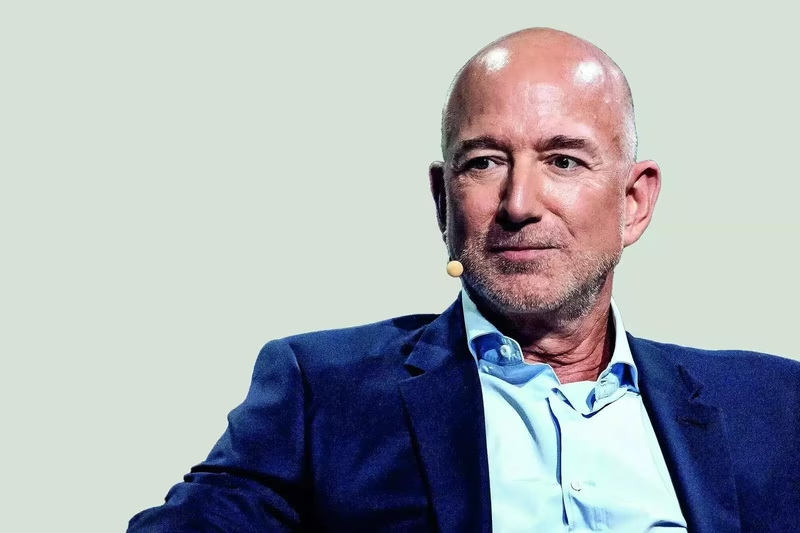
The sun may be setting on California’s reign as the undisputed home of tech royalty. In a move that has sent shockwaves through Silicon Valley and beyond, Google co-founders Larry Page and Sergey Brin are reportedly packing their bags and heading for friendlier shores—specifically, Florida. This high-profile departure isn’t happening in a vacuum; it’s a direct echo of Amazon founder Jeff Bezos’s own relocation to Miami and appears to be a strategic response to a looming financial threat: California’s controversial billionaire tax.
Table of Contents
- The Great California Exit: What We Know
- Following Jeff Bezos’s Blueprint
- The Billionaire Tax: The Real Catalyst?
- Why Florida is the New Billionaire Bunker
- Broader Implications for California and Tech
- Conclusion: A New Chapter for Tech Titans
- Sources
The Great California Exit: What We Know
Larry Page and Sergey Brin didn’t just buy a vacation home; they’ve been systematically dismantling their California footprint. By late 2025, over 60 LLCs linked to the two tech titans were either terminated, relocated, or made inactive in the state . Sergey Brin alone has moved about 15 of his investment companies to Nevada . On the real estate front, Page has made his intentions crystal clear, dropping a staggering $173.4 million on two luxurious estates in Miami’s Coconut Grove neighborhood . This isn’t a subtle signal—it’s a full-scale strategic withdrawal from the state that gave birth to their $2 trillion empire.
Following Jeff Bezos’s Blueprint
The parallels between the Google founders’ move and Jeff Bezos’s are impossible to ignore. After nearly three decades in Seattle, Bezos announced his move to Miami in late 2023, citing a desire to be closer to family and his aerospace company, Blue Origin’s, Florida operations . He secured his new home base by purchasing not one, but two properties on the exclusive “Billionaire Bunker” of Indian Creek . Now, Page and Brin seem to be following the same playbook, leveraging Florida’s appeal for both personal and business reasons. This coordinated migration suggests a broader trend among the ultra-wealthy, who are increasingly viewing traditional tech hubs as less hospitable.
The Billionaire Tax: The Real Catalyst?
While lifestyle and business logistics play a role, the primary driver behind this exodus appears to be fiscal. California is poised to vote on a radical piece of legislation in November 2026: the “2026 Billionaire Tax Act” . This ballot initiative would impose a one-time 5% tax on the net worth of any individual residing in California on January 1, 2026, whose assets exceed $1 billion . For someone like Larry Page, whose net worth is estimated in the tens of billions, this could mean a tax bill in the hundreds of millions of dollars, payable over five years . The timing of the Google founders’ moves—just before the critical January 1, 2026, residency date—is more than coincidental; it’s a calculated financial maneuver to avoid what they likely see as an existential threat to their wealth .
Why Florida is the New Billionaire Bunker
Florida has become the destination of choice for these fleeing billionaires for one simple, powerful reason: its tax structure. The state boasts no personal income tax, no estate tax, and no inheritance tax . For individuals whose primary source of wealth is capital gains and investments, this represents an enormous annual savings. By establishing residency in Florida before the end of 2025, Page and Brin can effectively shield their vast fortunes from California’s proposed levy while enjoying significant ongoing tax benefits. This makes the Sunshine State not just a retirement haven, but a strategic financial fortress for the world’s wealthiest individuals .
Broader Implications for California and Tech
The departure of its most famous tech pioneers is a major blow to California’s image and economy. These individuals aren’t just wealthy residents; they are engines of investment, philanthropy, and innovation. Their exit could signal to other high-net-worth individuals that the state is no longer open for business, potentially triggering a wider capital flight . This raises a critical question for California policymakers: is the potential revenue from a billionaire tax worth the risk of losing its most valuable economic assets? The state, which already hosts more billionaires than any other, is at a crossroads .
Conclusion: A New Chapter for Tech Titans
The moves by Larry Page and Sergey Brin are far more than a change of scenery. They represent a profound statement about the relationship between government policy and private capital in the 21st century. Faced with a potential multi-hundred-million-dollar tax bill, the founders of Google have chosen to vote with their feet—and their fortunes. As California prepares for a pivotal vote on its billionaire tax, the world will be watching to see if this exodus becomes a flood, permanently reshaping the geography of American wealth and innovation. For now, the message from Silicon Valley’s founding fathers is clear: the rules of the game have changed, and they’re taking their business elsewhere.
Sources
- Details on Larry Page and Sergey Brin’s California LLC terminations and Florida property purchases: Various news reports from late 2025 [[3], [4], [6]].
- Information on Jeff Bezos’s move to Miami: Public announcements and real estate records from November 2023 [[11], [13]].
- Official details and status of the California “2026 Billionaire Tax Act”: Ballot initiative filings and expert analyses from Q4 2025 [[15], [18], [19], [20]].
- Analysis of Florida’s tax advantages for the ultra-wealthy: Financial and legal commentary from 2025 [[24], [29]].
- [INTERNAL_LINK:california-economy-impact]
- [INTERNAL_LINK:florida-real-estate-market-boom]
- Forbes: Expert Report On The California 2026 Billionaire Tax