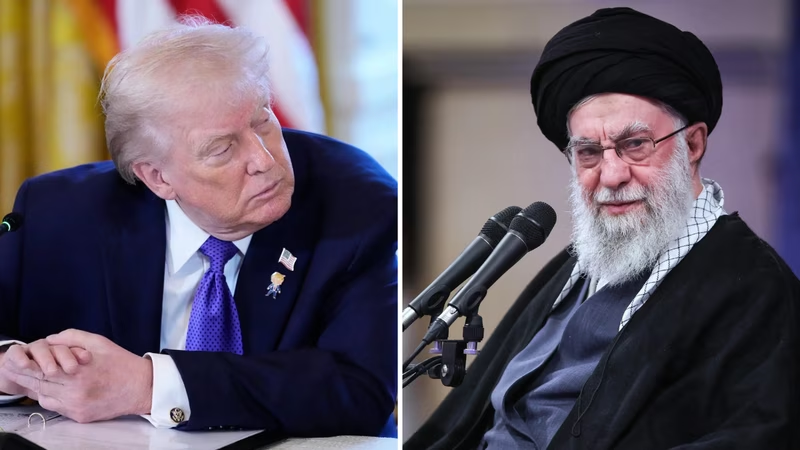
Tensions between Tehran and Washington are heating up once again—this time with fiery rhetoric from both sides. In a rare and pointed address, Iran’s Supreme Leader Ayatollah Ali Khamenei issued a stern **Khamenei warning to US**, denouncing American “deceitful actions” and accusing Washington of relying on “hirelings” to destabilize the Islamic Republic. The statement comes amid a surge in aggressive posturing from former U.S. President Donald Trump, who has openly backed anti-government protesters in Iran and proposed a sweeping 25% tariff on any nation trading with Tehran. The exchange marks a dangerous escalation in an already volatile relationship, raising fears of renewed confrontation in the Middle East.
Table of Contents
- The Khamenei Warning to US: Full Context
- Trump’s Renewed Threats and the 25% Tariff Proposal
- US Political Reaction: Lindsey Graham’s Sarcastic Response
- Historical Backdrop: Why Iran Distrusts American Promises
- Economic Pressure: Sanctions and Global Trade Implications
- What This Means for Middle East Stability
- Conclusion: A New Chapter in an Old Rivalry
- Sources
The Khamenei Warning to US: Full Context
Speaking during a high-profile gathering of military commanders, Ayatollah Khamenei didn’t mince words. “Stop your deceitful actions,” he declared, directly addressing U.S. politicians. He accused America of orchestrating unrest in Iran through proxies and “paid agents,” referencing recent protests that erupted after economic hardships and social grievances boiled over. “You think you can topple our system with street agitators funded from abroad? You are mistaken,” he said, reinforcing Iran’s long-standing narrative of resistance against foreign interference.
Notably, Khamenei emphasized that Iran would not be intimidated by threats or economic coercion—a clear signal that Tehran is preparing for a prolonged standoff. His remarks were broadcast nationwide, underscoring their strategic importance within Iran’s domestic political landscape as well as their international messaging.
Trump’s Renewed Threats and the 25% Tariff Proposal
The Supreme Leader’s comments appear to be a direct response to Donald Trump’s recent statements. In a January 2026 rally, Trump vowed to “crush the regime in Tehran” if re-elected, calling it “the world’s leading sponsor of terror.” He went further by proposing a draconian new trade measure: a 25% tariff on all goods imported into the U.S. from countries that continue trading with Iran.
This proposal, while unlikely to become law without congressional approval, serves as a potent political symbol. It echoes Trump’s “maximum pressure” campaign from his first term, which included withdrawing from the 2015 nuclear deal (JCPOA) and reimposing harsh sanctions. Analysts suggest this rhetoric is aimed at galvanizing his base ahead of the 2028 election cycle—but it’s having real-world consequences, pushing Iran toward a more defiant posture.
US Political Reaction: Lindsey Graham’s Sarcastic Response
Republican Senator Lindsey Graham, a longtime Iran hawk, responded to Khamenei’s speech with biting sarcasm. “Wow, the Ayatollah is upset? I’m shocked—shocked!” Graham quipped on social media. “Maybe if he stopped funding terrorism and oppressing his own people, he wouldn’t have so many enemies.”
Graham’s tone reflects a broader bipartisan consensus in Washington that views Iran as a malign actor—though Democrats generally favor diplomatic engagement over Trump-style brinkmanship. Still, with the Biden administration maintaining many Trump-era sanctions, Tehran sees little daylight between U.S. administrations.
Historical Backdrop: Why Iran Distrusts American Promises
To understand Khamenei’s deep suspicion, one must look back decades:
- 1953 Coup: The CIA-backed overthrow of democratically elected Prime Minister Mossadegh cemented Iranian distrust of U.S. intentions.
- 1979 Hostage Crisis: The revolution and seizure of the U.S. Embassy created enduring animosity.
- 2018 JCPOA Withdrawal: Trump’s unilateral exit from the nuclear deal shattered Iranian faith in American commitments.
For Iran’s leadership, every U.S. promise is viewed through this lens of betrayal. As the Council on Foreign Relations notes, “Iranian hardliners see diplomacy as a trap—and Khamenei has consistently reinforced that view” .
Economic Pressure: Sanctions and Global Trade Implications
Trump’s proposed 25% tariff could disrupt global supply chains, particularly affecting nations like China, India, and Turkey—key buyers of Iranian oil before sanctions tightened. While most countries have reduced purchases to avoid U.S. penalties, some still engage in limited trade via barter or shadow fleets.
If implemented, the tariff would likely accelerate de-dollarization efforts among U.S. adversaries. It could also strain alliances, as European partners may resist secondary sanctions that hurt their own economies. For Iran, however, the move would reinforce its narrative of being under siege—a narrative the regime uses to justify internal repression and military spending.
What This Means for Middle East Stability
Rising U.S.-Iran tensions rarely stay contained. They ripple across the region:
- Houthis in Yemen: May escalate attacks on Red Sea shipping.
- Hezbollah in Lebanon: Could increase provocations along Israel’s border.
- Iraq & Syria: Iranian-backed militias might target U.S. bases.
With Israel already engaged in multiple fronts, any miscalculation between Washington and Tehran could ignite a wider regional war. Experts at the International Crisis Group warn that “rhetorical escalation often precedes kinetic escalation” .
For deeper analysis on regional flashpoints, see our coverage on [INTERNAL_LINK:middle-east-conflict-forecast-2026].
Conclusion: A New Chapter in an Old Rivalry
The **Khamenei warning to US** is more than just bluster—it’s a calculated message of defiance at a time when both nations are locked in domestic political battles. With Trump leveraging anti-Iran sentiment for electoral gain and Khamenei using U.S. threats to consolidate internal power, the path to de-escalation looks increasingly narrow. Unless cooler heads prevail, this latest exchange could mark the opening salvo in a new and dangerous phase of the decades-long U.S.-Iran cold war.
Sources
- Times of India: “’Stop deceitful actions’: Khamenei’s stern warning to US politicians amid Trump’s threats to Iran — key points” (Link)
- Council on Foreign Relations (CFR): “U.S.-Iran Relations: A Timeline of Key Events”
- International Crisis Group: “Escalation Risks in U.S.-Iran Tensions” (January 2026)
- U.S. Department of State: Statements on Iran Policy