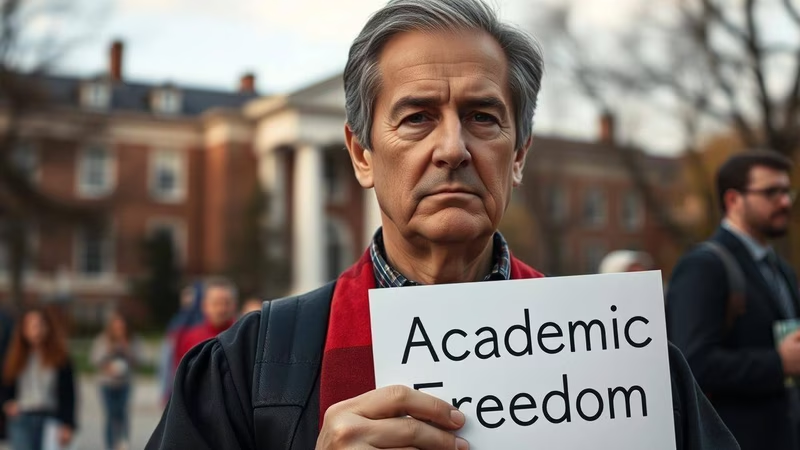
In a case that ignited national debate over free expression in academia, Clemson University and Dr. Joshua Bregy have quietly reached a settlement—ending a months-long standoff that began when the engineering professor was fired over a single social media post referencing conservative firebrand Charlie Kirk.
The agreement, finalized in early January 2026, allows Dr. Bregy to remain on the university payroll—with full benefits—until May 15, 2026, though he will not return to teaching duties. In addition, Clemson has agreed to provide him with letters of recommendation to support his future career endeavors .
For the ACLU of South Carolina, which represented Bregy, the outcome is more than just a personal victory—it’s a landmark moment for academic freedom in an era where faculty members increasingly fear professional repercussions for their political views .
Table of Contents
- What Happened: The Clemson Professor Fired Controversy
- The Social Media Post That Sparked the Firing
- Why Academic Freedom Is at Stake
- The Settlement Terms and What They Mean
- Broader Implications for U.S. Faculty
- Clemson’s Response and Institutional Accountability
- Conclusion
- Sources
What Happened: The Clemson Professor Fired Controversy
In September 2025, Dr. Joshua Bregy—a respected researcher in the Department of Mechanical Engineering—was abruptly terminated by Clemson University. The reason? A post on X (formerly Twitter) that read: “If you think Charlie Kirk is extreme, you haven’t been paying attention to history.”
While seemingly innocuous to some, the remark drew swift backlash from certain student groups and online activists who interpreted it as an endorsement of Kirk’s polarizing rhetoric. Within 48 hours, Clemson announced Bregy’s dismissal, citing “violation of university values” and “creating a hostile environment”—though no formal complaint from students or colleagues was ever filed .
Bregy, who had tenure-track status and a clean employment record, denied any intent to endorse extremism. He maintained the post was a historical commentary, not a political manifesto.
The Social Media Post That Sparked the Firing
The now-deleted post didn’t tag Charlie Kirk, include inflammatory language, or reference any specific policy. Yet, in today’s hyper-polarized climate, context often gets lost in viral outrage.
Charlie Kirk, founder of Turning Point USA, is a frequent target of criticism for his views on immigration, climate change, and education reform. But as the American Civil Liberties Union (ACLU) pointed out, “disagreeing with someone’s interpretation of a public figure is not grounds for termination—especially for tenured or tenure-track faculty” .
Why Academic Freedom Is at Stake
This case cuts to the core of a growing crisis in higher education: the erosion of intellectual diversity and open discourse. According to a 2025 survey by the Foundation for Individual Rights and Expression (FIRE), 62% of faculty members admit to self-censoring their views on politics, race, or gender in class or online .
When universities punish professors for off-campus, non-threatening speech—even if controversial—they send a chilling message: conformity over curiosity.
Key principles under threat include:
- Extramural Speech Protection: Faculty should be free to express personal opinions outside the classroom without fear of job loss.
- Due Process: Termination requires clear evidence of misconduct, not public pressure.
- Ideological Neutrality: Universities must protect all viewpoints, not just those aligned with prevailing campus sentiment.
The Settlement Terms and What They Mean
While neither party admitted wrongdoing, the settlement includes significant concessions from Clemson:
- Dr. Bregy remains employed until May 15, 2026, with full salary and health benefits.
- He is released from all teaching and administrative duties.
- Clemson will provide neutral-to-positive letters of recommendation upon request.
- No disciplinary notation will appear on his personnel file.
Though not a full reinstatement, the deal effectively nullifies the punitive nature of the firing. As ACLU of South Carolina Legal Director Susan Dunn stated, “This sends a clear message: public universities cannot fire faculty for protected speech without facing serious legal consequences” .
Broader Implications for U.S. Faculty
The Bregy case could set a precedent for similar disputes nationwide. With state legislatures in Florida, Texas, and Tennessee already passing laws to protect faculty speech, federal courts may soon be forced to clarify the boundaries of academic freedom in the digital age [INTERNAL_LINK:campus-free-speech-laws].
Moreover, private donors and research funders are watching closely. If universities are seen as politically biased or legally reckless, they risk losing grants and partnerships—adding financial pressure to uphold principled neutrality.
Clemson’s Response and Institutional Accountability
In a brief statement, Clemson said it “supports faculty research and funding rights” and remains “committed to a respectful academic environment” . Notably, the university did not apologize or reverse its initial decision—suggesting the settlement was driven more by legal pragmatism than moral reckoning.
Still, the episode has prompted internal reviews. Faculty senate leaders are now pushing for clearer social media guidelines that distinguish between personal opinion and professional conduct—a move many hope will prevent future overreach.
Conclusion
The resolution of the Clemson professor fired saga is more than just a personnel matter—it’s a referendum on whether American universities can still serve as true marketplaces of ideas. While Dr. Bregy’s career may never fully recover, his stand has reignited a crucial conversation about balance, fairness, and the cost of silence. In an age where a single tweet can end a career, this settlement offers a glimmer of hope: that academic freedom, however fragile, is still worth defending.
Sources
- Times of India. (2026, January). Clemson professor fired over Charlie Kirk post reaches settlement. Retrieved from https://timesofindia.indiatimes.com/education/news/clemson-professor-fired-over-charlie-kirk-post-reaches-settlement-university-supports-faculty-research-and-funding-rights/articleshow/126478952.cms
- ACLU of South Carolina. (2026, January 10). Statement on Joshua Bregy Settlement with Clemson University. Retrieved from https://www.aclusc.org
- American Civil Liberties Union (ACLU). (n.d.). Free Speech. Retrieved from https://www.aclu.org/issues/free-speech
- Foundation for Individual Rights and Expression (FIRE). (2025). Faculty Free Expression Survey Report. Retrieved from https://www.thefire.org