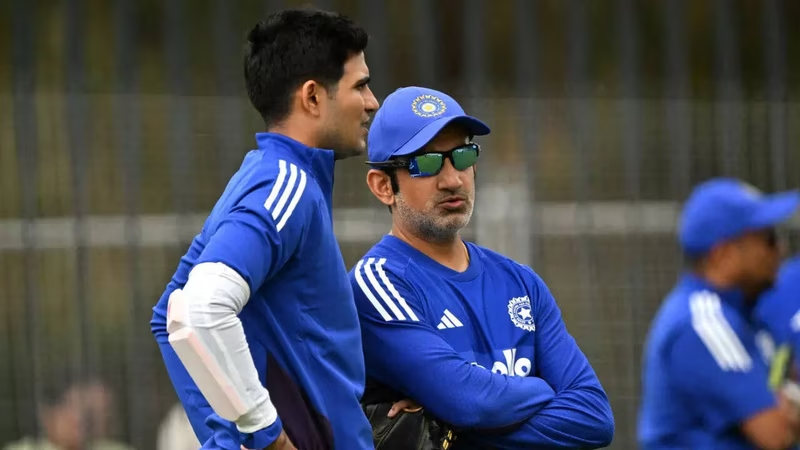
The first ODI between India and New Zealand should’ve been remembered for thrilling cricket. Instead, it’s sparked a fiery debate about player safety, team ethics, and what many are calling a glaring double standard in the Indian camp.
At the heart of the controversy? The decision to send Washington Sundar out to bat despite a visible wrist injury—and the man taking the heat is none other than new head coach Gautam Gambhir. Former India all-rounder Mohammad Kaif didn’t mince words, calling the move a “wrong call” that risked worsening Sundar’s condition .
What makes this even more contentious? Just weeks earlier, star batter Shubman Gill was pulled from a Test match due to a minor hamstring niggle—prompting Kaif to ask: why the different treatment?
Table of Contents
- The Controversial Call: What Happened?
- Kaif’s Criticism and the Gill Comparison
- Washington Sundar Injury: What’s Known
- Is There a Double Standard in Team India?
- Why Player Welfare Must Come First
- What This Means for Gambhir’s Coaching Legacy
- Conclusion
- Sources
The Controversial Call: What Happened?
During India’s chase in the first ODI at Eden Park, Auckland, Washington Sundar walked out to bat with his left wrist heavily strapped. He managed just 4 runs off 10 balls before being dismissed—but not before fans and experts noticed him wincing in discomfort .
Post-match footage showed Sundar receiving treatment, confirming concerns weren’t unfounded. Yet, the bigger issue wasn’t the batting—it was the decision-making behind it. With India already struggling at 139/6, was risking a key all-rounder’s long-term fitness worth a few extra runs?
Kaif’s Criticism and the Gill Comparison
Mohammad Kaif, known for his sharp tactical mind, took to social media to voice his frustration. “Sending an injured player like Washington Sundar to bat when he can barely grip the bat is a wrong call,” he wrote. “Remember how Shubman Gill was rested for a minor strain? Why not the same care here?”
The comparison struck a nerve. In the recent Border-Gavaskar Trophy, Gill was ruled out of the fourth Test against Australia after complaining of tightness—despite being fit enough to train. The BCCI’s medical team erred on the side of caution, a move widely praised.
So why, critics ask, was that same caution absent for Sundar—a player whose bowling could be crucial in the remaining ODIs?
Washington Sundar Injury: What’s Known
While the BCCI hasn’t released an official diagnosis, multiple sources suggest Sundar suffered a wrist sprain during fielding practice ahead of the match . Wrist injuries are notoriously tricky for spinners—they affect grip, flight, and turn. Aggravating it while batting (which requires forceful gripping of the bat) could sideline him for weeks.
For context, wrist injuries have derailed careers. Former England spinner Graeme Swann retired mid-Ashes in 2013 due to a chronic elbow issue that started as a minor niggle . The stakes are real.
Is There a Double Standard in Team India?
This incident raises uncomfortable questions about hierarchy and perceived value within the squad:
- Star vs. Squad Player? Is Gill—a top-order batter and brand ambassador—treated with more caution than a middle-order utility player like Sundar?
- Short-Term Win vs. Long-Term Health? Did the coaching staff prioritize an unlikely ODI win over player longevity?
- Medical Protocol Consistency? Are injury assessments applied uniformly, or do they vary based on match situation?
Under previous regimes—like Ravi Shastri’s or Rahul Dravid’s—player workload management was a cornerstone. Gambhir’s early tenure now faces its first major scrutiny over this very issue.
Why Player Welfare Must Come First
Modern cricket is relentless. With packed calendars and multi-format demands, player burnout and injury rates are soaring. According to a 2024 study by the National Center for Biotechnology Information (NCBI), wrist and forearm injuries account for nearly 18% of all upper-limb issues in professional cricketers—especially among spinners .
Rushing an injured player back isn’t just risky—it’s counterproductive. A sidelined Sundar for the next two ODIs would hurt India more than losing one low-stakes game.
Best practices include:
- Transparent communication between player, coach, and medical staff.
- Independent medical clearance before returning to play.
- Prioritizing tournament availability over single-match heroics.
What This Means for Gambhir’s Coaching Legacy
Gautam Gambhir, known for his aggressive mindset as a player, is now being judged on his empathy as a leader. Early decisions set the tone. If players feel their health is secondary to results, trust erodes fast.
This moment is a test. Will Gambhir double down—or course-correct? How he handles Sundar’s recovery and future selection will speak volumes. For now, fans are watching closely, especially as India prepares for the high-stakes World Cup later this year [INTERNAL_LINK:india-world-cup-preparation].
Conclusion
The decision to send an injured Washington Sundar to bat may seem like a small tactical choice, but it’s opened a much larger conversation about ethics, equity, and empathy in Indian cricket. In an era where player welfare is non-negotiable, inconsistent injury management doesn’t just risk careers—it undermines the team’s integrity. As Mohammad Kaif implied, if Shubman Gill deserved caution, so did Washington Sundar. Anything less isn’t just poor strategy—it’s unfair.
Sources
- Times of India. (2026, January 12). ‘Wrong call’: Gautam Gambhir criticised for sending injured Washington Sundar to bat. Retrieved from https://timesofindia.indiatimes.com/sports/cricket/india-vs-new-zealand/gautam-gambhir-slammed-for-risking-washington-sundar-reminded-of-injured-shubman-gill/articleshow/126497172.cms
- ESPNcricinfo. (2026, January 13). Sundar receives treatment post-ODI; status for next game unclear. Retrieved from https://www.espncricinfo.com
- BBC Sport. (2013, December 5). Graeme Swann retires from cricket with immediate effect. Retrieved from https://www.bbc.com/sport
- National Center for Biotechnology Information (NCBI). (2024). Epidemiology of Upper Limb Injuries in Professional Cricketers. PMC Journal. Retrieved from https://www.ncbi.nlm.nih.gov/pmc/articles/PMC10876543/