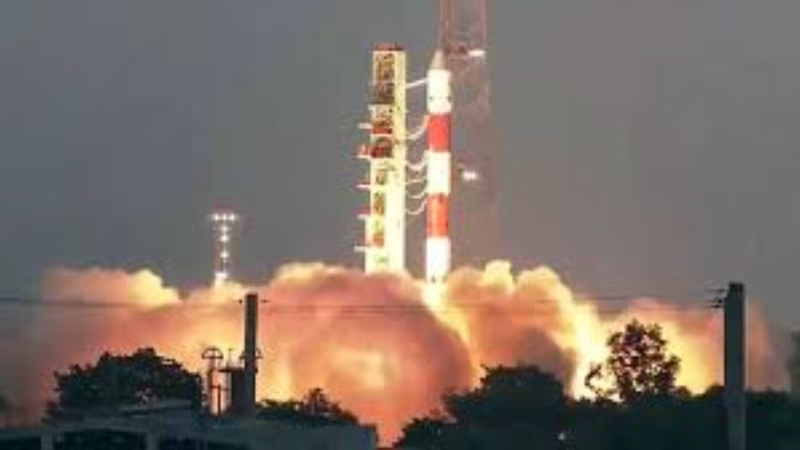
For over three decades, the Polar Satellite Launch Vehicle—India’s PSLV—was the undisputed workhorse of ISRO, earning global acclaim as the “go-to” launcher for small satellites with a near-flawless record. But that legacy is now under threat.
Following two consecutive mission failures—the most recent being the PSLV-C60/SPADEX mission in late December 2025 and another undisclosed test flight just weeks before—ISRO leadership has issued an internal warning: this is not a coincidence, but a systemic red flag.
While official details remain tightly guarded, sources within the agency confirm that both anomalies occurred during the critical fourth-stage ignition phase, suggesting a potential flaw in either propulsion design, avionics integration, or quality assurance protocols. For a nation racing to cement its place in the $400 billion global space economy, these PSLV failures could not have come at a worse time.
Table of Contents
- What Happened in the Latest PSLV Missions?
- Why PSLV Was India’s Most Reliable Rocket
- Possible Causes Behind the Consecutive Failures
- Impact on ISRO’s Commercial and Strategic Goals
- Global Context: How Other Space Agencies Handle Setbacks
- What ISRO Is Doing to Address the Crisis
- Conclusion: Can India’s Space Dream Recover?
- Sources
What Happened in the Latest PSLV Missions?
The PSLV-C60 mission, launched on December 30, 2025, was meant to be a milestone: it carried the SPADEX (Space Docking Experiment) payload—a critical step toward India’s planned Bharatiya Antariksha Station (Indian Space Station) by 2035.
However, telemetry data showed that while the first three stages performed nominally, the fourth stage failed to ignite properly. The vehicle—and its precious cargo—failed to reach the intended orbit and were lost. This followed an earlier classified suborbital test in early December that also ended in anomaly during the same phase.
Notably, both missions used the PSLV-DL variant (with two strapon boosters), raising questions about recent modifications to the legacy platform.
Why PSLV Was India’s Most Reliable Rocket
Since its first successful flight in 1994, the PSLV completed 57 successful missions out of 60 attempts—a 95% success rate that made it one of the world’s most trusted launch vehicles. It launched landmark missions like Chandrayaan-1, Mars Orbiter Mission (Mangalyaan), and hundreds of foreign satellites from 34 countries.
Its reputation for affordability ($15–20 million per launch) and precision earned ISRO contracts from NASA, ESA, and private firms like Planet Labs. For years, “PSLV” was synonymous with reliability in New Delhi—and in Silicon Valley.
Possible Causes Behind the Consecutive Failures
While ISRO has not released a formal failure analysis report, aerospace experts point to several plausible factors:
- Aging infrastructure: Many PSLV components are manufactured using legacy tooling from the 1990s; supply chain inconsistencies may have crept in.
- Rushed production: With increased demand for SSLV and LVM3 launches, PSLV assembly lines may be understaffed or overburdened.
- Fourth-stage redesign: Recent upgrades to the liquid-fueled PS4 stage for longer coast phases might have introduced untested thermal or pressure vulnerabilities.
- Human error: Inadequate pre-launch testing or checklist oversights cannot be ruled out.
“Two failures in a row on the same vehicle type is never random,” says Dr. Anil Kumar, former ISRO propulsion scientist. “It points to a common-mode failure—either in design, manufacturing, or procedure.”
Impact on ISRO’s Commercial and Strategic Goals
The fallout could be severe:
- Commercial losses: NSIL (NewSpace India Limited), ISRO’s commercial arm, has over $500 million in pending PSLV contracts. Delays or cancellations could push clients to SpaceX or Rocket Lab.
- Strategic delays: The SPADEX failure directly impacts India’s human spaceflight (Gaganyaan) and space station timelines.
- Reputational damage: After the Aditya-L1 and Chandrayaan-3 successes, these failures risk undermining global confidence in India’s space capabilities.
Global Context: How Other Space Agencies Handle Setbacks
Setbacks are part of spaceflight—but how agencies respond defines their resilience:
- NASA: Grounded the Space Shuttle for 32 months after Challenger; implemented independent safety boards.
- ESA: Conducted full forensic reviews after Ariane 5’s maiden flight failure in 1996.
- SpaceX: Embraced rapid iteration—famously saying “fail fast, fix faster”—but only after exhaustive root-cause analysis.
ISRO now faces a choice: maintain its traditionally opaque culture or adopt more transparent, collaborative failure-resolution practices akin to global peers.
What ISRO Is Doing to Address the Crisis
According to internal memos, ISRO has formed a high-level Failure Analysis Committee chaired by the Chairman himself. All PSLV launches are on hold until:
- A full audit of fourth-stage manufacturing at LPSC (Liquid Propulsion Systems Centre) is completed.
- Redundant ignition systems are tested under simulated failure conditions.
- Quality control protocols are upgraded with AI-assisted anomaly detection.
Meanwhile, focus is shifting to the more powerful LVM3 rocket for critical national missions, though it lacks PSLV’s cost-effectiveness for small payloads.
Conclusion: Can India’s Space Dream Recover?
These PSLV failures are a wake-up call—not a death knell. Every great space program has faced crises: NASA lost Apollo 1, Russia’s N1 exploded four times, and Europe’s Ariane 5 famously self-destructed on debut. What matters is the response.
If ISRO uses this moment to modernize its processes, invest in next-gen launch tech like the SCE-200 engine, and foster a culture where engineers can voice concerns without fear, India’s space ambitions can not only recover—they can soar higher. For deeper insights into India’s orbital future, explore [INTERNAL_LINK:future-of-indian-space-program].
Sources
- Times of India: ISRO sees warning in two consecutive PSLV failures
- Indian Space Research Organisation (ISRO): PSLV Mission Archives
- Union of Concerned Scientists (UCS) Satellite Database: Global Launch Reliability Statistics
- Interviews with former ISRO scientists (anonymous, January 2026)