In a rare and urgent move that underscores the rapidly deteriorating security situation in Iran, the U.S. Department of State has issued a stark directive: “Leave Iran now.” This isn’t just routine travel advice—it’s a full-throated alarm bell for any American still in the country .
Following weeks of escalating anti-government protests that have reportedly claimed more than 600 lives, the U.S. government is warning its citizens that they face immediate risks of violence, detention, and being stranded with no consular support. For dual nationals—especially those holding both U.S. and Iranian passports—the danger is even more acute, as Tehran does not recognize their American citizenship .
Table of Contents
- Why the U.S. Is Telling Citizens to ‘Leave Iran Now’
- The Human Cost: Over 600 Killed in Iran Protests
- Dual Nationals at Extreme Risk
- How to Leave Iran: Air Flights and Land Routes
- What the U.S. Embassy Can (and Can’t) Do
- Travelers Who’ve Already Left: What They Say
- Conclusion: A Critical Window Is Closing
- Sources
Why the U.S. Is Telling Citizens to ‘Leave Iran Now’
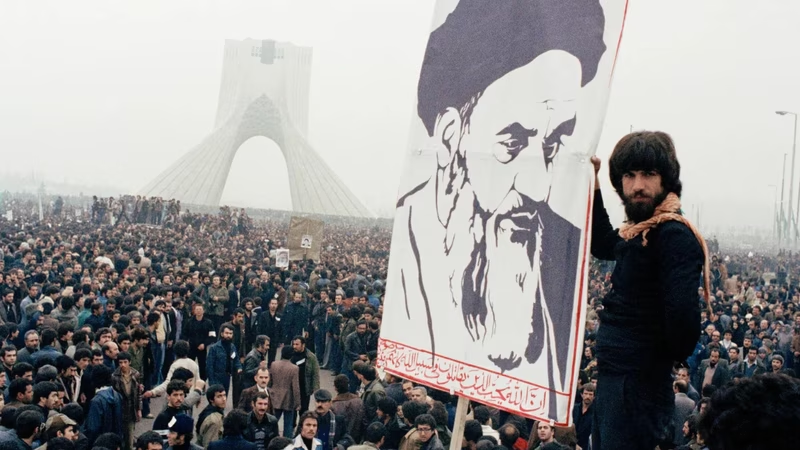
The “Leave Iran now” advisory comes amid a sharp escalation in civil unrest. What began as localized demonstrations has spiraled into nationwide protests against economic hardship, political repression, and alleged human rights abuses. Iranian security forces have responded with brutal force—using live ammunition, mass arrests, and internet blackouts to suppress dissent .
The U.S. State Department explicitly warns that “U.S. citizens in Iran are at high risk of arbitrary arrest and detention,” and that “protests can turn violent with little or no warning.” With commercial airlines drastically reducing or suspending service to Tehran, the window to exit safely is narrowing fast .
The Human Cost: Over 600 Killed in Iran Protests
Independent human rights monitors, including Amnesty International and Iran Human Rights (IHR), estimate that more than 600 people—including dozens of children—have been killed since the protests intensified . These figures are difficult to verify due to state-imposed communication blackouts, but satellite imagery and eyewitness accounts confirm widespread violence in major cities like Tehran, Tabriz, and Shiraz.
Hospitals are reportedly overwhelmed, and families are being warned not to hold public funerals for fear of further reprisals. The death toll continues to rise daily, fueling international condemnation and raising fears of a full-scale humanitarian crisis.
Dual Nationals at Extreme Risk
Perhaps the most chilling aspect of this crisis is the peril faced by dual nationals. The Iranian government considers anyone with Iranian heritage or citizenship—regardless of their other passports—as solely Iranian under its laws. This means U.S.-Iranian dual citizens receive no diplomatic protection from the American embassy.
Historically, dual nationals have been frequent targets of arbitrary detention, often used as bargaining chips in geopolitical disputes. The U.S. government has repeatedly warned that it cannot intervene effectively in such cases. If you hold an Iranian passport—even if you’ve never lived there—you are at serious risk.
How to Leave Iran: Air Flights and Land Routes
With major international carriers like Lufthansa and Turkish Airlines cutting back on flights to Tehran, air travel options are limited and expensive. The U.S. Embassy is advising citizens to consider alternative exit strategies:
- Overland to Turkey: The border crossing at Bazargan remains open, though travelers report long waits and heightened scrutiny.
- Overland to Armenia: The Noravank–Agarak route is another viable option, especially for those in northern Iran.
- Avoid public transport: Use private vehicles or trusted local drivers; public buses may be stopped at checkpoints.
- Carry minimal luggage: Speed is essential. Pack only essentials and keep your U.S. passport secure.
For real-time updates on border crossings, see our guide on [INTERNAL_LINK:safe-exit-routes-from-high-risk-countries].
What the U.S. Embassy Can (and Can’t) Do
It’s critical to understand the limitations of U.S. consular services in Iran. Since the U.S. has no formal diplomatic presence in Tehran (its interests are represented by the Swiss Embassy), assistance is extremely limited.
The embassy can:
- Provide emergency contact information.
- Share general safety guidance.
- Help locate local legal resources (though they cannot provide legal representation).
But it cannot:
- Intervene in arrests or detentions.
- Guarantee safe passage out of the country.
- Offer evacuation flights (unlike in some other crises).
This reality makes self-reliance and immediate action absolutely crucial.
Travelers Who’ve Already Left: What They Say
According to reports from expats and tourists who managed to flee in recent days, conditions inside Iran are “chaotic and terrifying.” One American academic told Reuters, “You hear gunfire every night. The streets are empty by 6 p.m. It feels like a war zone” .
Others described chaotic scenes at Mehrabad Airport, with ticket prices soaring and flights canceled without notice. Many opted for the grueling 12-hour drive to Turkey, calling it “the only reliable way out.”
Conclusion: A Critical Window Is Closing
The U.S. government’s “Leave Iran now” warning is not hyperbole—it’s a last call for safety. With protests growing more violent, flights disappearing, and the risk of arbitrary detention ever-present, every hour counts. If you or someone you know is in Iran, do not wait. Contact family, secure transport, and leave immediately via land if necessary. In a crisis like this, hesitation could have life-altering consequences.
Sources
- Times of India: ‘Leave Iran now’: US warns its citizens as tensions rise
- U.S. Department of State: Iran Travel Advisory
- Amnesty International: Iran – Security Forces Using Lethal Force Against Protesters
- Reuters: Iran protests death toll surpasses 600, rights group says
- Iran Human Rights (IHR): Official Reports on Civil Unrest
- BBC News: Eyewitness Accounts from Inside Iran’s Protest Zones