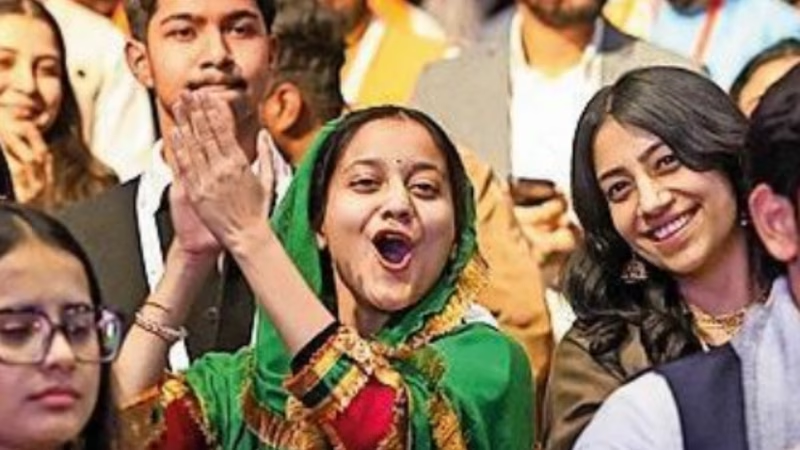
“It is your duty to end the slave mindset,” Prime Minister Narendra Modi told India’s Gen Z during a recent youth conclave—and the phrase instantly went viral. But this wasn’t just another motivational soundbite. It was a direct challenge to a psychological inheritance that, according to the PM, still holds back India’s potential more than 75 years after independence .
The term “slave mindset” refers to a deep-seated tendency to look outward—for validation, standards, innovation, and even self-worth—rather than trusting indigenous knowledge, local solutions, and homegrown confidence. From preferring foreign brands over Indian startups to doubting the value of Sanskrit or Ayurveda in modern science, Modi argued that this mental colonization persists in subtle but damaging ways.
His message? The baton has now passed to Gen Z—the most educated, digitally connected, and globally aware generation in Indian history—to finally break free.
Table of Contents
- What Does PM Modi Mean by ‘Slave Mindset’?
- Historical Roots of the Colonial Mentality
- How the Slave Mindset Shows Up Today
- Why Gen Z Is Uniquely Positioned to Break Free
- From Mindset to Movement: Atmanirbhar Bharat and Youth Innovation
- Critics and Supporters Weigh In
- Conclusion: Your Mind, Your Sovereignty
- Sources
What Does PM Modi Mean by ‘Slave Mindset’?
Speaking at the National Youth Conclave 2026, PM Modi didn’t mince words: “We got political freedom in 1947, but mental freedom is still pending.” He defined the slave mindset as an internalized belief that “foreign is superior”—whether in education, fashion, technology, or governance .
He cited examples: students dreaming only of Ivy League colleges while ignoring IITs and IIMs; engineers importing simple components that could be made locally; and consumers paying premium prices for imported goods with identical Indian alternatives. “True freedom begins when you trust your own mind,” he said.
Historical Roots of the Colonial Mentality
The concept isn’t new. Thinkers like Swami Vivekananda, Mahatma Gandhi, and Dr. B.R. Ambedkar long warned against psychological subjugation. Gandhi’s call for *swadeshi* (self-reliance) was as much economic as it was mental. Post-independence leaders like Jawaharlal Nehru pushed for scientific temper—but often through Western frameworks.
Colonial education systems deliberately positioned Indian knowledge as “backward.” As historian Dr. Dharampal documented, pre-colonial India had advanced systems in mathematics, metallurgy, and urban planning—much of which was erased or dismissed . The slave mindset, then, is the lingering echo of that erasure.
How the Slave Mindset Shows Up Today
It’s not always obvious. Often, it hides in everyday choices:
- ✅ Preferring English over regional languages in professional settings—even when unnecessary
- ✅ Assuming a startup must “go global” before proving its worth in India
- ✅ Dismissing traditional practices (like yoga or herbal medicine) as “unscientific” without inquiry
- ✅ Believing Indian institutions are inherently corrupt or inefficient, while idealizing foreign ones
This mindset doesn’t just limit individual potential—it slows national progress. Why innovate locally if you believe the best ideas come from elsewhere?
Why Gen Z Is Uniquely Positioned to Break Free
Unlike previous generations, Gen Z has tools their grandparents couldn’t imagine:
- Digital access: They can learn from global sources *and* rediscover Indian heritage online—from Vedic math tutorials to open-source Sanskrit databases.
- Startup culture: With platforms like MeitY’s Startup India, young entrepreneurs are building world-class apps rooted in local needs (e.g., BharatPe, DeHaat).
- Cultural confidence: From Bollywood’s global hits to Olympic medalists like Neeraj Chopra, national pride is rising organically—not imposed.
As [INTERNAL_LINK:youth-innovation-india] shows, this generation is already leading the charge in frugal innovation, climate tech, and digital public infrastructure.
From Mindset to Movement: Atmanirbhar Bharat and Youth Innovation
PM Modi linked the fight against the slave mindset directly to his flagship Atmanirbhar Bharat (Self-Reliant India) vision. But he clarified: “Self-reliance doesn’t mean isolation. It means having the confidence to contribute to the world from your own foundation.”
Initiatives like the India Semiconductor Mission, PLI schemes for electronics manufacturing, and the National Education Policy 2020—all aim to create ecosystems where young Indians can thrive without feeling inferior. When a 22-year-old from Tier-2 India builds an AI model trained on Hindi data, that’s mental decolonization in action.
Critics and Supporters Weigh In
Reactions have been polarized. Supporters hail the speech as “long overdue,” pointing to surveys showing 68% of Indian students feel “intellectually inadequate” compared to Western peers .
Critics, however, warn against conflating cultural pride with nationalism. “Rejecting all foreign influence is as dangerous as blindly accepting it,” said sociologist Dr. Nivedita Menon. Others argue that systemic issues—like underfunded schools or job scarcity—can’t be solved by mindset alone.
Yet even skeptics agree on one thing: the conversation itself is vital.
Conclusion: Your Mind, Your Sovereignty
PM Modi’s call to end the slave mindset isn’t about rejecting the world—it’s about refusing to see India through someone else’s eyes. For Gen Z, the challenge is clear: build, create, lead, and innovate with the quiet confidence that your roots are strong enough to support global wings. After all, true freedom isn’t just about who rules your land—it’s about who rules your mind.
Sources
- Times of India: It’s your duty to end ‘slave mindset’, PM tells Gen Z
- Ministry of Education, India: National Education Policy 2020
- Dharampal, The Beautiful Tree: Indigenous Indian Education in the Eighteenth Century (1983)
- NCAER Youth Survey 2025: Attitudes Toward Self-Reliance Among Indian Students