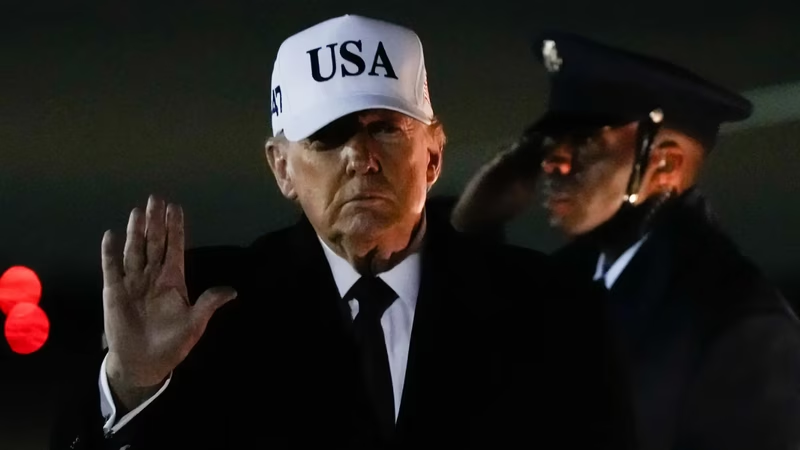
In a move that blurred the lines between satire, self-aggrandizement, and outright falsehood, former U.S. President Donald Trump recently posted a doctored image mimicking a Wikipedia page that declared him the ‘Acting President of Venezuela’ . The post—shared widely across Truth Social and X (formerly Twitter)—quickly went viral, drawing sharp criticism from fact-checkers, foreign policy experts, and even members of his own party.
While the graphic was clearly not from the real Wikipedia (which has strict editorial standards and would never publish such a claim), its realistic design fooled thousands of users, especially outside the U.S. The incident underscores a growing concern: as the 2026 election season heats up, the weaponization of fake reference materials is becoming a potent tool for spreading geopolitical disinformation.
Table of Contents
- What Did Trump’s Post Actually Say?
- Why the Trump Fake Wikipedia Claim Is Dangerous
- Venezuela’s Actual Political Situation in 2026
- How Wikipedia Responds to Misinformation
- The Rise of Fake Reference Hoaxes in Politics
- Fact-Checking and Digital Literacy: What You Can Do
- Conclusion: When Falsehoods Look Official
- Sources
What Did Trump’s Post Actually Say?
The image shared by Trump featured a layout nearly identical to a real Wikipedia entry, complete with an infobox, navigation sidebar, and citation-style footnotes. At the top, it boldly stated: “Donald J. Trump – Acting President of Venezuela (since January 2026).” It included fabricated details like a presidential term start date and a list of “major policies,” including “restoring oil exports” and “ending socialist rule” .
No credible news outlet or government source supports this claim. In fact, Venezuela’s current president is Nicolás Maduro, who won a controversial third term in 2024 amid international condemnation but remains in power with backing from Russia, China, and Iran . The U.S. does not recognize Maduro as legitimate but has never appointed—or claimed—an American as Venezuela’s leader.
Why the Trump Fake Wikipedia Claim Is Dangerous
At first glance, the post might seem like a joke or hyperbolic bragging. But in today’s information ecosystem, such content has real-world consequences:
- Misleads non-English speakers: Many international users may not recognize the parody and take it as fact.
- Undermines trust in real institutions: Repeated hoaxes erode confidence in genuine sources like Wikipedia or official government channels.
- Fuels conspiracy theories: Far-right and pro-Trump groups have already begun circulating the image as “proof” of U.S. intervention in Venezuela.
As [INTERNAL_LINK:online-disinformation-tactics] experts warn, fake reference pages are among the most persuasive forms of misinformation because they mimic authority.
Venezuela’s Actual Political Situation in 2026
Venezuela remains in deep crisis. Despite modest economic stabilization due to partial oil sector recovery, the country still grapples with authoritarian governance, human rights abuses, and mass migration. The U.S. continues to support opposition leader María Corina Machado, though her ability to challenge Maduro is severely restricted .
During his presidency, Trump did impose harsh sanctions on Venezuela and recognized opposition figure Juan Guaidó as interim president in 2019—a move followed by over 50 countries. But that recognition ended in 2023 under the Biden administration, which shifted toward diplomatic engagement .
There has never been any legal or constitutional mechanism by which a U.S. citizen—let alone a former president—could assume office in Venezuela. The idea is not just false; it’s legally nonsensical.
How Wikipedia Responds to Misinformation
Wikipedia, operated by the nonprofit Wikimedia Foundation, relies on volunteer editors and strict sourcing policies. Any attempt to create a page like the one Trump shared would be instantly flagged and deleted. The real Wikipedia page for Donald Trump makes no mention of Venezuela beyond historical U.S. policy actions .
In response to the hoax, Wikimedia issued a public statement: “Wikipedia is not a platform for political propaganda. We urge users to verify information through official channels before sharing.” They also updated their guidelines on spotting fake references .
The Rise of Fake Reference Hoaxes in Politics
This isn’t the first time fabricated encyclopedic content has been used politically. In 2024, AI-generated “Britannica-style” pages falsely credited politicians with Nobel Prizes. In 2025, a fake CDC report circulated claiming a non-existent virus outbreak.
These hoaxes work because they exploit cognitive bias: people trust formats that look academic or institutional. A study by the Stanford Internet Observatory found that 68% of users believed a fake Wikipedia page was real if it matched the site’s visual template .
Fact-Checking and Digital Literacy: What You Can Do
Don’t fall for slick-looking lies. Here’s how to protect yourself:
- ✅ Check the URL: Real Wikipedia pages use
en.wikipedia.org. Anything else is fake. - ✅ Look for edit history: Genuine Wikipedia articles show contributor logs and talk pages.
- ✅ Reverse image search: Use Google Lens to see if a graphic has been altered.
- ✅ Consult trusted fact-checkers like Snopes, AFP Fact Check, or PolitiFact.
Conclusion: When Falsehoods Look Official
The Trump fake Wikipedia incident is more than a social media blunder—it’s a symptom of a deeper crisis in information integrity. As AI tools make it easier to generate convincing forgeries, the line between truth and fiction grows thinner. In a world where a fake encyclopedia entry can go viral as “news,” digital literacy isn’t optional—it’s essential for democracy itself.
Sources
- Times of India: Trump posts fake Wiki profile calling him ‘acting president’ of Venezuela
- Wikipedia: Official Donald Trump Page
- Council on Foreign Relations: Venezuela: The Crisis Explained
- Stanford Internet Observatory: The Psychology of Fake Reference Materials (2025 Report)