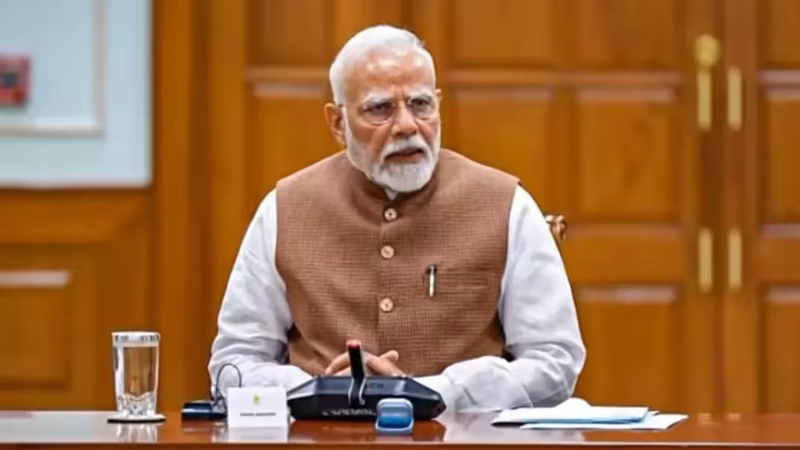
For the first time since India gained independence in 1947, the nerve center of executive power—the Prime Minister’s Office (PMO)—is preparing to pack its files and leave the hallowed halls of South Block. Within the next week, it will relocate to the state-of-the-art Sewa Teerth complex, a move that symbolizes not just a change of address but a profound transformation in how India’s highest office operates .
This isn’t merely an office shuffle. It’s the end of an era. For over seven decades, South Block—with its colonial architecture, marble corridors, and views of Raisina Hill—has been the silent witness to every major decision shaping modern India: wars declared, economies reformed, and peace treaties signed. Now, as the PMO moves to a purpose-built, tech-enabled facility, the nation stands at the threshold of a new chapter in governance.
Table of Contents
- Why Is the PMO Relocation Historic?
- Inside the Sewa Teerth Complex
- The Legacy of South Block
- How the PMO Relocation Fits into Central Vista
- What Changes for Governance and Security?
- Public and Political Reactions
- Conclusion: A Symbolic Leap Forward
- Sources
Why Is the PMO Relocation Historic?
The PMO relocation marks the first time the Prime Minister’s operational headquarters will function outside the Central Secretariat buildings on Raisina Hill. Since 1947, South Block has housed not only the PMO but also the Ministry of External Affairs and the Ministry of Defence—making it the epicenter of India’s strategic and diplomatic machinery .
While previous prime ministers worked from South Block, the new setup at Sewa Teerth represents a deliberate break from colonial-era infrastructure. As one senior official noted, “This move embodies Atmanirbhar Bharat—not just in economy, but in the very architecture of our institutions.”
Inside the Sewa Teerth Complex
Located near the revamped Central Vista Avenue, the Sewa Teerth complex is part of Prime Minister Narendra Modi’s ambitious urban renewal vision. Designed with sustainability, security, and digital integration in mind, the facility features:
- Smart command centers with real-time data dashboards for crisis management
- Energy-efficient systems including solar power and rainwater harvesting
- Enhanced cybersecurity infrastructure to protect sensitive communications
- Dedicated public grievance redressal zones aligned with the ‘Sewa’ (service) ethos
Unlike the constrained, heritage-laden spaces of South Block, Sewa Teerth offers modular workspaces, advanced video conferencing suites, and seamless connectivity with other ministries—enabling faster, more agile decision-making.
The Legacy of South Block
Built in 1929 as part of Edwin Lutyens’ imperial capital plan, South Block was originally intended to house the offices of the British Viceroy’s Council. Post-independence, it became the seat of India’s civilian leadership. Jawaharlal Nehru, Indira Gandhi, Atal Bihari Vajpayee, and Manmohan Singh all governed from its corridors.
Its grand staircases, sandstone façade, and circular courtyards are etched into India’s political memory. However, aging infrastructure, limited space, and outdated HVAC systems made modernization increasingly difficult—prompting the need for a functional upgrade.
How the PMO Relocation Fits into Central Vista
This move is the latest milestone in the ₹20,000-crore Central Vista Redevelopment Project—a sweeping initiative to modernize India’s administrative core . The project includes a new Parliament building (inaugurated in 2023), revamped North and South Blocks, and a unified Central Secretariat.
Critics have questioned the project’s cost and timing, but supporters argue it’s long overdue. “Colonial buildings weren’t designed for 21st-century governance,” says urban planner Dr. Meera Nair. “Digital India needs digital-ready infrastructure.”
As [INTERNAL_LINK:central-vista-project-explained] shows, the vision extends beyond aesthetics—it’s about creating a resilient, future-proof administrative ecosystem.
What Changes for Governance and Security?
Operationally, the PMO relocation promises several upgrades:
- Faster inter-ministerial coordination through integrated digital platforms
- Reduced physical paperwork via end-to-end e-governance systems
- Enhanced disaster response capabilities with AI-driven situational rooms
- Tighter perimeter security with biometric access and drone surveillance
Importantly, the PM’s residence at 7 Lok Kalyan Marg remains unchanged. Only the office functions are shifting.
Public and Political Reactions
Reactions have been mixed. Opposition leaders have called the move “symbolic over substance,” arguing funds could’ve been better spent on healthcare or education. Meanwhile, historians express concern about preserving South Block’s heritage—even as it’s repurposed for museum or archival use.
But many citizens see it as a bold step toward modernity. “It’s time our institutions reflected the India we are becoming—not the one we were under the Raj,” tweeted a Delhi-based entrepreneur.
Conclusion: A Symbolic Leap Forward
The PMO relocation to Sewa Teerth is more than bricks and mortar. It’s a statement: that India’s governance must evolve with its ambitions. While South Block will remain a monument to history, Sewa Teerth is being built for the future—one where service, speed, and sovereignty define the heart of power.
Sources
- Times of India: PMO likely to move to Sewa Teerth complex in next one week
- Press Information Bureau (PIB): Central Vista Redevelopment Project Overview
- Archaeological Survey of India: Heritage Status of Central Secretariat Buildings