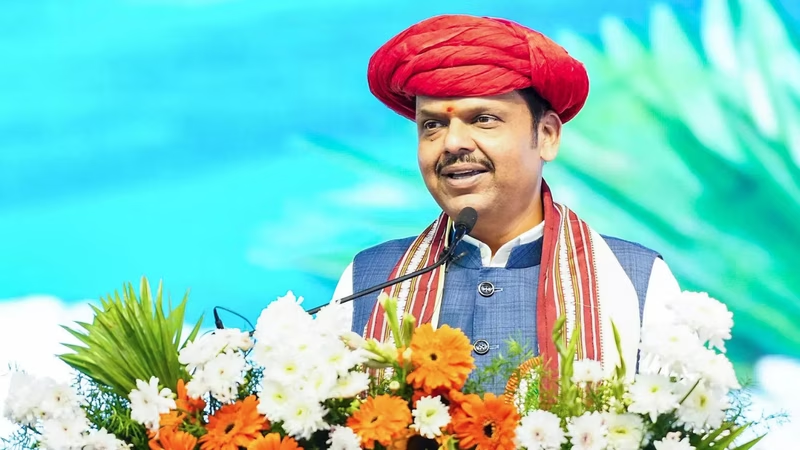
In a move that’s sent shockwaves through Maharashtra’s political corridors, the Election Commission of India (ECI) has **blocked the release of the January 2026 installment** of the hugely popular Ladki Bahin stipend—just days before key civic body elections across the state.
The decision isn’t just bureaucratic red tape. It’s a direct enforcement of the Model Code of Conduct (MCC), which prohibits governments from announcing or implementing new welfare schemes—or disbursing benefits under existing ones—once elections are announced. With voting scheduled in major urban centers like Pune, Nagpur, and Thane, the EC has drawn a hard line: no last-minute cash transfers that could sway voters.
For millions of women who rely on this ₹1,500 monthly support, the pause is more than inconvenient—it’s a stark reminder of how electoral timelines can override social welfare. But legally, the EC’s stance is ironclad. And politically, it’s a high-stakes check on the ruling Mahayuti alliance led by Chief Minister Eknath Shinde and Deputy CM Devendra Fadnavis.
Table of Contents
- What Is the Ladki Bahin Stipend?
- Why the EC Blocked the January Payment
- Model Code of Conduct Explained
- Political Fallout for Fadnavis and Shinde Government
- Impact on Beneficiaries and Public Sentiment
- Legal Precedents and Past EC Actions
- What Happens After the Elections?
- Summary
- Sources
What Is the Ladki Bahin Stipend?
Launched in September 2023 by the then newly formed Eknath Shinde-led government, the Ladki Bahin stipend promises ₹1,500 per month to every woman aged 21–65 from economically vulnerable households in Maharashtra. The scheme—inspired by similar initiatives like Madhya Pradesh’s ‘Ladli Behna’—aims to promote financial independence and reduce gender-based economic disparity.
To date, over **1.4 crore women** have been enrolled, making it one of the largest state-funded direct benefit transfers in India. Payments are made directly to bank accounts, usually around the 10th of each month.
Why the EC Blocked the January Payment
The trigger? The official announcement of **civic elections** in 87 municipal councils and corporations across Maharashtra, with polling set for late January 2026. Once the election schedule is notified, the MCC automatically comes into force.
According to an EC source, “Disbursing the January stipend now would be seen as an attempt to influence voters using public funds. The scheme may be welfare-driven, but timing matters—and this timing is impermissible.”
Notably, the December 2025 payment was released *before* the election notification, so it remains untouched. Only the January cycle falls under the ban.
Model Code of Conduct Explained
The MCC is a set of guidelines issued by the ECI to ensure free and fair elections. While not legally binding, it’s enforceable through constitutional morality and judicial backing. Key provisions relevant here include:
- Clause 1 (General Conduct): No party or candidate shall engage in activities that may aggravate tensions or create communal disharmony.
- Clause 4 (Ministers’ Conduct): Ministers cannot combine official visits with electioneering or announce new grants/schemes.
- Clause 6 (Official Machinery): Use of government resources—including fund disbursements—for electoral advantage is prohibited.
The Supreme Court has repeatedly upheld the EC’s authority to enforce the MCC, calling it “essential to democracy” (Satya Narayan v. Election Commission, 2013).
Political Fallout for Fadnavis and Shinde Government
The ruling Mahayuti alliance is caught in a bind:
- BJP (Fadnavis): Wants to project governance credibility but risks voter backlash for the delay.
- Shiv Sena (Shinde): Originally championed the scheme to counter Uddhav Thackeray’s faction; now faces accusations of “abandoning sisters.”
Opposition parties—especially the Maha Vikas Aghadi (MVA)—are already capitalizing. “They gave money to buy votes in 2024. Now they’re stopping it to hide corruption,” alleged a senior NCP leader.
Impact on Beneficiaries and Public Sentiment
For many women, the ₹1,500 isn’t pocket money—it’s groceries, school fees, or medicine. A one-month gap may seem minor to policymakers, but on the ground, it’s significant.
“I use this for my daughter’s tuition,” said Sunita More, a domestic worker in Mumbai. “If it doesn’t come, I’ll have to borrow. Again.”
Social media is flooded with #WhereIsMyLadkiBahin, mixing frustration with confusion—many don’t realize the EC, not the state, caused the pause.
Legal Precedents and Past EC Actions
This isn’t the first time the EC has halted welfare payments:
- In 2022, Tamil Nadu’s ‘Kalaignar Magalir Urimai Thogai’ was paused before local polls.
- In 2019, Punjab’s farm loan waivers were deferred during parliamentary elections.
- In 2014, Delhi’s free water scheme rollout was delayed due to MCC.
The consistent principle: **welfare must not become a campaign tool**.
For more on election ethics, see our explainer on [INTERNAL_LINK:model-code-of-conduct-india-explained].
What Happens After the Elections?
Good news for beneficiaries: the EC has clarified that **all pending installments will be released immediately after voting concludes**. If elections wrap up by February 1, the January + February payments could arrive together.
Long-term, the scheme’s future depends on fiscal sustainability. With an annual outlay of ~₹25,000 crore, critics question its viability—but for now, it remains a cornerstone of Maharashtra’s social policy.
Summary
The Election Commission’s decision to pause the Ladki Bahin stipend for January 2026 isn’t about cutting welfare—it’s about protecting electoral integrity. While the move may cause short-term hardship for millions of women, it upholds a critical democratic norm: public funds must never be weaponized for votes. As Maharashtra heads to the polls, both voters and politicians must remember—the true test of governance isn’t pre-election giveaways, but post-election accountability.
Sources
- Times of India, “Maharashtra civic polls: EC bars Fadnavis govt from dispersing Ladki Bahin stipend for January”: https://timesofindia.indiatimes.com/india/maharashtra-civic-polls-ec-bars-fadnavis-government-from-dispersing-ladki-bahin-stipend-for-january-heres-why/articleshow/126487106.cms
- Election Commission of India – Model Code of Conduct Guidelines: https://eci.gov.in
- Government of Maharashtra – Ladki Bahin Yojana Portal: https://mahabhun.gov.in/ladkibahinyojana
- Supreme Court of India, Satya Narayan v. Election Commission (2013): https://main.sci.gov.in