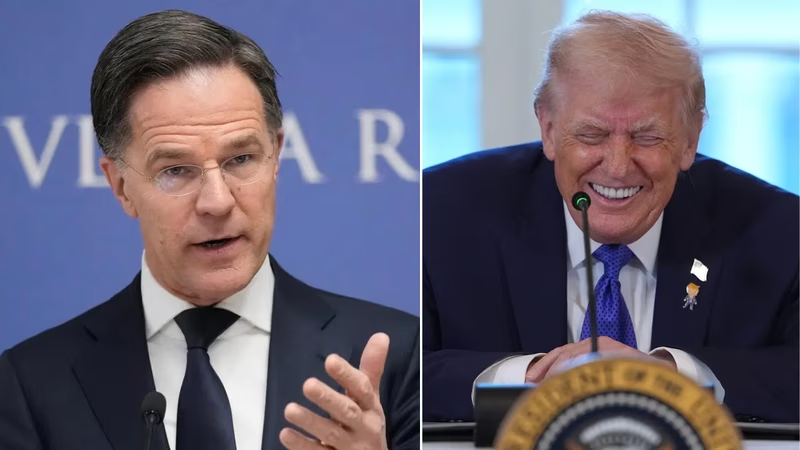
It sounds like a plot from a Cold War thriller—but it’s very real, and it’s happening now. In early 2026, the idea of the United States acquiring **Greenland** has resurfaced with alarming intensity, triggering emergency discussions within NATO and drawing sharp rebukes from Copenhagen. And in the middle of it all? Former President Donald Trump, who recently declared—without evidence—that he “deserves full credit” for NATO’s new Arctic security push.
This isn’t just political theater. The US Greenland claim touches on deep strategic, environmental, and military stakes in one of Earth’s most contested frontiers. With climate change melting Arctic ice at record speeds, new shipping lanes, vast mineral deposits, and critical surveillance positions are becoming accessible—and every global power wants a piece of the action.
Table of Contents
- Trump’s Returning Greenland Rhetoric
- Why the US Wants Greenland: Strategic Value Explained
- NATO Scrambles to Boost Arctic Security
- Denmark’s Firm Stance on Greenland Sovereignty
- Geopolitical Implications for Russia and China
- What Happens Next in the Arctic Race?
- Summary
- Sources
Trump’s Returning Greenland Rhetoric
In 2019, Trump shocked the world by publicly musing about buying Greenland—a semi-autonomous Danish territory—as a “real estate deal.” The proposal was swiftly rejected by Denmark’s prime minister, who called it “absurd.” Now, as he campaigns for a potential 2028 White House return, Trump is reviving the narrative—but with a twist.
At a recent rally, he claimed: “I made NATO focus on the Arctic. Without me, they’d be asleep while China and Russia took over Greenland. I should get credit—and maybe we still should buy it.”
There’s no evidence Trump directly influenced NATO’s current Arctic posture. But his comments have amplified speculation that a second Trump administration could aggressively pursue territorial or basing rights in Greenland—legally or otherwise.
Why the US Wants Greenland: Strategic Value Explained
Greenland isn’t just ice and polar bears. It’s a geostrategic goldmine:
- Thule Air Base: The US already operates its northernmost military installation here—a critical radar and missile-tracking site just 750 miles from the North Pole.
- Rare Earth Minerals: Greenland holds vast deposits of neodymium and dysprosium—essential for electric vehicles, wind turbines, and defense tech. China has been aggressively courting mining deals.
- New Shipping Routes: As sea ice retreats, the Northwest Passage and Northern Sea Route could cut Asia-Europe transit times by weeks.
- Surveillance Advantage: Control over Greenland offers unparalleled monitoring of Russian submarine activity and Chinese Arctic ambitions.
In short, whoever dominates Greenland gains a commanding position in the 21st-century Arctic race.
NATO Scrambles to Boost Arctic Security
NATO Secretary-General Jens Stoltenberg recently confirmed the alliance is “working urgently to enhance Arctic security” amid rising great-power competition. While he didn’t name the US directly, insiders say Trump’s renewed rhetoric—and actual Chinese and Russian moves—forced NATO’s hand.
Key initiatives include:
- Expanding joint naval patrols in the GIUK Gap (Greenland-Iceland-UK corridor).
- Upgrading early-warning systems across Arctic member states (Norway, Canada, Denmark).
- Conducting large-scale cold-weather drills like “Arctic Challenge 2026.”
But there’s tension within NATO too. European members fear that aggressive US posturing—especially talk of annexation—could destabilize relations with non-NATO Arctic players and undermine diplomatic norms.
Denmark’s Firm Stance on Greenland Sovereignty
Copenhagen has drawn a red line: **Greenland is not for sale**. Danish Prime Minister Mette Frederiksen reiterated that Greenlanders alone will decide their future—and so far, independence (not US annexation) is the dominant local sentiment.
Greenland’s government, led by Premier Múte Bourup Egede, has emphasized self-determination. While open to deeper US security cooperation—especially to counter Chinese influence—they reject any notion of becoming a US territory.
“We are not a commodity,” Egede stated in a recent interview. “Our land, our resources, our voice.”
Geopolitical Implications for Russia and China
Russia already considers the Arctic its “national priority,” with over 40 icebreakers and militarized bases along its northern coast. China, though not an Arctic state, declared itself a “near-Arctic nation” and has invested billions in infrastructure projects across Greenland and Iceland.
A US takeover—or even expanded control—of Greenland would directly threaten both powers’ ambitions:
- Russia: Would lose strategic depth near its Northern Fleet bases.
- China: Could see its Belt and Road “Polar Silk Road” ambitions blocked.
This tri-polar rivalry is turning the Arctic into the next flashpoint of global power competition.
For more on how climate change is fueling geopolitical shifts, see our analysis on [INTERNAL_LINK:climate-change-and-global-security].
What Happens Next in the Arctic Race?
Three scenarios are emerging:
- Diplomatic Engagement: The US strengthens ties with Denmark and Greenland through aid, scientific collaboration, and defense pacts—without territorial demands.
- Military Escalation: If Trump returns to office and pushes harder, it could trigger a sovereignty crisis and fracture NATO unity.
- Greenland Independence: By 2030, Greenland may hold a referendum on full independence—potentially opening the door to new alliances, including with the US.
One thing is certain: the Arctic is no longer a frozen wasteland. It’s the frontline of tomorrow’s world order.
Summary
The renewed US Greenland claim—fueled by Trump’s provocative statements and strategic necessity—is forcing NATO to act fast on Arctic security. While outright purchase remains legally and politically impossible, the scramble for influence over Greenland’s resources, location, and sovereignty is intensifying. For Denmark, Greenland, and the entire alliance, the challenge is balancing deterrence against Russia and China without igniting a new era of territorial conflict. In the melting Arctic, the ice may be disappearing—but the stakes have never been higher.
Sources
- Times of India, “Working to boost Arctic security: NATO chief amid US Greenland threat”: https://timesofindia.indiatimes.com/world/europe/working-to-boost-arctic-security-nato-chief-amid-us-greenland-threat-donald-trump-claims-credit-for-it-too/articleshow/126486459.cms
- NATO Official Website – Arctic Security Policy: https://www.nato.int
- Government of Greenland – Foreign Relations Statement: https://naalakkersuisut.gl
- U.S. Department of Defense – Arctic Strategy 2024: https://www.defense.gov