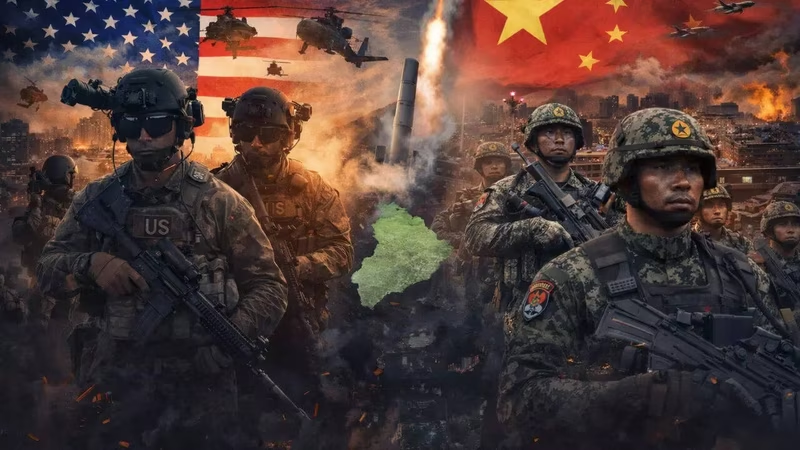
The world watched—some with awe, others with alarm—as reports surfaced of a highly precise, near-surgical U.S. operation in Venezuela aimed at destabilizing Nicolás Maduro’s regime. Whether fully confirmed or not, the mere plausibility of such a mission underscores a stark reality: America’s special operations forces, like Delta Force, operate on a plane that China’s military simply cannot yet reach. Despite massive investments in hypersonic missiles, stealth fighters, and cyber warfare, Beijing remains critically deficient in one key area: integrated, all-domain special operations.
This gap isn’t about hardware—it’s about doctrine, trust, and real-time fusion of intelligence, air, sea, and ground assets. And as analysts warn, any attempt by China to replicate such a mission against Taiwan would likely be far messier, bloodier, and less effective. So, what exactly is holding China back? Let’s dissect the China special forces capability gap—and why it matters for global security.
Table of Contents
- The Venezuela Precedent: What Was the Maduro Operation?
- China Special Forces Capability: Structure and Limitations
- Why Integration Is China’s Biggest Hurdle
- Political Control vs. Operational Flexibility
- Taiwan Scenario: Why a Surgical Strike Is Unlikely
- US Advantage: The All-Domain Fusion Model
- Conclusion
- Sources
The Venezuela Precedent: What Was the Maduro Operation?
While details remain classified, credible defense sources suggest the U.S. executed a covert action involving intelligence operatives, drone surveillance, and possibly small special ops teams to support anti-Maduro elements—without triggering full-scale conflict . The hallmark? Speed, deniability, and minimal collateral damage.
This “light footprint” approach reflects decades of refinement in U.S. special operations, where units like Delta Force, SEAL Team Six, and JSOC operate under a unified command with seamless access to satellite intel, electronic warfare, and rapid air extraction.
China Special Forces Capability: Structure and Limitations
China does have elite units—the People’s Liberation Army (PLA) hosts several special operations brigades under its five theater commands. There’s also the Snow Leopard Commando Unit and the secretive People’s Armed Police (PAP) special detachments. On paper, they’re well-equipped with night-vision gear, silenced weapons, and tactical drones.
But here’s the catch: these units are **siloed**. Unlike the U.S., where special ops fall under a single strategic umbrella (USSOCOM), China’s special forces report to regional army commands, naval fleets, or internal security organs—with little cross-branch coordination .
Why Integration Is China’s Biggest Hurdle
Modern special operations aren’t won by individual heroics—they’re won by data fusion. A Delta Force raid might involve:
- Real-time satellite imagery from NRO
- Electronic jamming from Air Force EC-37B aircraft
- Marine Corps Osprey insertion
- AI-driven target recognition from NSA feeds
In China, such integration is hampered by bureaucratic walls. The PLA Army doesn’t seamlessly share targeting data with the Navy. Cyber units operate under a different chain of command than ground forces. As RAND Corporation notes, “China’s joint operations remain aspirational, not operational” .
Political Control vs. Operational Flexibility
Another critical factor: the Chinese Communist Party’s (CCP) iron grip on military decision-making. Every major operation requires Politburo approval—a process that kills speed and surprise. U.S. special ops commanders can greenlight missions within hours; their Chinese counterparts may wait days for clearance.
This centralized control ensures loyalty but sacrifices agility—exactly what you need in a fast-moving hostage rescue or decapitation strike. As one former Pentagon official put it: “You can’t run a Delta-style op when your general needs to call Beijing for permission to move a squad.”
Taiwan Scenario: Why a Surgical Strike Is Unlikely
Many fear China might attempt a lightning raid on Taipei to capture leaders or seize key infrastructure. But experts agree: without true joint special ops capability, such an attempt would likely devolve into a blunt, high-casualty invasion.
“China would have to rely on overwhelming force—not precision,” says Dr. Lyle Goldstein of the Asia Maritime Transparency Initiative. “That means amphibious landings, artillery barrages, and urban combat—far from a ‘Maduro extraction’ model” .
US Advantage: The All-Domain Fusion Model
The U.S. edge lies not in better rifles, but in **networked warfare**. From battlefield AI (like Project Maven) to secure tactical cloud networks, American forces share a common operating picture in real time. This allows a drone operator in Nevada to guide a sniper in Caracas—something China’s fragmented systems can’t replicate.
For deeper insights into modern warfare doctrine, explore our analysis on [INTERNAL_LINK:future-of-joint-military-operations].
Conclusion
The China special forces capability gap isn’t permanent—but it’s significant. Until Beijing overcomes its structural fragmentation, political micromanagement, and lack of true jointness, it won’t be able to pull off the kind of clean, deniable, high-impact operations that define 21st-century special warfare. For now, any Chinese attempt at a Venezuela-style intervention—especially against Taiwan—would likely be far more destructive, escalatory, and less effective. In the shadow war of precision versus brute force, the U.S. still holds the scalpel.
Sources
- Times of India – “The Delta Force gap: Why China can’t do a Maduro-type op — for now” (https://timesofindia.indiatimes.com/defence/the-delta-force-gap-why-chinas-pla-cant-do-a-maduro-type-opfor-now/articleshow/126486432.cms)
- IISS Military Balance 2026 – “PLA Special Operations Forces Structure”
- RAND Corporation – “China’s Quest for Joint Military Operations” (https://www.rand.org)
- Asia Maritime Transparency Initiative – “Assessing PLA Readiness for Taiwan Contingencies”