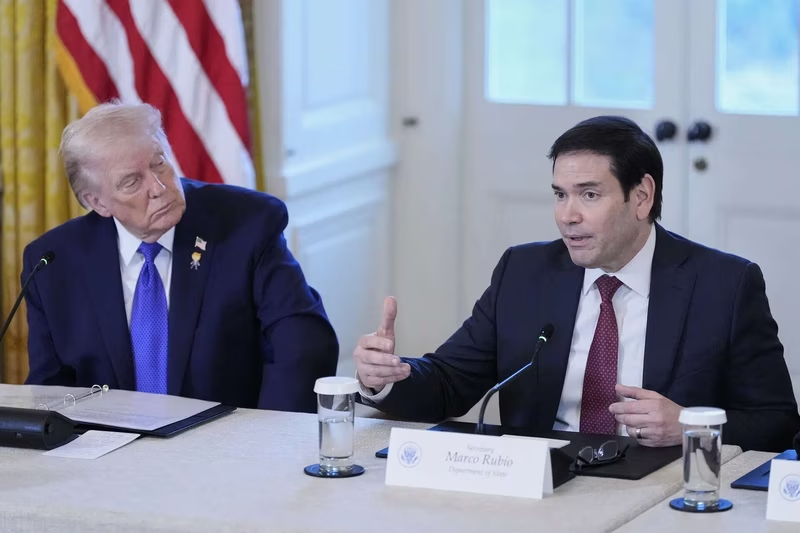
When Donald Trump launched one of the most aggressive U.S. foreign policy campaigns against Venezuela in recent memory, many assumed it was pure political theater. But behind the scenes, a deeply personal force was at work: Senator Marco Rubio. His childhood—steeped in the trauma of Cuban exile—became the emotional and ideological blueprint for America’s Venezuela strategy under Trump. This isn’t just diplomacy; it’s generational memory turned into statecraft.
Table of Contents
- The Exile Mentality: How Rubio’s Past Influenced Policy
- From Miami Kitchen Tables to the White House
- Key Elements of Trump’s Venezuela Policy Driven by Rubio
- Why Cuba and Venezuela Are Linked in Rubio’s Worldview
- Criticism and Controversy
- What This Means for Future U.S.–Latin America Relations
- Conclusion
- Sources
The Exile Mentality: How Rubio’s Past Influenced Policy
Marco Rubio didn’t learn about authoritarianism from textbooks. He heard about it at the dinner table. His parents fled Fidel Castro’s Cuba in 1956—not as political dissidents, but as ordinary citizens seeking freedom. Yet their narrative, shared across Miami’s Cuban-American community, painted a consistent picture: America had failed to fully confront tyranny in 1961 during the Bay of Pigs invasion. That “unfinished business” became a moral compass for Rubio.
This lived experience made him view regimes like Nicolás Maduro’s not just as geopolitical adversaries, but as personal betrayals of democratic ideals. When he joined Trump’s inner circle on Latin America issues, his Marco Rubio Venezuela policy vision wasn’t theoretical—it was visceral.
From Miami Kitchen Tables to the White House
Rubio’s rise from Florida state politics to U.S. Senate gave him a platform, but it was his alignment with Trump on regime change that granted him unprecedented influence. Despite their rocky 2016 primary battle, Trump recognized Rubio’s credibility with the powerful Cuban-American voting bloc—and his strategic clarity on socialist regimes.
By 2017, Rubio was effectively the architect of Trump’s Latin America strategy. He advised on sanctions, pushed for recognition of opposition leader Juan Guaidó as Venezuela’s legitimate president, and championed efforts to isolate Maduro diplomatically and economically .
Key Elements of Trump’s Venezuela Policy Driven by Rubio
The Trump administration’s approach to Venezuela bore Rubio’s fingerprints in several concrete ways:
- Maximum Pressure Campaign: Imposition of sweeping oil sanctions targeting PDVSA, Venezuela’s state-owned oil company, crippling its main revenue source.
- Diplomatic Isolation: Leading a coalition of over 50 countries to recognize Guaidó as interim president in 2019—a move Rubio personally lobbied for.
- Military Options on the Table: Rubio consistently advocated keeping military intervention as a “last resort,” a stance Trump echoed publicly.
- Cuba-Venezuela Nexus: Policies explicitly linked Havana’s support for Maduro, resulting in tightened restrictions on both regimes simultaneously .
Why Cuba and Venezuela Are Linked in Rubio’s Worldview
For Rubio, Cuba isn’t just a neighboring island—it’s the original sin of U.S. Cold War policy. And Venezuela, under Hugo Chávez and later Maduro, became Cuba’s economic lifeline after the Soviet Union collapsed. In his view, Maduro’s regime is a proxy extension of Castro-style communism.
“Cuba was not history. It was a wound,” as noted in a Times of India analysis . That wound never healed—and Venezuela became its open sore. This emotional linkage explains why Rubio treated Venezuela not as a standalone crisis, but as part of a broader ideological battle against what he calls “21st-century socialism.”
Criticism and Controversy
Not everyone agreed with this approach. Critics—including some within the State Department and humanitarian organizations—argued that the sanctions worsened Venezuela’s humanitarian crisis without dislodging Maduro. The Brookings Institution pointed out that regime change strategies often backfire, strengthening dictators’ nationalist narratives .
Moreover, the Guaidó gambit ultimately lost momentum by 2023, as international support waned and Maduro consolidated power. Yet Rubio remains unapologetic, framing the effort as morally necessary—even if imperfect.
What This Means for Future U.S.–Latin America Relations
Rubio’s imprint extends beyond Trump. His worldview continues to shape Republican foreign policy doctrine toward Latin America. Even under Biden, certain sanctions remain, showing bipartisan concern—but the maximalist, emotionally driven approach is uniquely Rubio’s legacy.
As new leaders emerge in Colombia, Brazil, and Mexico, the U.S. faces a choice: continue a confrontational posture rooted in exile trauma, or adopt a more pragmatic, engagement-based strategy. For deeper insights, see our coverage on [INTERNAL_LINK:us-latin-america-diplomacy-trends].
Conclusion
The Marco Rubio Venezuela policy wasn’t crafted in a Foggy Bottom conference room—it was forged in the kitchens of Miami’s Little Havana. His childhood memories of a “lost homeland” translated into a relentless drive to prevent another Cuba-like scenario in Venezuela. Whether this approach succeeded strategically is debatable, but its emotional and ideological power is undeniable. As long as Rubio remains a key voice in U.S. foreign policy, the ghosts of 1961 will continue to haunt America’s dealings with Latin America.
Sources
- U.S. Department of State Archives – Venezuela Policy Statements (2017–2021)
- Council on Foreign Relations – “U.S. Sanctions on Venezuela”
- Times of India – “Maduro Extraction: How Marco Rubio’s Childhood Shaped Donald Trump’s Venezuela Policy” (https://timesofindia.indiatimes.com/world/us/maduro-extraction-how-marco-rubios-childhood-shaped-donald-trumps-venezuela-policy/articleshow/126485040.cms)
- Brookings Institution – “The Limits of Sanctions in Venezuela” (https://www.brookings.edu)