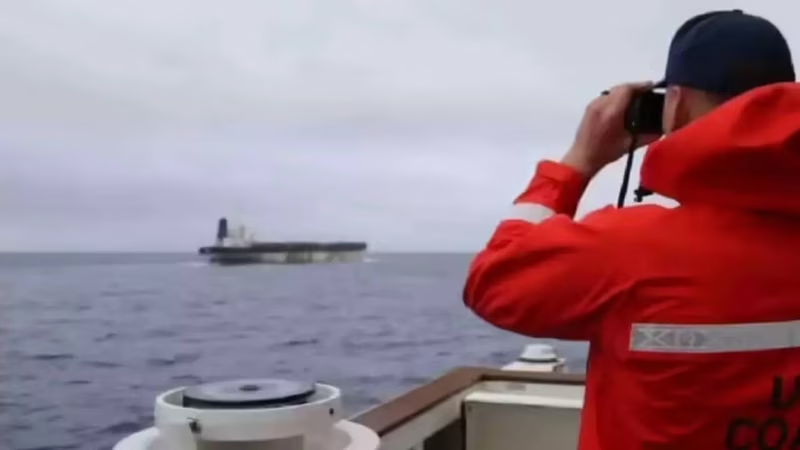
For families of merchant navy officers, every voyage is a mix of pride and anxiety. But for the Chauhans of Palampur, Himachal Pradesh, that anxiety has turned into a full-blown nightmare. Their 26-year-old son, Rakshit Chauhan, a newly certified merchant navy officer on his very first sea assignment, is now stranded in international waters—caught in the crossfire of geopolitics, sanctions, and maritime law enforcement.
Rakshit was serving aboard the Russian-flagged oil tanker Marinera when it was intercepted by the U.S. Coast Guard in the North Atlantic on January 7, 2026. The vessel, allegedly en route to Venezuela, was seized under sweeping U.S. sanctions targeting Russia’s shadow oil fleet. Now, Rakshit and two other Indian crew members are effectively detained—with no clear timeline for their release or repatriation. This unfolding ordeal has come to be known as the Marinera crisis .
Table of Contents
- The Seizure: What Happened to the Marinera?
- Marinera Crisis: Meet Rakshit Chauhan, the Young Officer at the Center
- Why Was the Marinera Targeted? U.S. Sanctions Explained
- The Plight of Indian Crew Members in Sanctioned Vessels
- Family Appeals to PM Modi for Diplomatic Intervention
- Conclusion: A Human Cost of Geopolitical Warfare
- Sources
The Seizure: What Happened to the Marinera?
According to U.S. Department of Justice statements, the Marinera was identified as part of a “sanctions evasion network” facilitating Russian oil exports in violation of the G7 price cap mechanism . Operating under a Russian flag and managed by entities linked to Moscow, the tanker was attempting to deliver crude oil to Venezuela—a known ally of the Kremlin.
The U.S. Coast Guard, supported by naval assets, boarded the vessel approximately 600 nautical miles off the coast of Newfoundland. All 22 crew members, including three Indians, were taken into custody. The ship was subsequently towed to a U.S. port for legal proceedings under civil forfeiture laws—a process that can take months, if not years.
Marinera Crisis: Meet Rakshit Chauhan, the Young Officer at the Center
Rakshit Chauhan, a graduate of the prestigious Tolani Maritime Institute, had just completed his pre-sea training when he secured a position with a Russian shipping company—a common path for many young Indian cadets seeking international exposure and competitive pay .
“He called us on January 5, excited about his first voyage,” his father, Rajesh Chauhan, told reporters, his voice breaking. “He said the ship was clean, the crew professional. He never imagined this.” Since January 7, all communication has ceased. The family learned of the seizure only through news reports and frantic calls to maritime unions.
Why Was the Marinera Targeted? U.S. Sanctions Explained
The U.S. and its allies have intensified efforts to curb Russia’s oil revenue since its invasion of Ukraine in 2022. Key measures include:
- G7 Price Cap: Allows Western services (insurance, shipping) only for Russian oil sold below $60/barrel.
- Shadow Fleet Crackdown: Targeting tankers that disable AIS tracking, engage in ship-to-ship transfers, or use forged documents.
- Secondary Sanctions: Penalizing non-U.S. entities that facilitate prohibited Russian oil trades.
The Marinera reportedly exhibited multiple red flags: no AIS signal for days, ownership obscured through shell companies, and destination mismatch. While crew members are typically not charged, they become collateral in lengthy legal battles.
The Plight of Indian Crew Members in Sanctioned Vessels
India supplies over 250,000 seafarers globally—the largest pool in the world . Many work on vessels flagged in Russia, Iran, or Venezuela due to higher wages and fewer regulatory hurdles. But this exposes them to significant risk:
- No consular access during initial detention periods.
- Prolonged uncertainty while ships undergo legal review.
- Potential blacklisting by international shipping registries.
The Directorate General of Shipping (DGS) has issued advisories, but enforcement is limited. For more on maritime labor rights, see [INTERNAL_LINK:indian-seafarers-rights-abroad].
Family Appeals to PM Modi for Diplomatic Intervention
Desperate and running out of options, Rakshit’s family has written to Prime Minister Narendra Modi, External Affairs Minister S. Jaishankar, and the Ministry of Ports, Shipping and Waterways. “We’re not asking for special treatment—just his safe return,” his mother pleaded .
Historically, India has secured the release of detained sailors through quiet diplomacy—as seen in the 2023 case of the Suez Rajan crew. But with U.S.-Russia tensions at a boiling point, the Marinera crisis presents a far more complex challenge.
Conclusion: A Human Cost of Geopolitical Warfare
The Marinera crisis is not just a legal or diplomatic issue—it’s a human tragedy. Behind the headlines are young professionals like Rakshit Chauhan, who signed up for adventure and livelihood, not geopolitical entanglement. As nations weaponize trade and sanctions, it’s the ordinary crew members who pay the price. The Indian government now faces a critical test: can it protect its citizens even when they’re caught in the stormiest seas of global politics?
Sources
Our reporting draws from official U.S. government releases, Indian maritime authorities, and verified family accounts. For authoritative data on global shipping sanctions, we reference the U.S. Department of the Treasury, which oversees sanctions enforcement.
- Times of India. “Himachal merchant navy officer among crew on Russian tanker seized by US; kin seeks PM Modi’s help for his safe return.” January 12, 2026.
- U.S. Department of Justice – Press Release on Marinera Seizure, January 8, 2026.
- Directorate General of Shipping, India – Seafarer Advisory Notices.
- International Chamber of Shipping – Crew Welfare Guidelines.