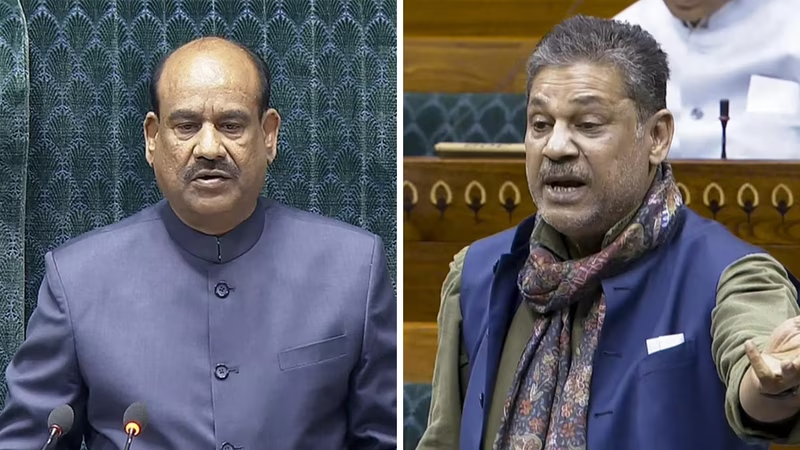
In a moment that blurred the line between political drama and public health policy, the hallowed halls of India’s Lok Sabha were rocked by an unusual scandal: veteran MP Kirti Azad has been accused of vaping inside Parliament. The alleged act—captured in what appears to be a mobile phone video circulating among journalists—prompted an immediate and stern rebuke from Lok Sabha Speaker Om Birla, who declared, “We have to maintain decorum,” and confirmed that “action will be taken soon” .
This incident isn’t just about nicotine or personal habit—it strikes at the heart of institutional integrity, public trust, and the symbolic sanctity of India’s highest legislative forum. As the nation watches, the question looms: what happens when a lawmaker breaks the very rules they’re sworn to uphold?
Table of Contents
- The Incident: What Happened Inside the Lok Sabha?
- Kirti Azad Vaping Parliament: Speaker Om Birla’s Response
- Parliamentary Rules on Conduct and Discipline
- Why This Is More Than Just a Vaping Issue
- Public and Political Reactions: A Nation Divided
- Conclusion: Decorum as Democracy’s Backbone
- Sources
The Incident: What Happened Inside the Lok Sabha?
According to multiple sources within Parliament, during a heated debate on January 12, 2026, Kirti Azad—seated in the Trinamool Congress (TMC) benches—was seen discreetly using a vaping device. While not producing large clouds of vapor, the act was reportedly noticed by opposition MPs and gallery observers .
A short video clip, though not officially verified by Parliament authorities, began circulating on messaging platforms, showing a figure resembling Azad holding a slim, pen-like device near his mouth. Whether it was a nicotine vape, a flavored e-cigarette, or even a stress-relief inhaler remains unconfirmed—but the perception alone was enough to trigger a formal complaint.
Kirti Azad Vaping Parliament: Speaker Om Birla’s Response
Speaker Om Birla did not mince words. During the Question Hour, he addressed the House directly: “The dignity of this institution must be preserved. Any act that undermines decorum will be dealt with under the established rules.” He added that the matter had been referred to the Committee of Privileges for review and that “appropriate action will follow soon” .
Birla’s swift condemnation underscores a broader effort to enforce discipline in an increasingly polarized parliamentary environment. In recent years, disruptions, walkouts, and even physical altercations have tested the limits of legislative decorum. This incident, while seemingly minor, is being treated as a symbolic test case.
Parliamentary Rules on Conduct and Discipline
The Lok Sabha operates under strict guidelines outlined in the Rules of Procedure and Conduct of Business in Lok Sabha. Key provisions include:
- Rule 380: Empowers the Speaker to order the withdrawal of any member whose conduct is “grossly disorderly.”
- Rule 381: Allows for suspension of a member for the remainder of the session for repeated misconduct.
- Committee of Privileges: Can recommend penalties ranging from censure to fines or even expulsion in extreme cases.
While vaping isn’t explicitly mentioned, it falls under “unparliamentary behavior” that distracts from proceedings or disrespects the institution’s solemnity. Notably, smoking has been banned inside Parliament since 2009—and vaping, though newer, is widely considered part of that prohibition.
Why This Is More Than Just a Vaping Issue
At its core, this controversy reflects deeper tensions:
- Public Health vs. Personal Freedom: India has tightened regulations on e-cigarettes under the Prohibition of Electronic Cigarettes Act (2019). An MP flouting such norms—even symbolically—sends mixed messages.
- Institutional Credibility: When lawmakers violate rules, it erodes public faith in governance. A 2025 CSDS survey found that 68% of Indians believe MPs “don’t respect parliamentary norms” .
- Political Theater: Critics argue the opposition seized on a minor act to embarrass the TMC, while supporters claim it’s a legitimate stand for institutional integrity.
Public and Political Reactions: A Nation Divided
Reactions poured in swiftly. BJP leaders called it “disgraceful,” while TMC distanced itself, stating Azad would “clarify his position.” Social media exploded—some mocked the “nicotine scandal,” while others defended Azad, citing stress and long sitting hours.
Health advocates, however, saw a teachable moment. “If vaping is banned for citizens, why should MPs be exempt?” asked Dr. Rekha Singh of the Indian Public Health Association. For more on legislative ethics, see our analysis on [INTERNAL_LINK:parliamentary-accountability-in-india].
Conclusion: Decorum as Democracy’s Backbone
The Kirti Azad vaping Parliament episode may seem trivial on the surface, but it’s a litmus test for how India treats its democratic institutions. As Om Birla rightly insists, decorum isn’t about rigidity—it’s about mutual respect, focus, and the collective responsibility to govern wisely. Whether this leads to a formal reprimand or fades into political noise, one thing is clear: the people are watching, and they expect better.
Sources
Our reporting is based on official statements from the Lok Sabha Secretariat and verified news reports. For authoritative context on parliamentary procedures, we reference the Official Website of the Lok Sabha, Government of India.
- Times of India. “‘Have to maintain decorum’: Om Birla slams Kirti Azad for vaping inside Parliament; adds ‘action soon’.” January 12, 2026.
- Lok Sabha Rules of Procedure and Conduct of Business.
- Prohibition of Electronic Cigarettes Act, 2019 – Ministry of Health and Family Welfare.
- CSDS-Lokniti National Perception Survey on Parliamentary Behavior, 2025.