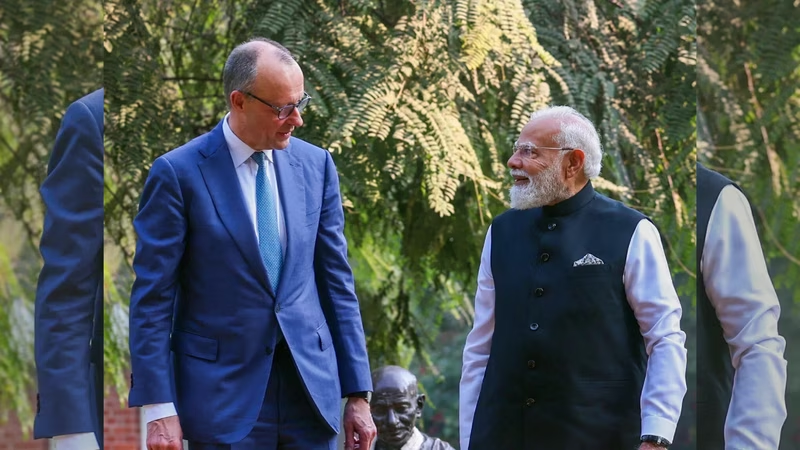
Move over, old alliances—there’s a new economic power couple in town. In a high-stakes summit in Ahmedabad on Monday, January 12, 2026, Indian Prime Minister Narendra Modi and newly appointed German Chancellor Friedrich Merz didn’t just shake hands; they laid the blueprint for a transformative partnership that could redefine global supply chains, clean energy, and technological innovation.
At the core of this historic engagement? A booming India-Germany trade relationship that has officially crossed the **$50 billion** mark—and shows no signs of slowing down . With over **2,000 German companies already operating in India**, from industrial giants like Siemens and Bosch to niche engineering firms, this isn’t just diplomacy—it’s deep economic integration in action.
Table of Contents
- The Ahmedabad Summit: A Strategic Inflection Point
- India-Germany Trade by the Numbers
- The Centre of Excellence: A Game-Changer for Tech and Clean Energy
- Why German Companies Are Betting Big on India
- Geopolitical Implications of a Stronger Indo-German Alliance
- Conclusion: From Factory Floors to Future Tech
- Sources
The Ahmedabad Summit: A Strategic Inflection Point
The choice of Ahmedabad as the venue was no accident. As the economic nerve center of Gujarat—and home to some of India’s most advanced manufacturing clusters—the city symbolizes the “Make in India” ethos that resonates deeply with German industry’s precision-engineering culture.
During the summit, PM Modi and Chancellor Merz were joined by a powerhouse delegation of CEOs from both nations. The message was clear: this partnership is driven not just by governments, but by the private sector. “Our shared values of innovation, sustainability, and skilled workforce development make this alliance natural,” said Modi during the joint address .
India-Germany Trade by the Numbers
The $50 billion bilateral trade figure is more than just a milestone—it’s a springboard. Here’s a closer look at what’s driving it:
- German Exports to India: Machinery, automotive parts, chemicals, and medical equipment dominate, reflecting India’s infrastructure and healthcare expansion.
- Indian Exports to Germany: Pharmaceuticals, textiles, IT services, and increasingly, electric vehicle components are gaining traction.
- Investment Flow: Germany is among the top 10 foreign investors in India, with cumulative FDI exceeding $15 billion since 2000 .
- Employment Impact: German firms in India employ over 800,000 people directly, with millions more in ancillary industries .
The Centre of Excellence: A Game-Changer for Tech and Clean Energy
Perhaps the most forward-looking outcome of the summit is the agreement to establish an India-Germany Centre of Excellence. This hub will focus on three critical areas:
- Green Hydrogen & Renewable Integration: Joint R&D on scalable green hydrogen production, a key pillar of both nations’ net-zero strategies.
- Advanced Manufacturing: Leveraging Industry 4.0 technologies like AI-driven automation and digital twins.
- <Skill Development: Creating certified training programs to build a future-ready workforce in engineering and clean tech.
This initiative mirrors successful models like the Indo-French Centre for Climate Research but with a sharper industrial focus. For deeper insights into international clean energy partnerships, see [INTERNAL_LINK:global-clean-energy-alliances].
Why German Companies Are Betting Big on India
German industry leaders aren’t just investing—they’re relocating entire value chains to India. Reasons include:
- Diversification Away from China: The “China+1” strategy has accelerated, with India emerging as the preferred alternative for high-quality manufacturing.
- Skilled, Cost-Competitive Talent: India’s engineering graduates and IT professionals offer world-class skills at competitive costs.
- Policy Stability: Reforms like the Production-Linked Incentive (PLI) scheme provide long-term predictability for investors.
Geopolitical Implications of a Stronger Indo-German Alliance
Beyond commerce, this partnership carries strategic weight. As Europe seeks reliable partners amid global uncertainty, India offers a democratic, growth-oriented counterbalance. Meanwhile, India gains access to cutting-edge European technology and a powerful voice in EU policy circles. It’s a symbiotic relationship that strengthens both nations’ positions on the world stage.
Conclusion: From Factory Floors to Future Tech
The Modi-Merz summit marks more than a diplomatic photo-op—it’s the ignition of a high-value, future-focused economic engine. With India-Germany trade already at $50 billion and a Centre of Excellence poised to drive innovation in clean energy and advanced manufacturing, this alliance is set to become a cornerstone of 21st-century global commerce. For businesses, policymakers, and citizens alike, the message is clear: the India-Germany corridor is open for business—and the future is being built together.
Sources
Our analysis draws on official statements from the Prime Minister’s Office and the German Federal Chancellery. For verified trade statistics and investment data, we reference the Germany Trade & Invest (GTAI) portal, a government-backed authority on German international business.
- Times of India. “India-Germany trade: PM Modi, German chancellor Merz meet CEOs; aim to boost economic ties.” January 12, 2026.
- Official joint statement, PMO India & German Federal Chancellery.
- Germany Trade & Invest (GTAI) – FDI and company presence data.