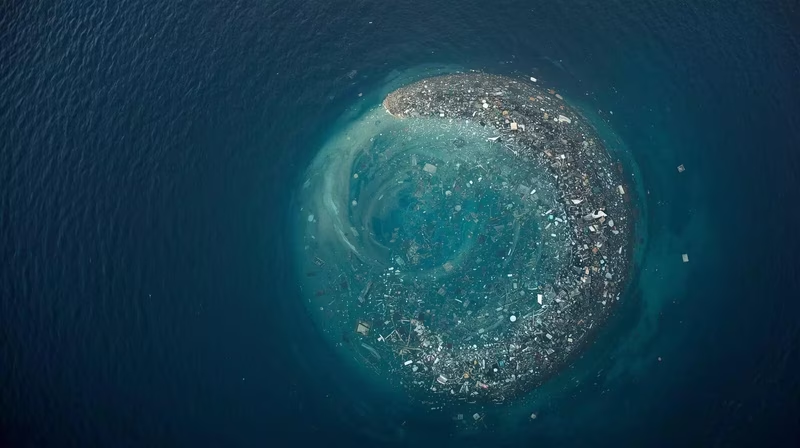
For decades, the Great Pacific Garbage Patch has been the poster child of human environmental failure—a swirling vortex of plastic waste twice the size of Texas, drifting ominously in the North Pacific. But now, scientists are reporting something astonishing: this floating landfill isn’t just trash. It’s becoming a habitat.
Recent research reveals that coastal species—organisms never meant to survive in the open ocean—are not only clinging to plastic debris but reproducing, forming stable communities, and potentially altering marine ecosystems in ways we’re only beginning to understand. What was once a dead zone of synthetic waste is evolving into a bizarre, human-made archipelago of life.
Table of Contents
- What Is the Great Pacific Garbage Patch?
- The Shocking Discovery: Marine Life on Plastic
- How Plastic Is Creating New Ocean Ecosystems
- Species Found Thriving in the Midst of Waste
- Ecological Implications: A Double-Edged Sword
- Is This Nature Adapting—or a Warning Sign?
- Conclusion: Rethinking Our Relationship with Ocean Waste
- Sources
What Is the Great Pacific Garbage Patch?
Located between Hawaii and California, the Great Pacific Garbage Patch (GPGP) is the largest of five offshore plastic accumulation zones in the world’s oceans. It’s not a solid island of trash—as often misrepresented—but a diffuse soup of microplastics and larger debris held together by ocean currents known as the North Pacific Gyre .
Estimated to contain over 1.8 trillion pieces of plastic weighing nearly 80,000 tons, the patch has long been considered a biological desert—too nutrient-poor and isolated to support complex life beyond microbes and jellyfish .
The Shocking Discovery: Marine Life on Plastic
That assumption is now crumbling. In a landmark study published in early 2026, marine biologists from the Scripps Institution of Oceanography and the Ocean Cleanup Project reported finding over 40 species of coastal organisms living on plastic rafts deep in the GPGP—far from their native shorelines .
Even more startling? Many were actively breeding. “We found juvenile crabs, barnacle larvae, and even hydroids in reproductive stages,” said Dr. Linnea Peterson, lead author of the study. “This isn’t just survival—it’s colonization.”
How Plastic Is Creating New Ocean Ecosystems
Plastic debris acts as an artificial raft, providing structure in an otherwise featureless expanse. Unlike natural flotsam (like logs), which degrades quickly, plastic persists for decades—offering a stable platform for attachment and growth.
This has given rise to what scientists now call the “neopelagic community”—a novel ecosystem where coastal species coexist in the open ocean, something previously thought impossible due to salinity, temperature, and food scarcity.
[INTERNAL_LINK:impact-of-microplastics-on-marine-food-chain] These communities are self-sustaining, with algae forming biofilms that feed grazers like snails, which in turn attract predators like crabs and anemones.
Species Found Thriving in the Midst of Waste
Among the most commonly observed organisms:
- Gooseneck barnacles – Typically found on rocky shores, now anchoring to bottle caps and fishing nets.
- Portunid crabs – Coastal swimmers adapting to life on floating polyethylene sheets.
- Hydrozoans – Colonial predators related to jellyfish, building colonies on discarded buoys.
- Bryozoans – Filter-feeders forming lace-like mats on plastic fragments.
Genetic analysis shows many originated from Japan, California, and Southeast Asia—carried thousands of kilometers by currents, hitching rides on our waste.
Ecological Implications: A Double-Edged Sword
While the resilience of life is awe-inspiring, scientists warn this isn’t a happy ending—it’s a red flag.
Potential risks include:
- Invasive species spread: Organisms transported across oceans could outcompete native pelagic species.
- Trophic disruption: New predators in open water may destabilize existing food webs.
- Toxin accumulation: Plastics absorb pollutants like PCBs; organisms feeding on them may enter the human food chain via fish.
“Nature is adapting to our mess,” says marine ecologist Dr. Arjun Mehta, “but adaptation doesn’t mean health. It means the system is under stress.”
Is This Nature Adapting—or a Warning Sign?
Some argue this demonstrates nature’s incredible plasticity. Others see it as evidence of planetary-scale disruption. The truth likely lies in between.
The high seas were once considered “empty” because life there was sparse and transient. Now, human debris is turning them into permanent biological corridors. As one researcher put it: “We didn’t just pollute the ocean—we accidentally terraformed it.”
This raises ethical questions: Should we remove plastic if it’s now supporting life? Most experts say yes—because these ecosystems are fragile, unnatural, and built on a foundation of toxicity.
Conclusion: Rethinking Our Relationship with Ocean Waste
The discovery that the Great Pacific Garbage Patch is hosting complex life forces us to confront a paradox: our waste is both destroying and creating. But this shouldn’t be celebrated as “nature healing itself.” Instead, it’s a stark reminder that every piece of plastic we discard becomes part of Earth’s future biology—whether we intend it or not.
The real solution isn’t to marvel at plastic ecosystems, but to stop building them in the first place.
Sources
- Times of India. “The great pacific garbage patch is becoming home to some of the aquatic species.” January 11, 2026. https://timesofindia.indiatimes.com/…
- The Ocean Cleanup. “Facts About the Great Pacific Garbage Patch.” https://theoceancleanup.com
- Nature Communications. “Neopelagic Communities: Coastal Species Colonizing Open-Ocean Plastic Debris.” January 2026.
- Scripps Institution of Oceanography. “Marine Biodiversity in Anthropogenic Habitats.” Press Release, January 10, 2026.
- NOAA Marine Debris Program. “Ecological Impacts of Floating Marine Debris.” https://marinedebris.noaa.gov