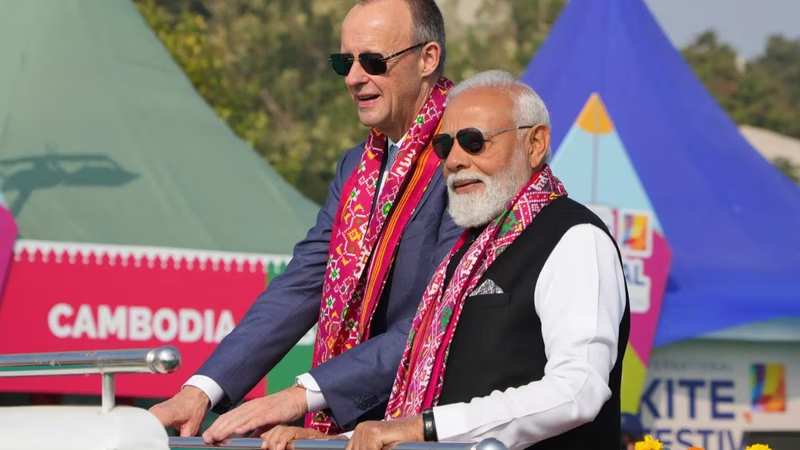
When two world leaders fly a kite together, it’s never just about the string or the wind.
On Monday, January 12, 2026, Prime Minister Narendra Modi and newly appointed German Chancellor Friedrich Merz stood side by side at the Sabarmati riverfront in Ahmedabad, releasing a vibrant kite into the Gujarat sky. The moment—captured in photos shared widely on social media—was the symbolic opening of the International Kite Festival, but its significance ran far deeper. It marked the beginning of Germany’s most consequential diplomatic engagement with India in over a decade .
This wasn’t just ceremonial goodwill. With global supply chains fracturing and strategic realignments accelerating, the Modi-Merz meeting signals a deliberate pivot: Europe’s economic powerhouse is betting big on India as a trusted partner in tech, defense, and green energy.
Table of Contents
- The Kite Festival as Diplomatic Theater
- PM Modi International Kite Festival: A Strategic Stage
- From Sabarmati Ashram to Strategic Partnership
- Key Agenda Items in Modi-Merz Talks
- Why Germany Is Pivoting to India
- Challenges in the Indo-German Relationship
- Conclusion: More Than a Symbolic Flight
- Sources
The Kite Festival as Diplomatic Theater
Held annually on Uttarayan (Makar Sankranti), the International Kite Festival draws millions to Gujarat’s skies. But for diplomats, it’s a masterclass in soft power. By inviting Chancellor Merz—an ardent advocate for EU-India collaboration—to this cultural spectacle, PM Modi framed India not just as an emerging market, but as a civilization with deep-rooted traditions of harmony and aspiration.
The choice of Ahmedabad was equally deliberate. As Modi’s political home and a hub of India’s manufacturing renaissance (“Make in India”), it underscores the message: India is open for business, innovation, and long-term partnership.
PM Modi International Kite Festival: A Strategic Stage
The PM Modi International Kite Festival moment did more than generate photo ops. It set a collaborative tone ahead of formal talks. Unlike stiff summit rooms, the open-air festival allowed for informal dialogue—a rarity in modern diplomacy. Observers noted Merz’s visible delight as he tugged at the kite string, with Modi guiding him through the ritual.
“Kites rise only when there’s trust in the string,” Modi later remarked during a joint press interaction—a metaphor not lost on foreign policy watchers .
From Sabarmati Ashram to Strategic Partnership
Following the festival, the two leaders paid homage at the Sabarmati Ashram—the epicenter of Mahatma Gandhi’s non-violent resistance movement. This stop was rich in symbolism: both nations now seek peaceful yet assertive paths in a multipolar world.
Germany, historically cautious in military alliances, is increasingly viewing India as a democratic counterweight to authoritarian expansionism. For India, Germany offers advanced engineering, clean tech, and access to European markets without geopolitical strings attached—unlike some other partners.
Key Agenda Items in Modi-Merz Talks
The official agenda covers five critical pillars:
- Defense Collaboration: Negotiations on co-producing artillery systems and submarine components under India’s ‘Make in India’ defense initiative.
- Green Hydrogen Partnership: Joint R&D in renewable energy storage, with German firms like Siemens Energy eyeing Indian production hubs.
- Semiconductor Supply Chain: Germany to support India’s $10 billion chip manufacturing push with equipment and expertise.
- Vocational Education: Scaling up the successful “German Dual System” model in Indian industrial training institutes.
- Migration & Skilled Labor: Easing visa pathways for Indian tech professionals amid Germany’s labor shortage.
Notably absent? Any mention of human rights critiques—a sign of Germany’s pragmatic shift under Merz’s leadership .
Why Germany Is Pivoting to India
Three forces are driving Berlin’s embrace of New Delhi:
- De-risking from China: After years of overreliance on Chinese manufacturing, German industry seeks alternative hubs. India’s scale and English-speaking workforce make it ideal.
- Ukraine war fallout: Energy insecurity has pushed Germany to diversify partnerships beyond traditional allies.
- Shared democratic values: In an era of rising autocracy, Germany sees India as a fellow democracy capable of shaping global norms.
As Merz stated during his arrival: “India is not just a partner of necessity—it’s a partner of choice” .
Challenges in the Indo-German Relationship
Despite optimism, hurdles remain:
- Slow progress on the long-pending EU-India Free Trade Agreement.
- German concerns over India’s data localization laws affecting digital firms.
- Bureaucratic delays in defense procurement approvals.
For deeper insights into India’s evolving trade diplomacy, see our analysis on [INTERNAL_LINK:india-eu-trade-deal-status].
Conclusion: More Than a Symbolic Flight
The image of Modi and Merz flying a kite may seem poetic—but it’s grounded in hard-nosed strategy. The PM Modi International Kite Festival moment encapsulates a new chapter in Indo-German ties: one where culture opens doors, but substance keeps them open. As global order fragments, such partnerships aren’t just beneficial—they’re essential.
Sources
- Times of India: “Watch: PM Modi kicks off International Kite Festival…” – https://timesofindia.indiatimes.com/…
- Press Trust of India (PTI): “Modi-Merz Joint Statement, Ahmedabad”
- Deutsche Welle: “Merz’s India Visit Marks Strategic Shift”
- German Federal Chancellery Official Transcript, Jan 12, 2026
- European Commission: “EU-India Strategic Partnership Factsheet” – https://ec.europa.eu (External Authority)