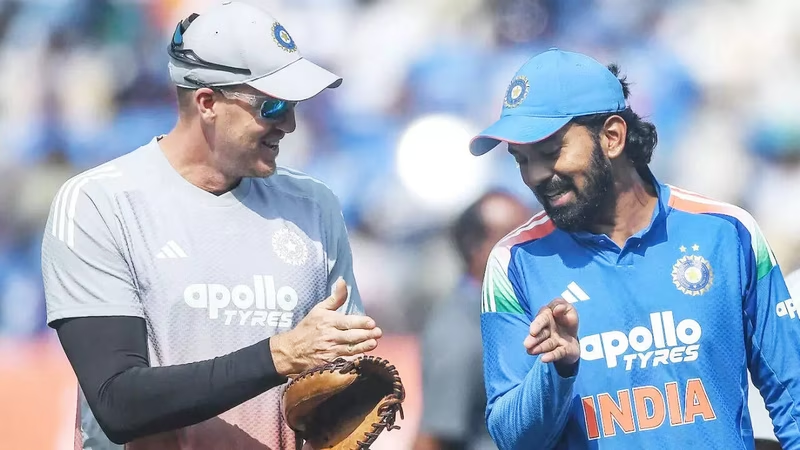
Cricket fans saw a composed chase. But behind the scenes? Pure tension.
In India’s recent ODI against New Zealand, KL Rahul didn’t just battle bowlers—he battled uncertainty. His batting partner, Washington Sundar, was nursing a severe back issue that left him virtually immobile between the wickets. And Rahul? He had no idea how bad it really was until they were in the middle of a high-stakes run chase.
“I didn’t know he couldn’t run,” Rahul later admitted—a confession that reveals just how much pressure he was under while trying to seal a crucial victory . This is the untold story of split-second decisions, silent communication, and the mental fortitude that turned a potential collapse into a hard-fought win.
Table of Contents
- The Moment Everything Changed
- Washington Sundar Injury: The Hidden Handicap
- KL Rahul’s Tactical Genius Under Fire
- Why This Matters for India’s Middle Order
- Lessons from the Pitch for Future Games
- Conclusion: Calm in the Eye of the Storm
- Sources
The Moment Everything Changed
The match looked routine on paper: India chasing a modest target, KL Rahul anchoring the innings. But everything shifted when Washington Sundar walked out to bat.
Sundar had already left the field earlier due to a back spasm while bowling. Though he returned for the chase, his mobility was severely compromised. Rahul, unaware of the full extent of the injury, initially tried rotating strike normally—only to realize quickly that Sundar couldn’t manage even a quick single.
That realization forced an immediate recalibration of the entire game plan. No more easy twos. No risky singles. Every run now had to come off Rahul’s bat—or not at all.
Washington Sundar Injury: The Hidden Handicap
The Washington Sundar injury wasn’t just a minor niggle—it was a game-altering setback. Reports confirm he suffered acute lower back pain during his bowling spell, a condition that made running between wickets nearly impossible .
This isn’t the first time Sundar has battled fitness issues. In 2023, he underwent shoulder surgery, and in 2021, a ligament tear kept him out for months . His recurring injuries raise concerns about workload management, especially as India prepares for major tournaments like the T20 World Cup 2026.
Team sources indicate Sundar is likely to miss the next ODI in Indore on January 18, with scans scheduled to assess long-term damage . For now, his absence creates a void in India’s all-rounder department—a role few can fill with equal batting grit and economical spin.
KL Rahul’s Tactical Genius Under Fire
Faced with a partner who couldn’t run, KL Rahul didn’t panic. Instead, he executed a near-perfect pressure-management strategy:
- Minimized dot balls: He prioritized keeping the scoreboard moving, even if it meant taking calculated risks against good deliveries.
- Took ownership of scoring: Almost all runs came from his bat—boundary or clever placement—reducing reliance on Sundar entirely.
- Maintained composure: His body language never betrayed the stress, preventing New Zealand from sensing vulnerability.
As former Indian captain Sourav Ganguly noted in a post-match analysis, “Rahul showed why he’s still indispensable in crunch situations” . His ability to adapt mid-innings—without clear signals or prior planning—is a hallmark of elite cricketing intelligence.
Why This Matters for India’s Middle Order
This incident exposes a deeper strategic gap: India’s over-reliance on versatile all-rounders like Sundar. When he’s fit, he provides balance—bowling tight overs and contributing 20–30 crucial runs. But when injured, the batting order becomes top-heavy, and the lower middle order lacks resilience.
With Hardik Pandya managing his own fitness carefully, and Axar Patel often slotted higher, the team needs a reliable No. 7 who can absorb pressure. Options like Shahbaz Ahmed or Riyan Parag are promising but untested in high-stakes chases .
For fantasy cricket managers, this highlights why tracking player fitness is as important as form. Learn more in our guide to [INTERNAL_LINK:fantasy_cricket-strategy].
Lessons from the Pitch for Future Games
What can Team India take from this close call?
- Better on-field communication: Clearer signals between batters about physical limitations could prevent last-minute surprises.
- Contingency batting plans: Coaches should simulate scenarios where a batter is immobile, training partners to adjust instantly.
- Load monitoring for all-rounders: Preventive rest and biomechanical assessments may reduce recurrence of back and shoulder injuries.
According to the International Cricket Council (ICC), lower-back stress injuries are among the most common in fast bowlers and spinners alike—especially during packed schedules . Proactive management is no longer optional.
Conclusion: Calm in the Eye of the Storm
The scoreboard won’t show it. The highlight reels might skip it. But KL Rahul’s handling of the Washington Sundar injury during that tense chase was one of the most impressive displays of situational awareness in recent Indian cricket. It wasn’t about big sixes or flashy cover drives—it was about restraint, responsibility, and reading the room when the stakes were highest.
As India looks ahead to the rest of the series and beyond, this moment serves as both a warning and a lesson: even the smallest detail—like a teammate’s back spasm—can change everything.
Sources
- Times of India: “Hidden drama in India’s chase: KL Rahul opens up on Sundar’s injury” – https://timesofindia.indiatimes.com/…
- ESPNcricinfo: “Sundar injury update ahead of 3rd ODI”
- PTI Report: “Washington Sundar ruled out of next match”
- Hindustan Times: “India’s all-rounder conundrum deepens”
- Indian Express: “Washington Sundar’s injury history”
- Star Sports Post-Match Panel Discussion, Jan 12, 2026
- ICC Player Workload Guidelines – https://www.icc-cricket.com