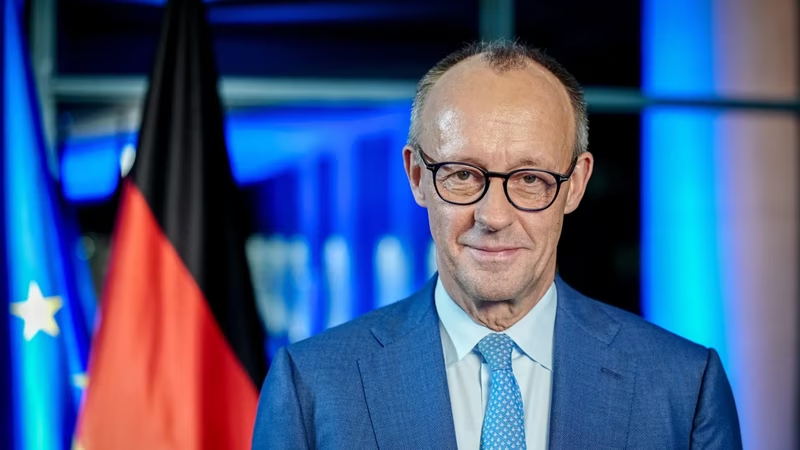
In a significant moment for global diplomacy, German Chancellor Friedrich Merz touched down in India on Monday, January 12, 2026, marking the beginning of his very first official visit to the world’s largest democracy . This two-day trip is far more than a ceremonial stop; it’s a strategic mission to deepen the already robust India-Germany relationship at a time when both nations are navigating a complex geopolitical landscape.
From the symbolic grounds of the Sabarmati Ashram to the high-stakes conference rooms of Gandhinagar, Merz’s itinerary is meticulously designed to blend cultural homage with hard-nosed negotiations on trade, cutting-edge technology, and crucial defense cooperation. The stakes couldn’t be higher.
Table of Contents
- A First Visit with Huge Stakes
- The Symbolism of Sabarmati and the Kite Festival
- The Core Agenda: Trade, Tech, and Defense
- Why the German Chancellor is Betting on India
- Challenges and Opportunities Ahead
- Conclusion: A Partnership Poised for Growth
- Sources
A First Visit with Huge Stakes
Friedrich Merz’s arrival in Ahmedabad is a powerful signal from Berlin. As the newly elected leader of Europe’s largest economy, his choice to make India one of his first international destinations speaks volumes about where Germany sees its future. This visit builds upon a series of high-level interactions between the two countries, including President Frank-Walter Steinmeier’s trip to India in 2024 and multiple ministerial exchanges .
The meeting with Prime Minister Narendra Modi is the centerpiece of this trip. It’s an opportunity for the two leaders to move beyond general statements of friendship and forge concrete, actionable plans that benefit both economies and enhance their strategic autonomy on the world stage.
The Symbolism of Sabarmati and the Kite Festival
Before diving into the nitty-gritty of bilateral talks, Merz and PM Modi will pay a joint visit to the historic Sabarmati Ashram, the epicenter of Mahatma Gandhi’s non-violent freedom struggle. This isn’t just a photo op; it’s a deliberate nod to the shared democratic values that underpin the India-Germany partnership .
Following this, they will attend the vibrant International Kite Festival in Ahmedabad. In a world often fraught with tension, this shared cultural experience serves as a gentle reminder of the human connection and mutual respect that can form the bedrock of a strong political and economic alliance. It’s a masterstroke in soft diplomacy.
The Core Agenda: Trade, Tech, and Defense
The real work begins in Gandhinagar, where the formal bilateral talks will take place. The agenda is packed with three critical pillars:
- Trade & Investment: Both nations are looking to significantly boost their trade volume, which stood at over €25 billion in 2024. Key areas include renewable energy, automotive manufacturing (especially electric vehicles), and pharmaceuticals. Germany is keen to diversify its supply chains away from over-reliance on China, and India presents a massive, skilled, and growing market .
- Technology & Innovation: Collaboration in green hydrogen, artificial intelligence, and semiconductor manufacturing is expected to be a major focus. Germany’s advanced engineering prowess combined with India’s vast IT talent pool could create a formidable innovation engine .
- Defense Cooperation: This is perhaps the most sensitive and strategically important area. Discussions are likely to revolve around potential defense deals, including the long-pending proposal for India to acquire German submarines. Strengthening defense ties is a clear signal of a deepening strategic trust between the two democracies .
Why the German Chancellor is Betting on India
For the German Chancellor, this pivot towards India is a calculated and necessary strategy. Europe is facing immense pressure from an assertive Russia and an increasingly competitive China. India, as a fellow democracy with a rapidly growing economy and a strategic location in the Indo-Pacific, is a natural partner for Germany to counterbalance these forces.
Furthermore, India’s ambitious “Make in India” and “Atmanirbhar Bharat” (Self-Reliant India) initiatives align well with Germany’s own industrial policy goals. By investing in India’s manufacturing sector, German companies can not only access a huge domestic market but also use India as a stable export hub for the wider region. [INTERNAL_LINK:india-as-global-manufacturing-hub] is a narrative that resonates strongly in Berlin.
Challenges and Opportunities Ahead
Despite the optimistic outlook, the path forward isn’t without hurdles. Bureaucratic delays, complex regulatory environments, and differing business cultures have sometimes slowed down previous collaborations. On the defense front, finalizing major deals like the submarine acquisition requires navigating intricate political and financial approvals on both sides.
However, the current political will at the highest levels seems stronger than ever. The personal rapport between the leaders and the clear strategic alignment on global issues provide a solid foundation to overcome these operational challenges.
Conclusion: A Partnership Poised for Growth
The arrival of the German Chancellor in India marks a pivotal moment in the bilateral relationship. This visit is a clear declaration that Germany sees India not just as a market, but as a critical strategic partner for the 21st century. The outcomes of the Modi-Merz talks in Gandhinagar will set the tone for a new era of Indo-German cooperation, one that could reshape trade flows, accelerate technological innovation, and contribute to a more stable and balanced global order. All eyes are on Gujarat as this historic partnership takes its next decisive step.
Sources
- Times of India: German Chancellor arrives in India: Merz begins first official visit
- Federal Foreign Office of Germany: Germany and India: Strategic Partners [[5], [15]]
- Ministry of External Affairs, India: India-Germany Bilateral Brief [[10], [18], [20]]
- European Commission: EU-India Relations (for broader context on EU-India trade)