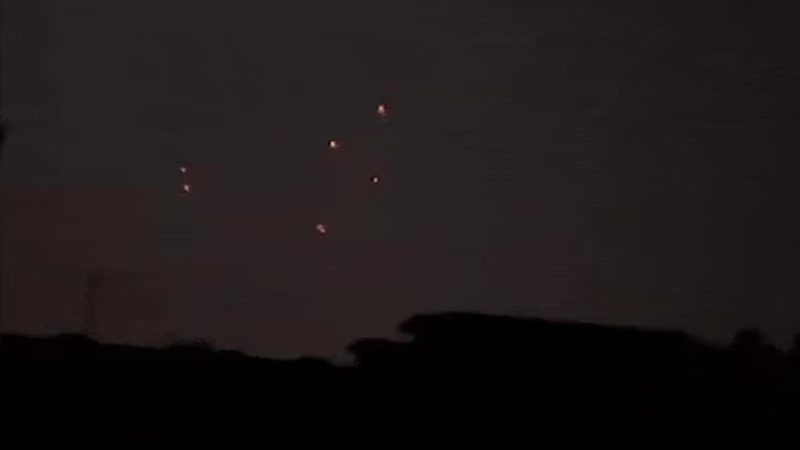
The serene skies over Jammu and Kashmir’s forward areas turned into a tense theatre of a new-age conflict on Sunday evening. Multiple suspected Pakistani drones were spotted breaching Indian airspace along the International Border (IB) and the Line of Control (LoC), sending security forces into high alert across the districts of Samba, Rajouri, and Poonch .
This isn’t an isolated incident but part of a worrying and persistent trend that has redefined the nature of cross-border threats. The sight of these unmanned aerial vehicles hovering over sensitive military installations is no longer just a security nuisance; it’s a direct challenge to India’s sovereignty. So, what do these latest incursions mean for the region’s stability?
Table of Contents
- The Latest Incident: A Coordinated Probe?
- A Growing Menace: The Rise of Pakistani Drones
- Why Are These Drones a Major Threat?
- India’s Evolving Counter-Drone Strategy
- Conclusion: A New Normal on the Border?
- Sources
The Latest Incident: A Coordinated Probe?
According to official reports, security forces observed at least five separate drone movements across the forward areas of Samba, Rajouri, and Poonch districts on the evening of January 11, 2026 . In one specific instance, a drone-like object was tracked moving from Tain towards Topa in the Mankote sector of Poonch district at around 6:25 PM .
The objects were seen hovering for a few minutes before retreating back across the border. This brief but deliberate presence triggered immediate ground search operations and, in some locations, prompted troops to open fire using light and medium machine guns as a deterrent . The swift activation of counter-drone measures highlights the military’s preparedness for such intrusions .
A Growing Menace: The Rise of Pakistani Drones
The recent sightings are not a one-off event but a continuation of a deeply concerning pattern. The year 2025 saw a staggering 791 reported drone intrusions along India’s western border with Pakistan, a figure that underscores the scale of this new threat vector .
A major flashpoint occurred in April 2025, when India intercepted over 600 drones across 30 different locations in a single coordinated attempt, which many analysts believe marked a turning point in the shadow war . This relentless use of UAVs by elements from across the border has forced India to completely rethink its border security doctrine.
Why Are These Drones a Major Threat?
The primary concern isn’t just surveillance. While gathering intelligence on troop movements and installations is a key objective, the more sinister purpose is the smuggling of contraband. These drones are increasingly being used as aerial mules to ferry weapons, narcotics, and even communication equipment to support terrorist activities within Indian territory .
Their small size, low-altitude flight, and ability to operate under the radar (sometimes literally) make them incredibly difficult to detect and intercept with conventional air defence systems. This asymmetry gives a non-state actor or a hostile state a cheap and effective tool to destabilize a region.
India’s Evolving Counter-Drone Strategy
Faced with this persistent threat, the Indian military has been forced to innovate rapidly. The strategy now involves a multi-layered approach:
- Detection and Tracking: Deploying a network of RF detectors, radar systems, and electro-optical sensors to create a comprehensive airspace picture along the border.
- Soft Kill Measures: Using sophisticated jammers to disrupt the drone’s communication link with its operator, forcing it to land or return.
- Hard Kill Measures: Employing kinetic solutions like the indigenous Man Portable Counter Drone System (MPCDS) installed in the Akhnoor sector, or simply using small arms fire as a last resort .
- Physical Barriers: Bolstering the Anti-Infiltration Obstacle System (AIOS) with these new technologies to create a more robust defensive line .
Conclusion: A New Normal on the Border?
The repeated incursions of Pakistani drones over Jammu and Kashmir represent a fundamental shift in the tactics of hybrid warfare. It’s a low-cost, high-impact strategy that exploits technological gaps. For India, the response must be equally agile and technologically advanced.
While the successful detection and engagement of these drones in Rajouri and Poonch demonstrate improved readiness, the sheer volume of attempts suggests this is a long-term problem. The security of the LoC is no longer just about the ground; it’s a three-dimensional battle that extends into the skies above. The Indian armed forces are clearly engaged in this new front, but the war for control of the airspace is far from over.
Sources
- Times of India: J&K: Suspected Pak drones spotted along LoC, IB near Samba, Rajouri and Poonch districts
- Ministry of Defence Data: Reported 791 drone intrusions in 2025
- Security Analysis: Details on the April 2025 mass drone incursion
- Indian Army Statements: On counter-drone measures and engagements [[19], [24], [25]]
- Brookings Institution: The Future of Warfare in a World of Drones (for context on global drone warfare trends)