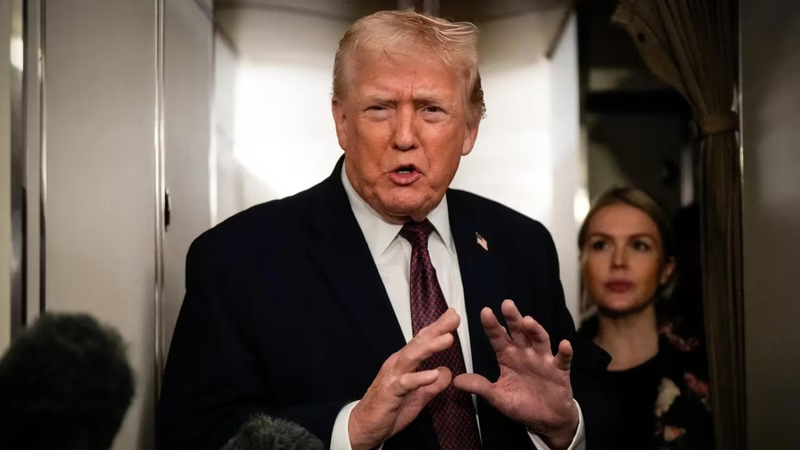
In a dramatic twist that could reshape Middle East geopolitics, former President Donald Trump has claimed that Iranian leaders are now eager to negotiate with the United States—amid intensifying domestic unrest and fears of a brutal government crackdown .
Speaking from his Mar-a-Lago estate, Trump declared, “We may have to act,” suggesting that while diplomacy might be possible, military options remain firmly on the table if Iran continues its violent suppression of protesters . This latest development throws a spotlight on a volatile moment in US-Iran relations—one where humanitarian crisis, regime survival, and great-power brinkmanship collide.
But is this a genuine opening for peace, or just another round of high-stakes political theater? Let’s unpack what’s really happening on the ground in Iran, what Trump’s claims mean, and whether a Trump Iran negotiation is even feasible.
Table of Contents
- The Iran Protest Crisis: A Nation in Revolt
- Trump’s Bold Claim: “Iran Wants to Talk”
- US Military Options: From Sanctions to Strikes
- History of Trump-Iran Negotiation Efforts
- What Does Tehran Really Want?
- Conclusion: A Perilous Crossroads for Diplomacy
- Sources
The Iran Protest Crisis: A Nation in Revolt
Since early January 2026, cities across Iran—from Tehran to Mashhad—have erupted in mass demonstrations triggered by economic hardship, political repression, and anger over the regime’s handling of civil liberties . Unlike previous uprisings, these protests appear more decentralized and youth-driven, with social media playing a critical role despite government internet blackouts.
Iran’s security forces, including the feared Islamic Revolutionary Guard Corps (IRGC), have responded with lethal force. Reports from human rights groups indicate dozens killed and thousands arrested . The US State Department has condemned the violence, and senior officials are reportedly considering targeted strikes against IRGC units directly involved in the crackdown—a move that would dramatically escalate tensions .
Trump’s Bold Claim: “Iran Wants to Talk”
Against this backdrop, Trump’s assertion that “Iran called us—they want to negotiate” has raised eyebrows in Washington and Tehran alike. While he offered no verifiable evidence of direct communication, his comments align with long-standing rumors that backchannel talks have been quietly explored by both sides .
Crucially, Trump tied any potential dialogue to Iran’s behavior: “If they don’t stop killing their own people, we may have to act.” This framing positions him as both a dealmaker and a strongman—a dual persona central to his foreign policy brand.
US Military Options: From Sanctions to Strikes
According to sources cited by the Times of India, the Biden administration (and possibly a future Trump team) is actively reviewing options to respond to Iran’s internal crackdown . These include:
- Targeted airstrikes on IRGC intelligence and Basij militia facilities linked to protest suppression.
- Expanded sanctions on Iranian oil exports and financial institutions.
- Cyber operations to disrupt regime surveillance capabilities.
- Diplomatic isolation through UN resolutions condemning human rights abuses.
However, many experts warn that military action—even limited strikes—could trigger a wider regional conflict, especially given Iran’s alliances with Hezbollah in Lebanon and Houthi rebels in Yemen .
History of Trump-Iran Negotiation Efforts
This isn’t the first time Trump has floated the idea of direct talks with Iran. In 2019, he famously walked away from a potential meeting with then-President Hassan Rouhani at the UN General Assembly. His “maximum pressure” campaign—marked by the withdrawal from the JCPOA nuclear deal in 2018—aimed to force Tehran back to the negotiating table on terms favorable to Washington .
Yet that strategy ultimately failed to produce a new agreement and instead pushed Iran to enrich uranium beyond pre-2015 limits. Now, with Iran’s regime appearing more vulnerable than ever, Trump may see a renewed opportunity to achieve what eluded him during his presidency.
What Does Tehran Really Want?
Analysts caution against taking Trump’s claims at face value. Iran’s leadership is deeply factionalized. While moderates may seek relief from crippling sanctions, hardliners in the IRGC view any concession to the US as existential betrayal .
Moreover, reaching out for negotiations during a domestic crisis could be interpreted as weakness—something Supreme Leader Ayatollah Khamenei has historically avoided. Any “call” to the US was likely exploratory, not an official overture. As one former CIA Middle East analyst noted, “Tehran plays the long game. They probe for cracks in US unity, not peace deals” .
Conclusion: A Perilous Crossroads for Diplomacy
The situation surrounding a potential Trump Iran negotiation sits at a dangerous intersection of internal revolt, geopolitical ambition, and electoral posturing. While the desire for a diplomatic breakthrough is understandable, the risks of miscalculation are immense.
For the US, the path forward must balance moral clarity with strategic patience. Supporting the Iranian people’s right to protest doesn’t necessarily require bombing IRGC bases—but it does demand a coherent policy that goes beyond slogans. Whether Trump’s latest claim is a genuine opening or just noise ahead of the 2028 election remains to be seen. But one thing is certain: the world is watching.
Sources
- Times of India: ‘We may have to act’: Iran wants to ‘negotiate’ with US? Trump makes fresh claim
- Reuters: U.S. weighs targeted strikes on Iran over protest crackdown
- Amnesty International: Iran: Security forces using lethal force against protesters
- Council on Foreign Relations: U.S.-Iran Relations Timeline
- Brookings Institution: What Iran’s protests mean for U.S. policy