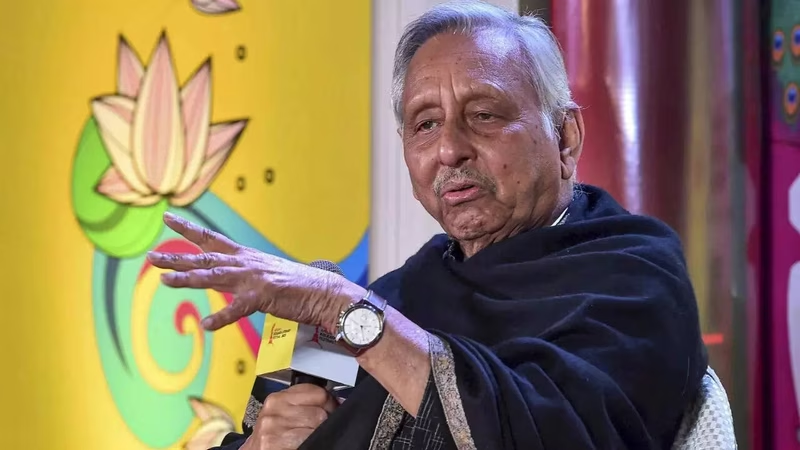
A single phrase—“Hinduism in paranoia”—has once again thrown Indian politics into a heated debate over a fundamental question: What is the true difference between Hinduism vs Hindutva? Veteran Congress leader Mani Shankar Aiyar’s latest remarks have drawn a sharp line in the sand, prompting a swift and forceful counter from the ruling BJP .
This isn’t just a semantic argument; it’s a clash of worldviews with deep historical roots and profound implications for India’s future as a secular democracy. Let’s unpack this complex and often-misunderstood distinction, the context of Aiyar’s comments, and why this debate matters to every citizen.
Table of Contents
- The Spark: Aiyar’s “Paranoia” Remark
- BJP’s Counter: Hindutva as “Hindu Tattva”
- Hinduism vs Hindutva: A Historical and Philosophical Divide
- The Origin of Hindutva: Savarkar’s Vision
- Why This Debate Matters for India’s Future
- Conclusion: Seeking Clarity in a Polarized Era
- Sources
The Spark: Aiyar’s “Paranoia” Remark
In a recent public address, Mani Shankar Aiyar argued that Hindutva is not synonymous with the ancient faith of Hinduism. He described it as a modern political construct that fosters fear among Hindus, particularly towards Muslims. His core point was that Hinduism, as a spiritual and philosophical tradition, has survived and thrived for millennia on its own merits, without needing the protective—or, in his view, aggressive—shield of Hindutva .
By framing Hindutva as a state of “paranoia,” Aiyar was directly challenging its foundational narrative, which often positions Hindus as being under siege and in need of political mobilization for their survival and dignity.
BJP’s Counter: Hindutva as “Hindu Tattva”
The BJP, whose ideological parent is the Rashtriya Swayamsevak Sangh (RSS)—an organization built on the principles of Hindutva—was quick to respond. Senior leader Sudhanshu Trivedi offered a direct rebuttal, stating that Hindutva is not a separate ideology but rather the core essence or “Hindu tattva” of Hinduism itself .
In this view, cherishing and protecting Hindu culture, traditions, and interests is not paranoia but a natural and necessary expression of one’s faith. The BJP’s stance effectively rejects the separation Aiyar proposes, arguing that the two are intrinsically linked and inseparable.
Hinduism vs Hindutva: A Historical and Philosophical Divide
To understand this conflict, we must look beyond the current political rhetoric. Scholars and historians have long drawn a clear distinction between the two concepts:
- Hinduism is primarily a religious, spiritual, and philosophical tradition. It is known for its immense diversity, lack of a single founder or central authority, and its core principles of pluralism, tolerance, and the pursuit of truth (Satya). As author and politician Shashi Tharoor notes, “Hinduism is about seeking the Truth” and is fundamentally inclusive .
- Hindutva, on the other hand, is a political ideology. Its primary goal is to define Indian national identity in terms of a shared Hindu cultural heritage. It often promotes a more monolithic vision of society, emphasizing a common ancestry, geography, and culture for all who are considered part of the “Hindu nation” .
In essence, Hinduism is a faith, while Hindutva is a nationalist project built around that faith .
The Origin of Hindutva: Savarkar’s Vision
The term “Hindutva” was formally defined and popularized in 1923 by Indian nationalist Vinayak Damodar Savarkar in his seminal essay, “Hindutva: Who is a Hindu?” . Savarkar, an atheist himself, was less concerned with religious dogma and more focused on creating a unified political identity for the people of India based on a common culture, language, and sacred geography .
His definition was explicitly political, aiming to consolidate a Hindu majority against what he perceived as external threats during the colonial era. This origin story is crucial because it shows that Hindutva was conceived from the outset as a tool for political mobilization, distinct from the theological and spiritual practices of Hinduism.
Why This Debate Matters for India’s Future
This is far more than an academic exercise. The conflation or separation of these two ideas has direct consequences for how India governs itself.
If Hindutva is seen as the sole, monolithic representation of Hinduism, it can marginalize the faith’s vast internal diversity and its long-standing traditions of syncretism and coexistence. It can also lead to policies that prioritize the interests of one religious community over others, challenging the secular foundations of the Indian Constitution.
Conversely, understanding the distinction allows for a space where one can be a devout Hindu while also being a committed secular citizen who respects all faiths. It protects the rich, pluralistic core of Hinduism from being reduced to a mere political slogan .
Conclusion: Seeking Clarity in a Polarized Era
The row between Mani Shankar Aiyar and the BJP over the Hinduism vs Hindutva debate is a microcosm of a much larger struggle for India’s soul. Aiyar’s “paranoia” comment, while provocative, points to a genuine concern about the weaponization of religious identity for political gain. The BJP’s defense of Hindutva as “Hindu tattva” reflects its core belief that cultural nationalism is essential for national unity.
For the average citizen, the key takeaway is to recognize that these are not interchangeable terms. One is a millennia-old, diverse spiritual path. The other is a 20th-century political ideology. Understanding this difference is the first step toward a more informed and nuanced public discourse on faith, identity, and democracy in modern India.
Sources
- Times of India: Hinduism in paranoia: Mani Shankar Aiyar criticises Hindutva
- Shashi Tharoor on Twitter/X: The difference between Hinduism and Hindutva
- Council on Foreign Relations: Hindu Nationalism in India
- UCLA MANAS Project: Hinduism versus Hindutva
- Encyclopædia Britannica: Hindutva: Definition, Origin, History, & Facts