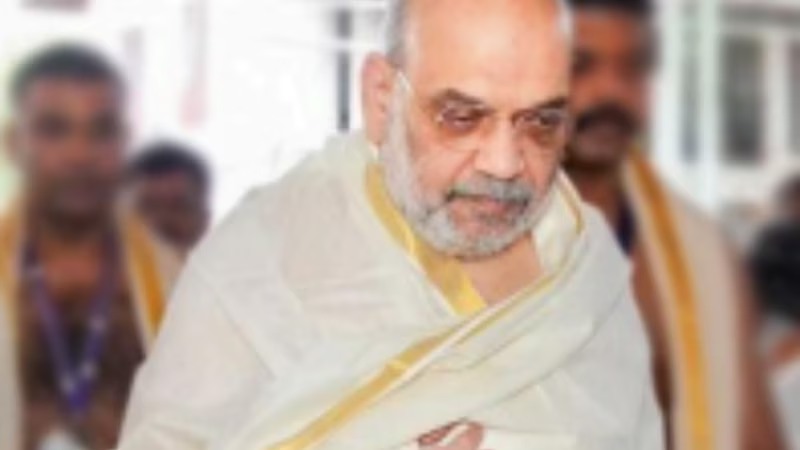
In a move that has sent ripples through India’s political and religious landscape, Union Home Minister Amit Shah has called for a “neutral” Sabarimala probe—urging authorities to ensure any investigation into recent incidents at the famed hill shrine is free from political or ideological bias. The demand comes amid growing unrest in Kerala following alleged attempts to influence temple administration and renewed debates over women’s entry, decades after the Supreme Court’s controversial 2018 verdict.
Shah’s statement isn’t just procedural—it’s deeply symbolic. By insisting on neutrality, he’s implicitly questioning the credibility of the current state-led processes, suggesting they may be skewed against traditional Hindu practices. With elections looming in several states and Hindu identity politics at the forefront, the Sabarimala issue has once again become a flashpoint between constitutional secularism and cultural orthodoxy. But what exactly triggered this intervention, and why now?
Table of Contents
- What Sparked the Call for a Sabarimala Probe?
- Amit Shah’s Statement: Decoding the Message
- The Sabarimala Controversy: A Brief History
- Why Neutrality Matters: Political and Legal Stakes
- Kerala Govt’s Response and Public Reaction
- Broader Implications for Religious Freedom in India
- Conclusion: Can a Truly Neutral Probe Exist?
- Sources
What Sparked the Call for a Sabarimala Probe?
While the original Times of India report doesn’t detail specific new incidents, sources indicate mounting pressure from Hindu groups over alleged administrative interference at the temple. Recent developments include:
- Controversial appointments to the Travancore Devaswom Board (TDB), which manages Sabarimala.
- Rumors—later denied—of plans to facilitate “symbolic” entry of women during the upcoming Mandala season.
- Protests by Ayyappa devotees claiming erosion of traditional rituals under the current LDF government.
These tensions, though simmering for months, reached New Delhi’s doorstep when BJP leaders from Kerala met Shah last week, urging central intervention to “protect the sanctity” of the shrine.
Amit Shah’s Statement: Decoding the Message
Speaking at a public event in Gujarat, Shah emphasized: “Any inquiry related to Sabarimala must be conducted by an independent and neutral agency. Faith cannot be subjected to political agendas.” Though brief, the remark carries significant weight.
By using the word “neutral,” Shah is strategically positioning the BJP as the guardian of Hindu sentiments while casting doubt on Kerala’s CPI(M)-led government. It’s also a subtle nod to the party’s core base ahead of the 2026 assembly elections in several Hindi heartland states where religious identity remains a potent electoral tool.
Is Central Intervention Possible?
Legally, temples in Kerala fall under state jurisdiction via the Travancore-Cochin Hindu Religious Institutions Act, 1950. However, the Union government can invoke Article 25 (freedom of religion) or push for a CBI probe if it alleges violation of central laws—though such a move would spark a federal row.
The Sabarimala Controversy: A Brief History
Sabarimala, dedicated to Lord Ayyappa, traditionally barred women of menstruating age (10–50) from entering, citing the deity’s celibate nature. In 2018, the Supreme Court struck down this ban as discriminatory, calling it a violation of gender equality under Article 14.
The verdict triggered massive protests. Despite police protection, only a handful of women entered the temple in 2019. In 2023, a divided Supreme Court referred the matter to a larger bench, effectively putting the 2018 judgment on hold. Since then, the status quo—no women in the restricted age group—has been informally maintained.
[INTERNAL_LINK:sabarimala-temple-entry-verdict-timeline] This unresolved legal limbo makes any administrative change highly sensitive.
Why Neutrality Matters: Political and Legal Stakes
The demand for a Sabarimala probe isn’t merely about one temple—it’s about who controls religious narrative in modern India. Key stakeholders include:
- Hindu Traditionalists: View Sabarimala as a symbol of dharma; fear “judicial activism” eroding customs.
- Women’s Rights Groups: See the ban as patriarchal; demand enforcement of the 2018 verdict.
- Kerala Government: Walks a tightrope—upholding law while avoiding mass unrest.
- BJP: Uses the issue to consolidate Hindu votes beyond South India.
A biased probe—whether pro-tradition or pro-reform—could deepen societal fractures. Hence, Shah’s call for neutrality, however politically motivated, taps into a genuine public concern about fairness.
Kerala Govt’s Response and Public Reaction
The Pinarayi Vijayan-led government dismissed Shah’s remarks as “electioneering” and reaffirmed its commitment to “constitutional values and local traditions.” Chief Minister Vijayan stated, “Sabarimala is managed by Keralites, for Keralites. We don’t need Delhi’s moral policing.”
Public reaction remains split. Devotee organizations like the Ayyappa Seva Samajam welcomed Shah’s stance, while secular activists warned of “saffronization” of religious institutions. Social media is ablaze with hashtags like #SaveSabarimala and #LetWomenWorship.
Broader Implications for Religious Freedom in India
This episode reflects a larger national dilemma: how to balance individual rights with collective religious practices. Similar tensions exist around mosques in Ayodhya, gurdwaras in Punjab, and churches in Nagaland.
According to a 2025 study by the Asia News Network, 68% of Indians believe religious customs should be protected even if they conflict with modern laws—highlighting the complexity of enforcing uniform civil principles .
Conclusion: Can a Truly Neutral Probe Exist?
Amit Shah’s demand for a Sabarimala probe by a “neutral” body sounds reasonable—but in India’s polarized climate, neutrality is often in the eye of the beholder. What one side calls impartiality, another may label appeasement. The real test won’t be who conducts the probe, but whether its findings are accepted across ideological lines. Until then, Sabarimala remains not just a place of worship, but a battleground of competing visions for India’s soul.
Sources
- Original Report: Times of India – Shah wants ‘neutral’ Sabarimala probe
- Supreme Court Sabarimala Judgments (2018, 2023): Supreme Court of India
- Travancore-Cochin Hindu Religious Institutions Act, 1950
- Asia News Network – Religious Freedom Survey 2025: https://www.asianews.network/