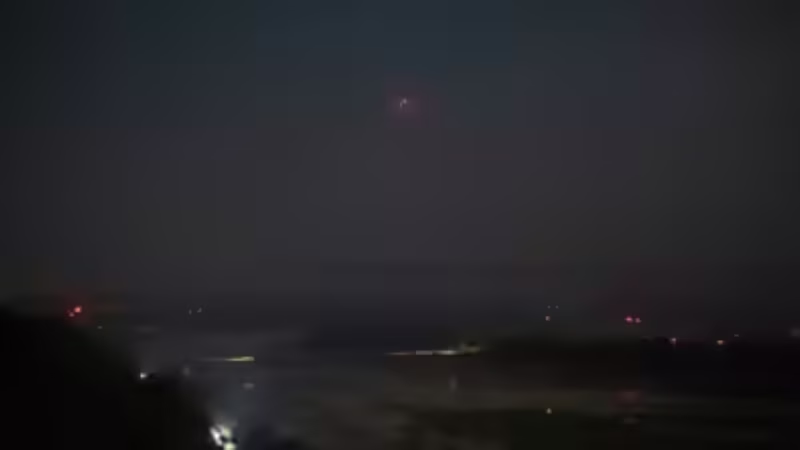
In a high-alert development that underscores escalating cross-border threats, Indian security agencies have confirmed sightings of multiple suspected Pakistani drones over LoC and the International Border (IB) in Jammu and Punjab sectors. The incursions—detected late Sunday night—have triggered an immediate and wide-ranging ground and aerial search operation involving the Border Security Force (BSF), Army, and specialized counter-drone units.
While no physical drone has been recovered as of Monday morning, radar signatures and visual sightings from forward posts strongly indicate coordinated aerial activity originating from Pakistani territory. This isn’t just routine espionage; experts warn these drones could be scouting for infiltration routes or preparing to drop narcotics, weapons, or even IED components—a tactic increasingly used by hostile elements since 2020. The incident marks one of the most serious border security challenges in early 2026.
Table of Contents
- What Happened? Details of the Drone Sightings
- Why Pakistani Drones Over LoC Are a Growing Threat
- India’s Counter-Drone Strategy: How Forces Are Responding
- The Narcotics and Arms Smuggling Link
- Geopolitical Implications: Escalation or New Normal?
- Conclusion: Vigilance in the Age of Drone Warfare
- Sources
What Happened? Details of the Drone Sightings
According to official sources, between 11 PM Sunday and 3 AM Monday, surveillance radars and ground troops reported at least three separate drone signatures along sensitive stretches:
- Jammu’s Arnia sector (IB): A slow-moving drone spotted hovering near a BSF outpost for nearly 8 minutes before vanishing westward.
- Rajouri district (LoC): Visual confirmation by sentries of a small quadcopter-type drone flying low over no-man’s-land.
- Amritsar rural belt (IB): Radar detected an unidentified aerial object moving parallel to the border fence before losing signal.
Immediately, standard operating procedures (SOPs) were activated. Patrols were doubled, night-vision drones deployed for counter-surveillance, and local police alerted to search nearby fields and rooftops for crash sites or dropped contraband.
Why Pakistani Drones Over LoC Are a Growing Threat
The use of commercial-grade drones by Pakistan-based actors has surged since 2020. What began as occasional reconnaissance has evolved into a systematic campaign. The Pakistani drones over LoC phenomenon is now a critical national security concern for three key reasons:
- Affordability & Accessibility: Drones like DJI Mavic or custom-built octocopters cost under $2,000 and can be easily modified.
- Stealth Capability: Small size and low-altitude flight make them hard to detect by conventional radar.
- Dual-Use Potential: Can carry payloads up to 5–7 kg—enough for pistols, grenades, or 2–3 kg of heroin.
As noted by the Institute for Defence Studies and Analyses (IDSA), “Drones have become the new proxy tool—low-risk for the sender, high-impact for the target” .
From Recon to Resupply
Initially used for mapping Indian post locations, these drones are now increasingly weaponized. In 2024 alone, Indian forces recovered over 120 drones along the western border—many with drug packets strapped underneath . This latest wave suggests a shift toward more aggressive, coordinated probing.
India’s Counter-Drone Strategy: How Forces Are Responding
India has rapidly upgraded its anti-drone ecosystem since 2022. Key measures now in play include:
- Drone-jamming systems: Deployed at vulnerable border outposts to disrupt GPS and radio signals.
- AI-powered radar networks: Capable of distinguishing birds from micro-drones.
- Counter-UAS drones: Equipped with nets or RF interceptors to capture hostile UAVs mid-air.
- Joint task forces: BSF, Army, and state police now share real-time intel via secure apps.
[INTERNAL_LINK:india-anti-drone-technology-2026] Still, gaps remain—especially in rural IB areas where terrain limits radar coverage. That’s why boots-on-ground searches remain crucial after every incursion alert.
The Narcotics and Arms Smuggling Link
Punjab and Jammu have long been targeted for drug trafficking from Pakistan. According to the Central Bureau of Investigation (CBI), over 60% of drone-borne seizures in 2025 contained heroin or synthetic opioids . But the threat isn’t just chemical—it’s kinetic.
In November 2025, a drone intercepted near Fazilka carried a live pistol and 12 rounds. Security analysts believe such drops aim to arm local radicalized youth or sleeper cells, bypassing traditional infiltration routes heavily monitored by Indian forces.
Geopolitical Implications: Escalation or New Normal?
While Pakistan denies state involvement—calling these “rogue elements”—evidence points to tacit support or at least willful blindness. The timing is also suspicious: coming just weeks after India test-fired its Agni-V ICBM and deepened defense ties with the U.S.
However, full-scale escalation remains unlikely. Both nations understand the risks. Instead, this represents a dangerous “gray zone” tactic—below the threshold of war but above acceptable peacetime behavior. For India, the challenge is to respond firmly without triggering a broader crisis.
Conclusion: Vigilance in the Age of Drone Warfare
The recent sightings of Pakistani drones over LoC are not an isolated event—they’re part of a persistent, evolving threat landscape. As drone technology becomes cheaper and smarter, India’s border defenses must evolve faster. The ongoing search operation is more than a tactical response; it’s a symbol of national resolve. In this new era of asymmetric warfare, every square kilometer of airspace matters—and India is watching.
Sources
- Original Report: Times of India – Suspected Pak drones seen over LoC, IB
- Institute for Defence Studies and Analyses (IDSA): https://www.idsa.in/
- BSF Annual Report 2025 – Drone Incursions Data
- Central Bureau of Investigation (CBI) – Narcotics Seizure Statistics: https://cbi.gov.in/