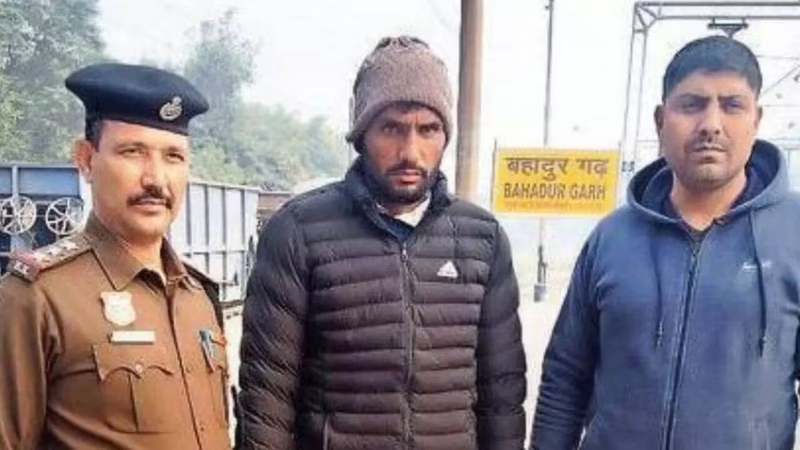
In a story that reads like a thriller but is tragically real, a 15-year-old boy from Haryana endured unimaginable horror—kidnapped, forced into bonded labor, and left for dead after his arm was shredded in a fodder cutter. But what followed was an equally extraordinary tale of persistence: a five-month, 10,000-kilometer manhunt by Gurgaon police that spanned over 500 villages across Haryana and Uttar Pradesh, culminating in the arrest of his tormentor, Anil.
This case has become a grim yet powerful symbol of both the brutal reality of child exploitation in rural India and the relentless dedication of law enforcement when they refuse to give up. At its heart lies the harrowing experience of a teenager tortured in fodder cutter machinery—a phrase that now echoes far beyond local headlines.
Table of Contents
- The Horror: What Happened to the 15-Year-Old?
- The Manhunt: How Police Tracked Down the Tormentor
- Who Is Anil? The Accused Profiled
- Systemic Issues: Child Labor and Bonded Slavery in India
- Why This Case Matters: A Win for Justice and Deterrence
- Conclusion: Resilience in the Face of Brutality
- Sources
The Horror: What Happened to the 15-Year-Old?
The victim, whose identity is protected under Indian law due to his age, was just 15 when he vanished from his home in Gurgaon district. He was lured with promises of work and a small wage—common tactics used by traffickers targeting impoverished families. Instead, he was taken to a remote farm in western Uttar Pradesh, where he was forced into grueling labor with no pay, under constant threat and surveillance.
The turning point came during a routine chore: feeding dry stalks into a mechanical fodder cutter. In a split second, his right arm was pulled into the machine. The injury was catastrophic—his limb was shredded beyond repair. His captor, Anil, didn’t rush him to a hospital. Instead, after a brief, panicked attempt to hide the evidence, he simply abandoned the bleeding teenager on the roadside, hoping he’d either die or disappear.
Miraculously, the boy was found by locals and rushed to a hospital, where doctors amputated what remained of his arm to save his life. When he regained consciousness, his first words were not of despair—but of his captor’s name: Anil.
The Manhunt: How Police Tracked Down the Tormentor
Armed only with a first name and a vague description, the Gurgaon police launched one of the most exhaustive investigations in recent memory. Over the next five months, a dedicated team crisscrossed rural Haryana and UP, visiting more than 500 villages and logging nearly 10,000 kilometers on their vehicles.
They used a mix of old-school detective work and modern tech:
- Door-to-door inquiries in agricultural belts where fodder cutters are common.
- CCTV footage analysis from highway toll plazas and market towns.
- Local informants and farmer networks to identify suspicious labor practices.
- Mobile tower pings to triangulate possible locations based on the victim’s fragmented memories.
Finally, a breakthrough came when a villager in Shamli district (UP) recognized Anil from a police sketch. Within 48 hours, Anil was apprehended while trying to flee to Rajasthan.
Gurgaon Police’s Dogged Determination
“We treated this not just as a crime, but as a moral obligation,” said Deputy Commissioner of Police (Crime) in Gurgaon, highlighting the team’s refusal to treat the case as “just another missing child.” Their persistence paid off—and sent a strong message: even in the most remote corners, perpetrators cannot hide forever.
Who Is Anil? The Accused Profiled
Anil, in his late 30s, is reportedly a small-time farmer with a history of employing undocumented laborers. Police sources indicate he had previously exploited migrant workers from Bihar and Jharkhand, but this was the first time his actions led to such severe physical harm—and public scrutiny.
He has been charged under multiple sections of the Indian Penal Code, including:
- Kidnapping (Section 363)
- Wrongful confinement (Section 342)
- Voluntarily causing grievous hurt (Section 326)
- Violations of the Child Labour (Prohibition and Regulation) Act, 1986
If convicted, he could face life imprisonment.
Systemic Issues: Child Labor and Bonded Slavery in India
While Anil’s arrest is a victory, it exposes a deeper, festering wound. According to the International Labour Organization (ILO), India is home to the world’s largest number of child laborers—estimated at over 10 million children under 14.
Bonded labor, though outlawed since 1976 under the Bonded Labour System (Abolition) Act, persists in agriculture, brick kilns, and domestic work—often hidden behind layers of debt and fear. Families in poverty-stricken regions are especially vulnerable to false job promises.
[INTERNAL_LINK:child-labor-laws-in-india] This case underscores why enforcement must go beyond legislation—it requires boots on the ground, community vigilance, and trauma-informed rehabilitation for survivors.
Why This Case Matters: A Win for Justice and Deterrence
The successful resolution of this teenager tortured in fodder cutter case is more than just a single arrest. It demonstrates:
- Police accountability works when departments prioritize vulnerable victims.
- Public awareness saves lives—local villagers played a crucial role in the rescue.
- Deterrence is possible: Traffickers now know that even rural anonymity won’t protect them.
Moreover, the survivor is now receiving counseling and financial aid under state victim compensation schemes—a critical step toward healing.
Conclusion: Resilience in the Face of Brutality
This story is a stark reminder of the darkness that can fester in forgotten corners of society—but also of the light that dogged policing and human compassion can bring. The 15-year-old’s courage in naming his abuser, and the Gurgaon police’s refusal to quit, have turned a tale of horror into one of hope. While the road to full recovery is long, justice has taken its first, vital step. And for every trafficker watching, the message is clear: no matter how far you run, someone will keep searching.
Sources
- Original Report: Times of India – 5 months, 500 villages: How dogged policing tracked down 15-yr-old boy’s tormentor
- Child Labour Laws: Ministry of Labour & Employment, Government of India
- ILO Data on Child Labor: International Labour Organization – India
- Bonded Labour Act: Bonded Labour System (Abolition) Act, 1976