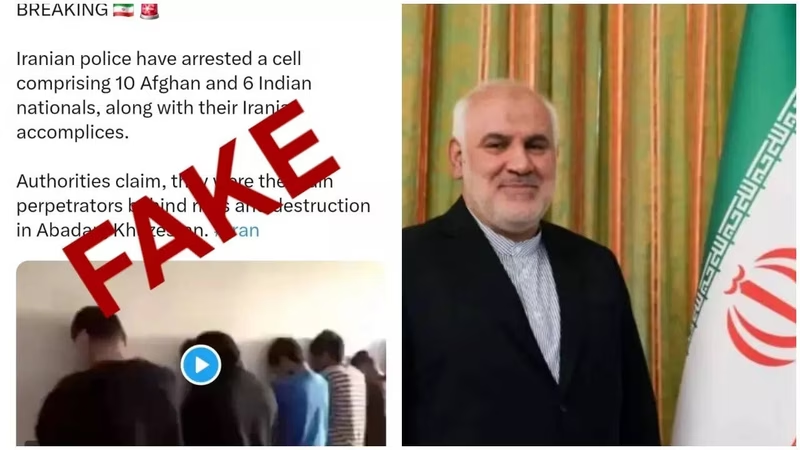
When social media lit up with reports that six Indian nationals had been arrested in Iran during recent anti-government protests, panic rippled through families and diaspora communities. The alleged detentions—linked to deadly unrest in the southwestern city of Abadan—suggested a dangerous escalation for foreign nationals caught in Iran’s political maelstrom.
But within hours, Iran’s ambassador to India, Seyyed Mohammad Reza Sajjadi, issued a sharp rebuttal: the story was “completely fake.” In a statement aimed at quelling misinformation, he urged Indians to “trust only credible and official sources” .
This stark contradiction—viral claims versus diplomatic denial—has left many wondering: is Iran hiding something, or is this another case of digital disinformation exploiting real-world chaos? The answer matters deeply for the safety of thousands of Indian expatriates working across the Middle East.
Table of Contents
- The Origin of the Arrest Claims
- Iran arrests Indian nationals: Tehran’s Firm Rejection
- Context: The Abadan Protests and Why They Matter
- India’s Response and Citizen Safety Protocols
- The Danger of Misinformation in Crisis Zones
- How to Verify News About Citizens Abroad
- Conclusion: Trust—but Verify—in a Volatile Region
- Sources
The Origin of the Arrest Claims
The rumor appears to have originated from unverified social media posts and messaging apps, claiming that Iranian security forces had detained 16 foreign nationals—6 Indians and 10 Afghans—for allegedly participating in arson and vandalism during protests in Abadan. Some posts even included purported screenshots of police bulletins, though none were authenticated by official Iranian media or law enforcement channels.
Given the sensitivity around foreign nationals in politically unstable regions, the story gained rapid traction, especially among Indian migrant worker groups in Gulf countries [INTERNAL_LINK:indian-expats-middle-east].
Iran arrests Indian nationals: Tehran’s Firm Rejection
Ambassador Sajjadi didn’t mince words. In a public statement, he categorically denied any such arrests, calling the reports “baseless fabrications” designed to “create unnecessary fear and tension between our two friendly nations” .
He emphasized that Iran maintains strict protocols regarding foreign nationals and that any legal action would be communicated through formal diplomatic channels—not social media. The embassy also confirmed it had received no distress calls or consular requests related to such detentions.
This aligns with standard practice: under the Vienna Convention on Consular Relations, Iran is obligated to inform the Indian embassy immediately if any Indian citizen is arrested or detained.
Context: The Abadan Protests and Why They Matter
The rumors didn’t emerge in a vacuum. Abadan, an oil-rich city near the Iraq border, has been a flashpoint in Iran’s ongoing wave of civil unrest. Triggered by economic hardship, water shortages, and anger over government corruption, protests have turned violent, with reports of clashes between demonstrators and security forces .
In such environments, foreign workers—especially those from South Asia—are often vulnerable to arbitrary detention, mistaken identity, or exploitation by local actors. While there’s no evidence this happened in Abadan, the fear is rooted in historical precedent, including past incidents in Libya, Yemen, and even earlier phases of Iran’s 2019–2020 protests.
India’s Response and Citizen Safety Protocols
The Ministry of External Affairs (MEA) has not issued a formal statement confirming arrests, which itself is telling. However, it has reiterated its standard advisory for Indians in Iran:
- Avoid all protest areas and large gatherings.
- Register with the Indian Embassy in Tehran via the MADAD portal.
- Keep travel documents updated and maintain emergency contacts.
India currently has over 8,000 citizens in Iran, mostly employed in construction, healthcare, and energy sectors. The MEA operates a 24/7 helpline and has contingency evacuation plans, though large-scale extraction remains logistically complex due to airspace restrictions and regional tensions .
The Danger of Misinformation in Crisis Zones
This episode highlights a growing global problem: the weaponization of false narratives during geopolitical crises. Bad actors—whether state-sponsored trolls or opportunistic scammers—often amplify unverified claims to:
- Incite panic and erode trust in governments.
- Damage bilateral relations (e.g., India-Iran ties are crucial for Chabahar Port and energy deals).
- Divert attention from real issues on the ground.
According to the International Fact-Checking Network (IFCN), misinformation spikes by over 300% during civil unrest events .
How to Verify News About Citizens Abroad
If you hear alarming news about relatives overseas, follow these steps:
- Check the official website and social media of the Ministry of External Affairs.
- Contact the nearest Indian embassy or consulate directly.
- Use the MADAD app (madad.gov.in) for real-time alerts.
- Avoid sharing unconfirmed reports—even with good intentions.
Conclusion: Trust—but Verify—in a Volatile Region
As of now, all credible evidence suggests that reports of Iran arrests Indian nationals are unfounded. Iran’s swift denial, backed by the absence of any MEA confirmation, strongly supports this. However, the incident serves as a critical reminder: in an age of digital noise, emotional headlines must be met with disciplined verification. For India, protecting its citizens abroad requires not just diplomatic vigilance—but also a public armed with facts, not fear.