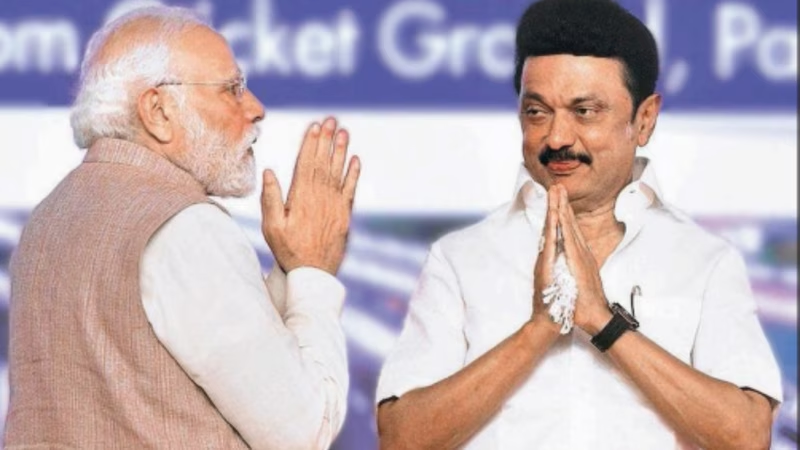
In a letter that blends diplomacy with deep regional sentiment, Tamil Nadu Chief Minister M K Stalin has issued a powerful appeal to Prime Minister Narendra Modi: step up India’s engagement with Sri Lanka to safeguard the fundamental rights of its Tamil population. This isn’t just a routine political statement—it’s a direct call for moral leadership on an issue that has simmered for decades and continues to shape India’s southern politics .
Stalin’s intervention comes at a critical juncture. While Colombo has made symbolic gestures toward reconciliation since the end of the civil war in 2009, concrete progress on justice, accountability, and political autonomy for Tamils remains elusive. For millions in Tamil Nadu, this is not a foreign policy matter—it’s a matter of kinship, history, and conscience.
Table of Contents
- Stalin’s Letter: Key Demands
- Tamil rights in Sri Lanka: Why Tamil Nadu Cares So Deeply
- The Current State of Sri Lankan Tamils
- India’s Diplomatic Tightrope
- Historical Context: From Indo-Lanka Accord to Now
- What Modi Can Do Next: Practical Steps
- Conclusion: A Test of Regional Leadership
- Sources
Stalin’s Letter: Key Demands
In his communication to the Prime Minister, Stalin laid out a clear set of expectations for India’s role:
- Direct Diplomatic Engagement: Urge the Sri Lankan government to implement long-pending constitutional reforms that grant meaningful autonomy to the Northern and Eastern provinces.
- Accountability for War Crimes: Push for credible investigations into alleged human rights violations during the final stages of the civil war.
- Protection of Cultural Identity: Advocate for the preservation of Tamil language, heritage sites, and land rights in traditional Tamil areas.
- Economic Rehabilitation: Support sustainable development projects in war-affected regions to rebuild livelihoods.
Crucially, Stalin emphasized that India—given its geographic, cultural, and historical ties—has a “unique responsibility” to be the voice of Eelam Tamils on the global stage .
Tamil rights in Sri Lanka: Why Tamil Nadu Cares So Deeply
The connection between Tamil Nadu and Sri Lankan Tamils transcends politics. It’s rooted in shared language, literature, and a collective memory of displacement and persecution. The 1983 anti-Tamil pogroms, the brutal civil war, and the 2009 Mullivaikkal massacre are not distant events—they are living traumas for many families in the state.
Every major political party in Tamil Nadu, across ideological lines, has historically championed the cause of Sri Lankan Tamils. For the DMK, under both M Karunanidhi and now M K Stalin, it’s a core part of their Dravidian identity and foreign policy outlook [INTERNAL_LINK:tamil-nadu-political-history].
The Current State of Sri Lankan Tamils
Despite promises of reconciliation, the ground reality remains grim:
- Land Occupation: Thousands of acres of private Tamil land remain under military control.
- Political Marginalization: The 13th Amendment (which promised provincial councils) is only partially implemented.
- Missing Persons: Over 20,000 people remain unaccounted for since the war’s end.
- Economic Disparity: The Northern Province has the lowest per capita income in Sri Lanka.
Recent reports from Human Rights Watch and the UN Office of the High Commissioner for Human Rights (OHCHR) confirm that systemic discrimination persists .
India’s Diplomatic Tightrope
For New Delhi, the issue is fraught with complexity. On one hand, India must respond to domestic pressure from Tamil Nadu. On the other, it cannot afford to alienate Colombo, especially as China expands its influence in the Indian Ocean Region through ports like Hambantota.
PM Modi’s government has walked a careful line—providing humanitarian aid and infrastructure support while avoiding overt criticism of Sri Lanka’s internal affairs. But Stalin’s letter argues that quiet diplomacy is no longer enough; bold, principled engagement is required.
Historical Context: From Indo-Lanka Accord to Now
The legacy of Rajiv Gandhi’s 1987 Indo-Lanka Accord looms large. While intended to bring peace, it led to the deployment of the Indian Peace Keeping Force (IPKF) and ultimately the assassination of Gandhi by the LTTE. Since then, Indian governments have been cautious.
However, the post-war era demands a new approach—one that supports democratic Tamil political parties in Sri Lanka rather than armed groups. As Stalin notes, “The struggle today is for dignity, not division.”
What Modi Can Do Next: Practical Steps
Experts suggest India can take several actionable steps without compromising strategic interests:
- Link Development Aid to Reforms: Tie infrastructure grants to measurable progress on Tamil political rights.
- Host Inclusive Dialogues: Facilitate talks between Colombo and moderate Tamil political leaders in Chennai or New Delhi.
- Support International Mechanisms: Back UN-led accountability processes while ensuring they’re not weaponized by Western powers.
- Boost People-to-People Ties: Expand educational and cultural exchanges between Tamil Nadu and Northern Sri Lanka.
Conclusion: A Test of Regional Leadership
M K Stalin’s appeal to PM Modi over Tamil rights in Sri Lanka is more than a regional demand—it’s a test of India’s ability to balance realpolitik with ethical foreign policy. As the undisputed leader of South Asia, India has both the leverage and the moral obligation to ensure that the tragic chapters of the past are not repeated. The world is watching to see if New Delhi will rise to the occasion.