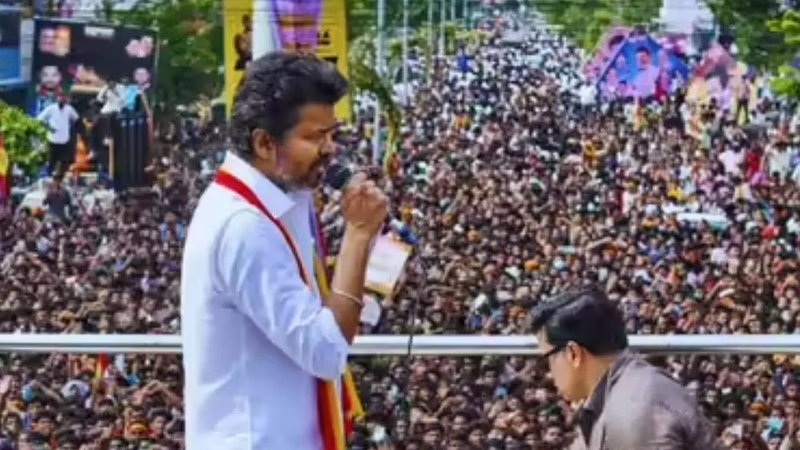
Today marks a critical juncture in one of Tamil Nadu’s most tragic public disasters. K. Vijay, president of the Thanthai Periyar Dravidar Kazhagam (TVK), is set to appear before the Central Bureau of Investigation (CBI) in New Delhi as part of the ongoing probe into the Karur stampede that left 41 people dead in September 2025 .
This isn’t just another routine questioning. The CBI’s summons—issued after the Supreme Court transferred the case from state authorities—signals a high-stakes escalation. Investigators are reportedly focusing on whether proper permissions were obtained, if safety protocols were ignored, and whether political pressure played a role in allowing the event to proceed despite known risks.
Table of Contents
- The Karur Tragedy: A Brief Recap
- Karur stampede CBI investigation: Why the Supreme Court Stepped In
- Who Is K. Vijay and What Is His Role?
- What the CBI Is Likely to Ask
- Security Concerns and Political Fallout
- Broader Implications for Public Event Safety
- Conclusion: Accountability in the Aftermath of Tragedy
- Sources
The Karur Tragedy: A Brief Recap
On a fateful day in September 2025, a massive crowd had gathered in Karur, Tamil Nadu, for a religious and cultural event organized by the TVK. As thousands surged toward the venue, chaos erupted near a narrow bottleneck. Panic spread, and in the ensuing crush, 41 people—including women and children—lost their lives .
Initial reports pointed to severe overcrowding, lack of barricades, absence of emergency exits, and minimal police presence. Eyewitnesses described scenes of utter desperation, with people trampled underfoot in a matter of minutes. The incident sparked nationwide outrage and demands for accountability at the highest levels of event organization.
Karur stampede CBI investigation: Why the Supreme Court Stepped In
Public trust in the Tamil Nadu state police’s ability to conduct an impartial probe quickly eroded. Allegations surfaced that local officials had granted last-minute permissions under political influence and failed to enforce basic safety norms.
In response to petitions from victims’ families and civil society groups, the Supreme Court of India took the extraordinary step of transferring the entire investigation to the CBI in late 2025 . This move underscored the Court’s concern about potential cover-ups and the need for a “credible, independent, and time-bound inquiry.”
Who Is K. Vijay and What Is His Role?
K. Vijay is not just a political figure—he was the chief organizer of the ill-fated event. As president of TVK, he oversaw logistics, permissions, and public announcements. While he has maintained that all necessary clearances were obtained, investigators are probing whether verbal assurances were mistaken for formal approvals, or whether warnings from district officials were ignored.
Notably, ahead of his CBI appearance, Vijay’s team formally requested enhanced security from Delhi Police, citing “potential threats” and the emotionally charged nature of the case—a sign of the immense pressure surrounding this hearing [INTERNAL_LINK:tamil-nadu-political-parties-profile].
What the CBI Is Likely to Ask
Based on standard procedure in mass casualty investigations, the CBI’s line of questioning will likely focus on:
- Event Permissions: Were written no-objection certificates (NOCs) obtained from police, fire, and municipal authorities?
- Crowd Estimates: What was the projected attendance vs. actual turnout? Was there a crowd management plan?
- Safety Infrastructure: Were barricades, signage, medical booths, and emergency exits in place?
- Communication Logs: Were there any prior warnings from local administration about venue capacity?
- Financial Accountability: Who funded the event, and were funds used for safety measures?
Vijay’s answers could determine whether charges of culpable homicide not amounting to murder (IPC 304) or criminal negligence (IPC 304A) are recommended against him or other organizers.
Security Concerns and Political Fallout
The case has already triggered political tremors in Tamil Nadu. Opposition parties are demanding Vijay’s resignation and calling for a broader audit of all politically-backed public gatherings. Meanwhile, TVK supporters claim the leader is being unfairly targeted.
The CBI’s handling of the case will be watched closely—not just for justice for the 41 victims, but as a test of whether powerful figures can be held accountable for preventable tragedies.
Broader Implications for Public Event Safety
The Karur disaster is a grim reminder of India’s recurring stampede problem. According to the National Crime Records Bureau (NCRB), over 100 people have died in crowd-related incidents across India since 2020 alone .
Experts argue that without mandatory national standards for public assembly permits—akin to fire safety codes—such tragedies will continue. The Karur stampede CBI investigation could become a catalyst for reform, pushing states to adopt stricter pre-event risk assessments and real-time monitoring systems.
Conclusion: Accountability in the Aftermath of Tragedy
As K. Vijay faces the CBI today, the eyes of 41 grieving families—and a nation weary of preventable deaths—are upon him. The Karur stampede CBI investigation is more than a legal proceeding; it’s a moral reckoning. Will this case finally establish that organizing a public event comes with non-negotiable responsibilities—or will it fade into the long list of forgotten tragedies? The answer begins in a Delhi interrogation room today.