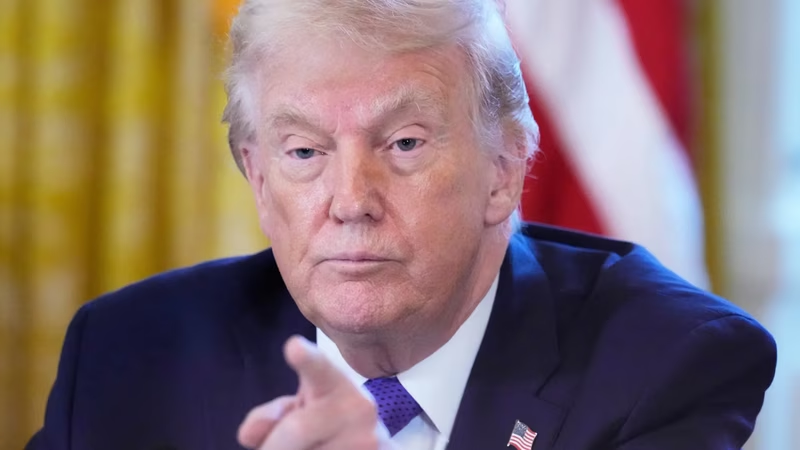
Tensions in the Middle East are reaching a boiling point. In a stark and unusually direct statement, former U.S. President Donald Trump has declared that the American military is actively reviewing “very strong options” in response to escalating events in Iran. His comments come amid a brutal government crackdown on nationwide anti-regime protests—and raise a chilling question: Has Iran crossed the red line?
The phrase “red line” carries immense weight in international diplomacy. It signals a boundary beyond which consequences become inevitable. If Trump’s remarks reflect ongoing strategic discussions—even from outside office—they suggest the U.S. may be closer to direct intervention than at any time since the 2020 Soleimani strike.
Table of Contents
- What Does ‘Iran Crossed Red Line’ Mean in Geopolitical Terms?
- Trump’s Warning and the U.S. Military Posture
- Iran’s Response: Threats to U.S. Bases and Israel
- The Protest Crisis Fueling the Fire
- Historical Context: When Have Red Lines Been Crossed Before?
- What Happens Next? Potential Scenarios
- Conclusion: A Region on the Brink
- Sources
What Does ‘Iran Crossed Red Line’ Mean in Geopolitical Terms?
In foreign policy, a “red line” is not just rhetoric—it’s a strategic signal. When a nation declares one, it’s warning adversaries that certain actions will trigger severe consequences, potentially including military force. Past examples include Barack Obama’s (later unenforced) red line on chemical weapons in Syria and George W. Bush’s post-9/11 warnings to state sponsors of terror.
While Trump didn’t specify which line Iran allegedly crossed, analysts point to several possibilities: direct attacks on U.S. personnel, escalation of proxy warfare, or extreme human rights violations during the protest crackdown that could justify humanitarian intervention under evolving international norms.
Trump’s Warning and the U.S. Military Posture
Speaking from Mar-a-Lago, Trump stated, “The military is looking at it very seriously… We have very strong options, and they know it” . Though no longer in office, his influence over Republican foreign policy remains significant. His comments likely reflect intelligence briefings or discussions with current defense officials—raising questions about whether the Biden administration is also weighing stronger measures.
U.S. Central Command (CENTCOM) has already reinforced its presence in the Persian Gulf, with additional naval assets deployed near the Strait of Hormuz. According to the U.S. Department of Defense, these moves are “routine,” but regional allies interpret them as precautionary signals .
Iran’s Response: Threats to U.S. Bases and Israel
Tehran wasted no time firing back. Iran’s Parliament Speaker, Mohammad Bagher Ghalibaf, issued a dire warning: if the U.S. or its allies strike Iran, “American bases in the region and the Zionist entity [Israel] will become legitimate targets” . He also vowed “severe punishment” for protesters, framing the unrest as a foreign-backed conspiracy.
This dual-track response—military threats abroad, repression at home—is classic regime survival strategy. But it risks miscalculation. With Iranian-backed militias already active in Iraq, Syria, and Yemen, any direct U.S. action could ignite a multi-front regional war.
The Protest Crisis Fueling the Fire
At the heart of this escalation is a domestic uprising. Sparked by economic despair and political repression, protests have spread to over 30 cities. Unlike previous waves, these demonstrations include large numbers of women and youth demanding systemic change—not just reform.
Iranian security forces have responded with internet blackouts, mass arrests, and live ammunition. Human rights groups estimate hundreds have been detained and dozens killed in the past week alone . This level of violence has drawn condemnation from the UN and European powers, increasing pressure on Washington to act.
Historical Context: When Have Red Lines Been Crossed Before?
To understand the gravity of the current moment, consider these precedents:
- 2015 Nuclear Deal (JCPOA): The U.S. and P5+1 set clear limits on Iran’s uranium enrichment. Violations triggered sanctions—but not military action.
- 2019 Tanker Attacks: After oil tankers were sabotaged near the UAE, the U.S. blamed Iran but opted for cyber-retaliation instead of strikes.
- 2020 Soleimani Assassination: Following attacks on U.S. bases in Iraq, Trump ordered a drone strike that killed Iran’s top general—crossing Iran’s own red line and bringing the two nations to the brink of war.
Today’s situation is different. It’s not about nuclear centrifuges or proxy skirmishes—it’s about internal legitimacy and human rights, making diplomatic off-ramps harder to find.
What Happens Next? Potential Scenarios
Experts outline three likely paths forward:
- Diplomatic De-escalation: The U.S. and EU impose targeted sanctions on IRGC leaders while offering backchannel talks. Protests subside due to fatigue or repression.
- Controlled Military Action: A limited U.S. strike on an Iranian drone facility or militia base in Syria—enough to send a message without triggering all-out war.
- Regional Conflagration: Miscalculation leads to reciprocal strikes between Iran and Israel/U.S., drawing in Hezbollah, Houthis, and Iraqi militias in a cascading conflict.
[INTERNAL_LINK:middle-east-conflict-analysis-2026] provides deeper insights into scenario planning by global think tanks.
Conclusion: A Region on the Brink
The phrase “Iran crossed red line” is no longer just speculation—it’s a live geopolitical flashpoint. Whether driven by genuine strategic concern or political posturing, Trump’s warning underscores a dangerous reality: the window for peaceful resolution is narrowing. With Tehran doubling down on repression and Washington signaling resolve, the Middle East stands at a precipice. The world watches, hoping cooler heads prevail before another red line becomes a point of no return.
Sources
- Times of India: ‘Military looking at it’: Has Iran crossed red line? Trump says US studying ‘very strong options’
- U.S. Department of Defense: Official Statements on CENTCOM Deployments
- Amnesty International: Iran: Crackdown on Peaceful Protesters