‘Where Has Its Nationalism Gone?’: Owaisi’s Fiery Challenge to the Centre
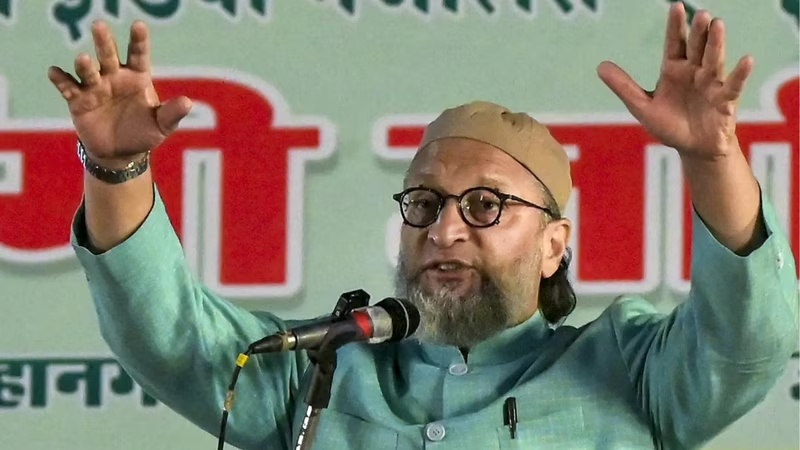
In a blistering political salvo that has sent shockwaves across the national discourse, AIMIM president Asaduddin Owaisi has directly questioned the integrity of the BJP-led central government’s nationalist credentials. Speaking at a public rally in Hyderabad on Sunday, January 11, 2026, Owaisi posed a provocative question: “Where has its nationalism gone?”—a rhetorical jab that cuts to the heart of current controversies surrounding foreign investments, diplomatic silence, and domestic justice . His speech, which targeted the government’s embrace of Chinese capital despite border tensions, its muted response to Donald Trump’s alleged derogatory remarks about India, and its asylum grant to Bangladesh’s Sheikh Hasina, has sparked intense debate across party lines.
Table of Contents
- Owaisi’s Three-Pronged Attack on the Centre
- Chinese Investments vs. National Security: A Contradiction?
- The Trump Silence: Diplomatic Prudence or Political Cowardice?
- Sheikh Hasina Asylum and Domestic Double Standards
- Muslim Youth Incarceration: A Human Rights Concern
- BJP’s Response and Political Fallout
- Conclusion: Nationalism Under Scrutiny
- Sources
Owaisi’s Three-Pronged Attack on the Centre
Owaisi’s critique rests on three key pillars that, he argues, expose a pattern of hypocrisy in the government’s actions:
- Inviting Chinese companies to invest in India despite ongoing military standoffs along the Line of Actual Control (LAC).
- Remaining silent on former U.S. President Donald Trump’s reported comments dismissing India as “not a real democracy.”
- Granting asylum to Bangladesh’s Prime Minister Sheikh Hasina while allegedly denying bail to Muslim youths detained under anti-terror laws without trial.
“You talk about ‘Atmanirbhar Bharat,’ but you roll out the red carpet for Chinese capital. You chant ‘Vocal for Local,’ yet you stay quiet when a foreign leader insults our democracy,” Owaisi charged .
Chinese Investments vs. National Security: A Contradiction?
Since the deadly Galwan clash in 2020, India has taken steps to restrict Chinese investment, including mandating government approval for all FDI from China. Yet, data from the Ministry of Commerce shows that Chinese-linked entities continue to enter India through third countries like Singapore and Mauritius . In 2025 alone, over $1.2 billion in indirect Chinese investment flowed into Indian tech and e-commerce sectors.
Owaisi seized on this, asking: “How can you claim to be tough on China while allowing its money to control our digital economy?” He contrasted this with the government’s aggressive stance on Pakistani artists or goods—a disparity he labeled “selective nationalism.”
The Trump Silence: Diplomatic Prudence or Political Cowardice?
Owaisi also highlighted the government’s conspicuous silence following reports that Donald Trump, during a private fundraiser in Florida, referred to India as a “country of chaos” and questioned its democratic legitimacy . While opposition parties demanded a formal protest, the MEA issued only a generic statement affirming India’s democratic values—no summoning of the U.S. envoy, no strong rebuke.
“When a cartoon offends you, you shut down embassies. But when a former U.S. president insults 1.4 billion Indians, you say nothing? Where is your nationalism then?” Owaisi asked, drawing loud applause.
Sheikh Hasina Asylum and Domestic Double Standards
In a lesser-known but equally pointed critique, Owaisi referenced India’s reported facilitation of safe passage for Bangladeshi PM Sheikh Hasina during recent political unrest in Dhaka—a move seen by some as strategic realpolitik. Yet, he juxtaposed this with the prolonged detention of dozens of Muslim youths under the Unlawful Activities (Prevention) Act (UAPA), many held for years without charge.
“You protect a foreign leader but forget your own citizens. Is justice only for the powerful?” he questioned, echoing concerns raised by human rights organizations like Amnesty International [INTERNAL_LINK:india-uapa-detentions-analysis].
Muslim Youth Incarceration: A Human Rights Concern
Citing data from the National Crime Records Bureau (NCRB), Owaisi noted that Muslims constitute nearly 58% of all UAPA detainees despite being only 14% of India’s population . Many cases, such as those linked to the Bhima Koregaon or Delhi riots investigations, remain pending for over five years.
“No trial, no bail, just endless jail. Is this the nationalism you preach?” he said, framing the issue as one of constitutional rights versus political persecution.
BJP’s Response and Political Fallout
As of January 11, the BJP has not issued an official rebuttal. However, party spokespersons on social media dismissed Owaisi’s remarks as “divisive rhetoric” aimed at “undermining national unity.” Critics, however, argue that his questions reflect genuine public anxieties about consistency in governance.
Conclusion: Nationalism Under Scrutiny
Owaisi’s attack isn’t just political theater—it’s a direct challenge to the moral coherence of the ruling establishment. By linking foreign policy, economic decisions, and domestic justice under the umbrella of Owaisi attacks Centre on nationalism, he forces a conversation many prefer to avoid. Whether his critique gains mainstream traction or remains confined to opposition circles, one thing is clear: the definition of “nationalism” in 2026 India is fiercely contested—and increasingly scrutinized.
Sources
- Times of India: ‘Where has its nationalism gone?’: Owaisi attacks Centre over Chinese investments
- Ministry of Commerce & Industry, India: FDI Policy Guidelines
- Amnesty International: India Human Rights Reports
- National Crime Records Bureau (NCRB): Crime in India 2024 Statistics