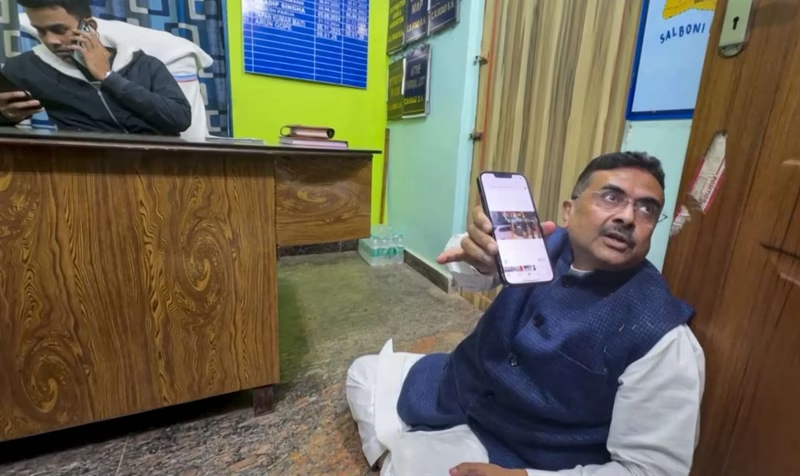
Tensions are boiling over in West Bengal after the BJP accused state authorities of failing to protect the Leader of the Opposition, Suvendu Adhikari, following what it describes as a violent attack on his motorcade in South 24 Parganas. Declaring that “even the LoP is not safe,” the party has demanded immediate action from both state and central governments—prompting the Union Ministry of Home Affairs (MHA) to formally seek a detailed report from Adhikari’s office .
The incident, which occurred during Adhikari’s visit to his Nandigram constituency—the very ground zero of his high-profile 2021 electoral battle against Chief Minister Mamata Banerjee—has reignited fierce political hostilities in a state already known for its volatile political climate . With assembly elections just over a year away, this confrontation could set the tone for an even more acrimonious campaign season.
Table of Contents
- What Happened in Nandigram? The Alleged Attack
- BJP’s Response and the National Outcry
- Why the MHA Stepped In—and What It Means
- TMC’s Counternarrative: Provocation or Politics?
- Is This Part of a Broader Pattern of Political Violence in Bengal?
- Conclusion: A Flashpoint in Bengal’s Fractured Democracy
- Sources
What Happened in Nandigram? The Alleged Attack
According to BJP sources, on January 9, 2026, while Suvendu Adhikari was touring parts of Nandigram, his convoy was allegedly blocked and pelted with stones by a group of individuals described as “TMC goons” . Videos circulating on social media show vehicles with visible dents and broken windows, though the extent of injuries—if any—remains unclear.
Adhikari, who serves as the Leader of the Opposition (LoP) in the West Bengal Legislative Assembly, claimed the local police failed to intervene despite prior intelligence about potential unrest. “In a democracy, if the LoP cannot move freely in his own constituency, what does that say about the rule of law?” he reportedly asked in a press statement .
BJP’s Response and the National Outcry
The BJP wasted no time in escalating the issue nationally. Senior leaders, including Union Ministers, took to X (formerly Twitter) to denounce the incident as “state-sponsored intimidation.” Party president JP Nadda called it “a direct assault on democratic norms,” while others framed it as evidence of the Trinamool Congress’s (TMC) authoritarian grip on Bengal .
The slogan “even LoP is not safe” quickly became a rallying cry, appearing on posters, news tickers, and digital campaigns across the country. For the BJP, this isn’t just about one incident—it’s a strategic narrative to paint West Bengal as a lawless zone under Mamata Banerjee’s rule, ahead of the 2027 assembly polls.
Why the MHA Stepped In—and What It Means
In an unusual move, the Ministry of Home Affairs (MHA) has formally requested a written report from Suvendu Adhikari’s office detailing the alleged attack . This step is significant because the LoP in a state legislature is not a central government appointee, and such interventions are rare unless there are concerns about constitutional functionaries or national security.
Legal experts note that while the MHA doesn’t have direct jurisdiction over state law and order (a subject under the State List in the Seventh Schedule of the Constitution), it can monitor situations that threaten “public order” or involve attacks on elected representatives . The request may also be a signal to the West Bengal government that New Delhi is watching closely.
TMC’s Counternarrative: Provocation or Politics?
Unsurprisingly, the Trinamool Congress has dismissed the BJP’s claims as “dramatization for political gain.” TMC spokesperson Saket Gokhale alleged that Adhikari’s team deliberately entered a sensitive area without coordinating with local police, possibly to provoke a reaction .
“This is classic BJP theater,” Gokhale stated. “They create chaos, film it, and then cry victimhood. The truth is, law and order in Bengal is far better than in BJP-ruled states like Uttar Pradesh or Haryana.”
The TMC further pointed out that Adhikari himself was accused of inciting violence during the 2021 Nandigram clashes—a case still under judicial review .
Is This Part of a Broader Pattern of Political Violence in Bengal?
West Bengal has a long and troubled history of political violence, with both Left Front and TMC regimes accused of using muscle power to silence opponents. According to data from the National Crime Records Bureau (NCRB), West Bengal consistently ranks among the top states for crimes related to “riots” and “offences against public tranquillity” .
[INTERNAL_LINK:political-violence-in-west-bengal-history] explores how electoral competition in Bengal has often blurred the line between protest and persecution.
While the BJP now positions itself as the victim, critics remind that during its rise in the state, its own cadres were frequently implicated in retaliatory violence. The current incident, therefore, may reflect not a new crisis, but the continuation of an entrenched culture of political hostility.
Conclusion: A Flashpoint in Bengal’s Fractured Democracy
The alleged Suvendu Adhikari convoy attack is more than a local skirmish—it’s a symbolic flashpoint in the larger battle for Bengal’s political soul. For the BJP, it’s proof of TMC’s authoritarianism; for the TMC, it’s a manufactured crisis to divert attention from governance failures. With the MHA now involved, the incident has transcended state boundaries, becoming a test of federal sensitivity and democratic accountability. As Bengal braces for another election cycle, one thing is clear: in this state, politics isn’t just contested at the ballot box—it’s fought on the streets.
Sources
- Times of India. (2026). ‘Even LoP is not safe’: BJP on alleged attack on Suvendu Adhikari’s convoy in Bengal; MHA seeks report. https://timesofindia.indiatimes.com/…/126464324.cms.
- Constitution of India, Seventh Schedule, State List – Entry 1 (Public Order).
- National Crime Records Bureau (NCRB). (2024). Crime in India Report. https://ncrb.gov.in.
- Press Trust of India (PTI). (2026). BJP-TMC Clash Escalates Over Nandigram Incident.