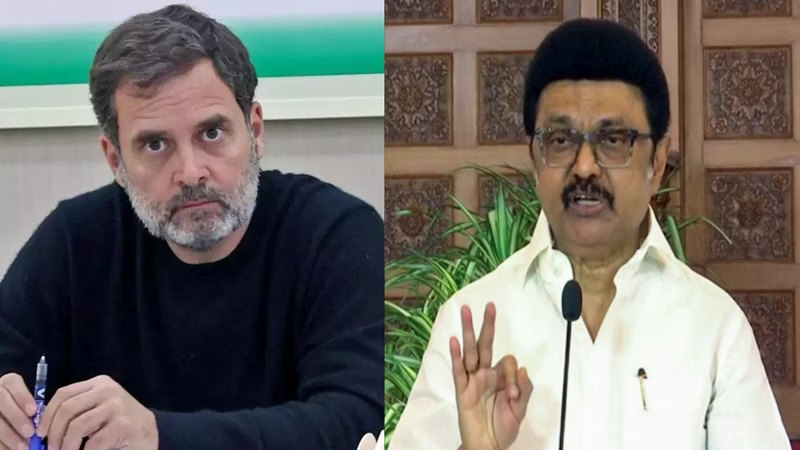
The political landscape of Tamil Nadu just got a lot clearer—and a lot more tense. In a blunt and unambiguous statement, senior DMK leader and Food Minister I Periyasamy has shut down any speculation about a coalition government in the state, declaring that Chief Minister MK Stalin is absolutely firm on one principle: no power-sharing in Tamil Nadu, not even with the Indian National Congress .
This declaration comes at a critical juncture, just months before the crucial 2026 Tamil Nadu Assembly elections, as the state unit of the Congress party has been increasingly vocal in demanding a formal share in governance—a move they argue is justified by their role in the ruling INDIA bloc at the national level . But the DMK’s message is clear: gratitude doesn’t equal governance.
Table of Contents
- The DMK’s Uncompromising Stance
- What Exactly Is Congress Asking For?
- A Fractured History: DMK-Congress Relations in Tamil Nadu
- Why MK Stalin Is Drawing a Hard Line
- What This Means for the 2026 Tamil Nadu Elections
- Conclusion: Unity at the Centre, Autonomy in the State
- Sources
The DMK’s Uncompromising Stance
Speaking to reporters in Chennai, I Periyasamy left no room for interpretation: “There will be no sharing of power. Chief Minister M K Stalin has made it very clear,” he stated emphatically . The remark wasn’t just a policy position—it was a political boundary being drawn in stone.
This isn’t the first time the DMK has signaled its reluctance to cede ministerial berths or decision-making authority. But the timing—amid renewed pressure from Congress leaders like TNCC chief K Selvaperunthagai—makes this rebuke particularly significant . It underscores a growing confidence within the DMK that it can win and govern alone, without relying on junior partners in the state.
What Exactly Is Congress Asking For?
The Tamil Nadu Congress Committee (TNCC) has been pushing for what it calls a “fair share” in the state cabinet, arguing that its support was instrumental in the DMK-led alliance’s victory in the 2021 elections and again in the 2024 Lok Sabha polls . They point to their performance in key constituencies and their role in the broader anti-BJP INDIA alliance as justification for ministerial positions.
However, critics note that Congress won only 8 out of 234 seats in the 2021 assembly elections—a paltry 3.4% of the total . From the DMK’s perspective, such a minor electoral footprint hardly warrants a seat at the governance table, especially when the party commands an overwhelming majority on its own.
A Fractured History: DMK-Congress Relations in Tamil Nadu
The relationship between the DMK and Congress in Tamil Nadu has always been transactional, not fraternal. While they’ve allied during national elections since 2019, their history is littered with betrayals and breakups:
- In the 1960s and 70s, the DMK rose to power partly by positioning itself as an alternative to Congress dominance.
- The two parties formed governments together in the 1989 and 1996 elections—but both alliances collapsed amid bitter infighting .
- By 2006, the DMK had completely sidelined Congress in state governance, a pattern that continued in 2021.
[INTERNAL_LINK:history-of-dmk-congress-alliances] details how trust between these two giants remains fragile at best.
Why MK Stalin Is Drawing a Hard Line
For MK Stalin, allowing Congress into his cabinet isn’t just about politics—it’s about legacy and control. As the son of DMK patriarch M Karunanidhi, Stalin has worked for decades to establish his own identity and authority. Sharing power with Congress could dilute his image as the undisputed leader of Dravidian politics.
Moreover, the DMK fears that giving Congress ministerial roles might embolden them to act independently, potentially siphoning off votes or creating parallel power centers. In a state where regional identity trumps national party loyalty, Stalin likely calculates that a solo run in 2026—backed by smaller allies like VCK or CPI—offers a cleaner, more controllable path to re-election.
What This Means for the 2026 Tamil Nadu Elections
The DMK’s refusal to share power could have ripple effects:
- Congress May Go Solo: If denied a meaningful role, the TNCC might contest independently, splitting the anti-AIADMK vote and inadvertently helping the BJP-AIADMK combine.
- DMK Seeks New Allies: The party may deepen ties with smaller Dravidian or Left parties to offset any Congress backlash without conceding real power.
- Voter Confusion: The public may struggle to reconcile the national-level INDIA alliance with state-level hostility, leading to lower turnout or strategic voting.
As one Chennai-based political analyst noted, “Stalin is betting that voters care more about who delivers water and roads than who sits in Delhi’s opposition photo-ops” .
Conclusion: Unity at the Centre, Autonomy in the State
The DMK’s rejection of power-sharing in Tamil Nadu reveals a fundamental truth about Indian federalism: national alliances don’t automatically translate to state-level power concessions. MK Stalin is sending a clear message—he will cooperate with Congress to fight the BJP in Parliament, but in Tamil Nadu, the DMK reigns supreme. Whether this strategy strengthens his mandate or fractures the opposition remains to be seen, but one thing is certain: Tamil Nadu’s 2026 election will be fought on DMK’s terms, not Congress’s.
Sources
- Times of India. (2026). No Rahul-Stalin in Tamil Nadu? DMK rejects Cong’s ‘sharing power’ proposal. https://timesofindia.indiatimes.com/…/126464611.cms.
- Election Commission of India. (2021). Tamil Nadu Legislative Assembly Election Results. https://results.eci.gov.in.
- The Hindu. (2025). Congress in Tamil Nadu: Between Alliance Loyalty and Electoral Irrelevance.
- Press Trust of India (PTI). (2026). Periyasamy’s Statement on DMK-Congress Tensions.