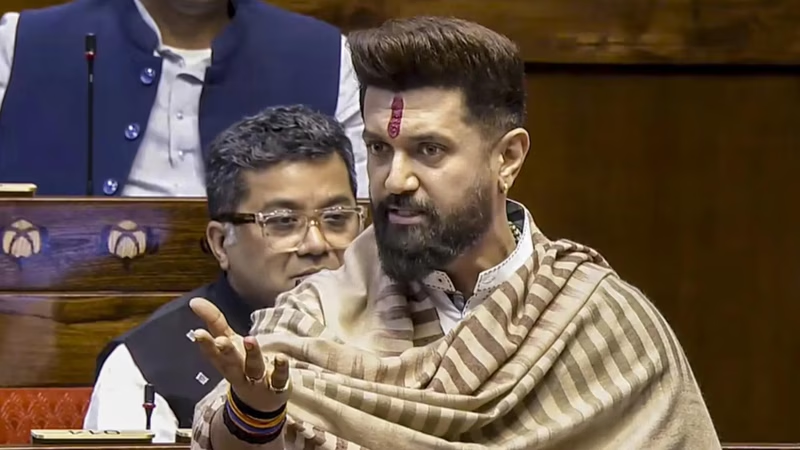
Chirag Paswan Fires Back: Opposition’s VB-G RAM G Protest Is ‘Electoral Gift’ to NDA
In a sharp political counterattack, Union Food Processing Industries Minister Chirag Paswan has dismissed opposition protests against the Centre’s new rural development initiative—VB-G RAM G—as a “misleading narrative” designed to create confusion. Speaking ahead of crucial by-elections and with an eye on the 2026 West Bengal Assembly polls, Paswan went further: he claimed these very protests could end up *helping* the NDA win in Bengal .
The controversy centers on the government’s restructured rural employment and infrastructure program, which replaces and refines elements of the older MGNREGA. While opposition parties like Congress and RJD have staged demonstrations alleging the scheme dilutes welfare commitments, Paswan argues they’re misrepresenting its intent—and inadvertently highlighting the NDA’s developmental focus.
Table of Contents
- What Is the VB-G RAM G Scheme?
- The VB-G RAM G protest: Opposition Claims
- Chirag Paswan’s Rebuttal: ‘Misleading Narrative’ or Political Truth?
- Why West Bengal Is the Battleground
- MGNREGA vs VB-G RAM G: A Policy Shift Explained
- Conclusion: Will This Help or Hurt the NDA in Bengal?
- Sources
What Is the VB-G RAM G Scheme?
VB-G RAM G stands for “Viksit Bharat – Gramin Awaas aur Manav Gati” (Developed India – Rural Housing and Human Progress). Launched in late 2025, it’s not a standalone program but a strategic convergence of multiple rural schemes—including housing (PMAY-G), roads (PMGSY), water (Jal Jeevan Mission), and livelihood support—under one integrated framework .
Unlike MGNREGA, which primarily guarantees 100 days of wage labor, VB-G RAM G emphasizes *asset creation* and *infrastructure outcomes*. The goal is to move beyond temporary employment toward sustainable rural transformation through coordinated project execution.
VB-G RAM G protest: Opposition Claims
Congress and RJD leaders have alleged that VB-G RAM G effectively sidelines MGNREGA, reducing guaranteed work and leaving rural laborers vulnerable. They argue the new scheme lacks legal backing and shifts focus from individual entitlements to top-down infrastructure projects .
Protests erupted in several states, including Bihar and West Bengal, with opposition workers holding rallies under banners like “Save MGNREGA” and accusing the BJP-led Centre of “abandoning the poor.” In Bengal, Trinamool Congress (TMC) also echoed concerns, framing it as an attack on rural welfare.
Chirag Paswan’s Rebuttal: ‘Misleading Narrative’ or Political Truth?
Paswan strongly rejected these claims. “This is a deliberate attempt to spread misinformation,” he stated. “VB-G RAM G doesn’t replace MGNREGA—it *complements* it by ensuring that the labor provided under MGNREGA contributes to lasting assets like roads, drains, and community centers” .
He accused Congress of hypocrisy, citing alleged corruption in MGNREGA implementation during their own tenure: “When they were in power, funds vanished, but no toilets or roads were built. Now they pose as saviors?”
Most strikingly, Paswan suggested the protests are backfiring: “By opposing a scheme that delivers concrete results, they’re reminding voters of their own failures. In Bengal, this ‘protest’ is actually helping us—it shows people who truly cares about development.”
Why West Bengal Is the Battleground
West Bengal remains a critical prize for both NDA and opposition blocs. After failing to unseat Mamata Banerjee in 2021, the BJP is aggressively rebuilding its rural outreach. Schemes like VB-G RAM G are central to this strategy:
- They target gram panchayats—where TMC’s dominance is being challenged.
- Visible infrastructure (pucca roads, piped water) creates tangible voter impact.
- Integrating housing and jobs appeals to youth and women voters.
Paswan’s comment signals that the NDA sees opposition resistance not as a threat, but as validation that their model is working [INTERNAL_LINK:nda-rural-strategy-bengal].
MGNREGA vs VB-G RAM G: A Policy Shift Explained
The core difference lies in philosophy:
| Feature | MGNREGA | VB-G RAM G |
|---|---|---|
| Primary Goal | Guaranteed wage employment | Integrated rural infrastructure |
| Legal Backing | Yes (Act of Parliament) | No (Executive scheme) |
| Funding Focus | Wages (60%), Materials (40%) | Outcome-based asset creation |
| Governance | Panchayat-led | Convergence across ministries |
Experts at the World Bank note that while MGNREGA excels in social protection, outcome-focused models like VB-G RAM G may yield higher long-term economic returns—if implemented transparently .
Conclusion: Will This Help or Hurt the NDA in Bengal?
Chirag Paswan’s bold claim—that the VB-G RAM G protest aids the NDA—rests on a calculated political bet: that voters value visible development over ideological debates. If rural households see faster road construction, better housing, and reliable water under this new framework, opposition noise may indeed fade. But if implementation falters or perceived as undermining worker rights, the backlash could intensify. Either way, the battle over VB-G RAM G is no longer just about policy—it’s become a frontline in India’s next electoral war.
Sources
- Times of India: ‘Misleading narrative’: Chirag jibes oppn over G RAM G protest, calls it ‘help’ in Bengal polls
- Ministry of Rural Development, Government of India – VB-G RAM G Guidelines (2025)
- World Bank Report: Rural Development Strategies in India, 2025