Somaliland Row Ignites Global Diplomatic Firestorm
In a dramatic escalation of tensions in the Horn of Africa, Somalia’s Defence Minister has accused Israel of secretly planning to relocate Palestinians to the breakaway region of Somaliland. The claim—described as a “flagrant violation of international law”—has drawn swift denials from both Tel Aviv and Somaliland authorities, while triggering condemnation from the Organisation of Islamic Cooperation (OIC). But what’s really behind this explosive allegation? Is it grounded in fact, or is the Somaliland row a symptom of deeper geopolitical maneuvering?
Table of Contents
- The Allegation: Somalia’s Shocking Claim
- Denials from Israel and Somaliland
- Background: The Secret Deal That Sparked Tensions
- Regional Fallout: OIC Condemnation and African Union Concerns
- Why This Matters for Palestine and Global Diplomacy
- Conclusion: Disinformation or a Warning Bell?
- Sources
The Allegation: Somalia’s Shocking Claim
Somalia’s Defence Minister, Abdulkadir Sheikh Dini, publicly alleged that Israel is orchestrating a covert plan to transfer displaced Palestinians to Somaliland—a self-declared republic that broke away from Somalia in 1991 but remains internationally unrecognized .
“This scheme violates the Fourth Geneva Convention and constitutes a grave breach of human rights,” Dini stated, framing the alleged plan as an attempt to permanently displace Palestinians under the guise of humanitarian resettlement . The accusation comes amid heightened scrutiny over Israel’s actions in Gaza and growing international calls for accountability.
Somaliland row: Swift and Categorical Denials
Both Israel and Somaliland moved quickly to reject the claims as baseless.
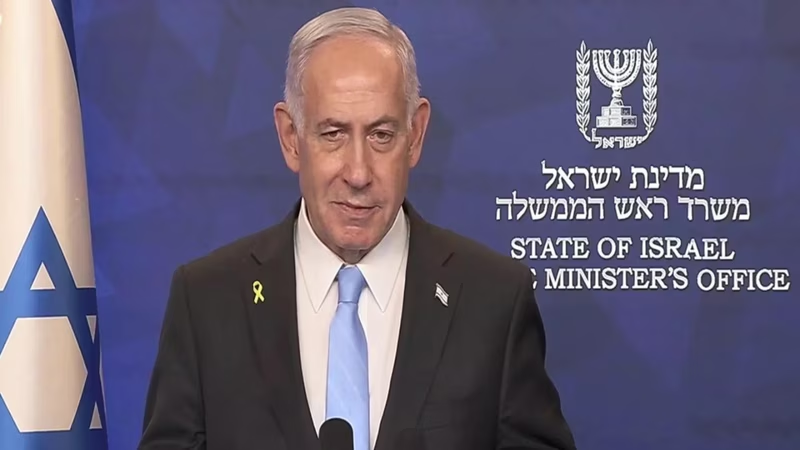
An Israeli government spokesperson called the allegation “completely false and without any factual basis,” emphasizing that Israel “has no such plans and never has” . Similarly, Somaliland’s Ministry of Foreign Affairs issued a statement denying any agreement involving Palestinian relocation, calling the report “a malicious fabrication aimed at destabilizing our region” .
Notably, however, neither side denied ongoing diplomatic talks—only the specific claim about Palestinian resettlement.
Background: The Secret Deal That Sparked Tensions
The current Somaliland row traces back to early January 2026, when Somali President Hassan Sheikh Mohamud revealed that Somaliland had agreed to “Israeli conditions” for formal recognition—a move that would make Israel the first country to recognize Somaliland’s sovereignty .
In exchange, reports suggest Israel sought access to a strategic Red Sea port in Berbera, giving it a critical naval foothold near the Gulf of Aden. This would significantly enhance Israel’s maritime security and intelligence capabilities, especially amid rising Houthi activity in the region [INTERNAL_LINK:israel-red-sea-strategy].
Somalia, which considers Somaliland part of its sovereign territory, views any foreign recognition of the region as an existential threat to its territorial integrity.
Regional Fallout: OIC Condemnation and African Union Concerns
The Organisation of Islamic Cooperation (OIC)—representing 57 Muslim-majority nations—issued a strong statement condemning “any attempt to exploit the Palestinian cause for geopolitical gains” and reaffirmed its support for Somalia’s territorial unity .
Meanwhile, the African Union (AU) expressed “deep concern” over external powers interfering in the Horn of Africa, warning that unilateral recognition of Somaliland could set a dangerous precedent for other secessionist movements across the continent .
The controversy has also strained relations between Somalia and countries perceived as sympathetic to Somaliland’s bid, including Ethiopia and the UAE.
Why This Matters for Palestine and Global Diplomacy
Even if the relocation claim is unfounded, its mere circulation carries serious implications:
- Weaponization of the Palestinian Cause: Accusations like these can be used to rally domestic and regional support, even if unverified.
- Erosion of Trust: Such allegations deepen mistrust between global South nations and Western-aligned powers.
- Precedent Risk: Any talk of relocating Palestinians—even hypothetically—echoes the long-rejected “transfer” proposals that have haunted Middle East diplomacy for decades.
As noted by Human Rights Watch, forced population transfers are prohibited under international humanitarian law, making the mere suggestion politically radioactive .
Conclusion: Disinformation or a Warning Bell?
While evidence for an actual Israeli plan to relocate Palestinians to Somaliland appears nonexistent, the Somaliland row reveals deeper truths: the Horn of Africa is becoming a new arena for great-power competition, and the Palestinian issue remains a potent tool in global diplomatic battles. Whether this episode fades as a false alarm or escalates into a broader crisis depends on how regional actors—and the international community—choose to respond. One thing is clear: in the shadow of war and fragmentation, every rumor carries weight.
Sources
- Times of India: Somaliland row: Somalia accuses Israel of planning Palestinian relocation; Tel Aviv denies
- Organisation of Islamic Cooperation (OIC): Official Statements Archive
- African Union Press Release on Horn of Africa Stability (January 2026)
- Human Rights Watch – International Humanitarian Law Guidelines