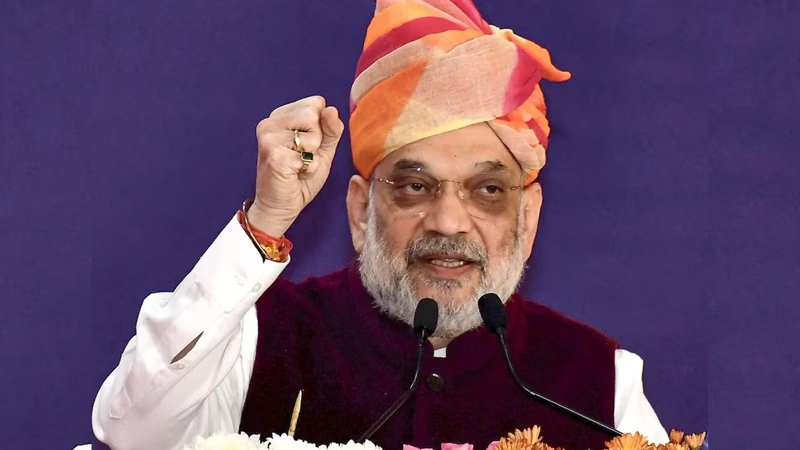
Can the BJP Really Win in Kerala? Amit Shah Thinks So
In a state long dominated by the Left and Congress-led fronts, the Bharatiya Janata Party (BJP) has historically struggled to break through. But Union Home Minister Amit Shah is betting big on a historic shift. Speaking at a recent party event, Shah confidently declared that the BJP vote share in Kerala is accelerating—and that the journey from 20% to 30%, and eventually 40%, “won’t be that long.” He went even further, asserting that the BJP is “confident of forming the government in 2026” .
This isn’t just hopeful rhetoric. It’s a strategic signal from the top of India’s ruling party, suggesting that Kerala—once considered a political fortress for its rivals—is now firmly in the BJP’s crosshairs. But what’s behind this bold claim? And is there real evidence to support it?
Table of Contents
- Amit Shah’s Bold Declaration on BJP Vote Share in Kerala
- The Numbers Behind the Claim: Historical Trends
- Local Body Wins: A Sign of Changing Tides?
- Why Kerala Matters for BJP’s National Ambitions
- Challenges Ahead for the BJP in Kerala
- Conclusion: Is a BJP Government in Kerala Really Possible?
- Sources
BJP vote share in Kerala: Shah’s Roadmap to Power
Amit Shah didn’t mince words. In his address, he framed the BJP’s growth in Kerala not as a distant dream but as an inevitable reality. “We got 20% [vote share] in the last election,” he said. “The journey from 20% to 30% and then to 40% won’t be that long” . This statement is significant because it moves beyond symbolic presence to outright governance ambitions.
Shah credited the party’s grassroots workers for this momentum, praising their dedication during recent local body elections. His message was clear: the BJP is no longer just contesting in Kerala—it’s building a sustainable political ecosystem capable of challenging the decades-old duopoly of the LDF and UDF.
The Numbers Behind the Claim: Historical Trends
To assess Shah’s claim, we need to look at the data:
- 2016 Kerala Assembly Elections: BJP secured 10.1% of the vote share, winning zero seats.
- 2021 Kerala Assembly Elections: Vote share jumped to 11.3%, still with no seats—but notable gains in districts like Thrissur and Ernakulam .
- 2024 Lok Sabha Elections: BJP’s vote share crossed 20% in several constituencies, including Alappuzha and Kollam, though it failed to win any of Kerala’s 20 seats .
While seat count remains zero, the steady climb in vote percentage—especially in urban and central Kerala—suggests a growing base. Political analysts note that crossing the 20% threshold is often a tipping point for third parties in India’s first-past-the-post system [INTERNAL_LINK:how-vote-share-translates-to-seats-in-india].
Local Body Wins: A Sign of Changing Tides?
Shah specifically highlighted the BJP’s performance in the 2020 and 2024 local body elections as proof of ground-level penetration. In 2020, the party won over 100 panchayat wards and even gained control of a few grama panchayats—a first in Kerala’s history .
More recently, in by-elections and civic polls, BJP candidates have come second in traditionally Left or Congress strongholds. These incremental wins matter because they build organizational depth, create local leadership, and normalize the BJP as a viable alternative in voters’ minds.
Why Kerala Matters for BJP’s National Ambitions
Kerala isn’t just another state for the BJP—it’s the final frontier in South India. With footholds in Karnataka, Telangana, and Andhra Pradesh, the only major southern state resisting BJP’s expansion is Kerala (and Tamil Nadu, where its presence is also limited).
A breakthrough in Kerala would:
- Complete the BJP’s pan-Indian footprint.
- Disrupt the narrative of “Southern resistance” to the party.
- Provide a massive morale boost ahead of the 2029 general elections.
Moreover, controlling Kerala would give the BJP leverage in the Rajya Sabha, where southern states hold significant sway.
Challenges Ahead for the BJP in Kerala
Despite Shah’s optimism, formidable obstacles remain:
- Strong Anti-Incumbency Against Third Fronts: Kerala voters have historically punished parties that split votes, fearing it benefits their main rival.
- Deep-Rooted Ideological Resistance: The state’s strong secular, communist, and social reform traditions clash with the BJP’s Hindutva platform.
- Lack of a Charismatic Local Face: Unlike other states, the BJP lacks a widely accepted Malayali leader who can connect emotionally with the masses.
Even if the BJP vote share in Kerala reaches 30%, converting that into seats will require near-perfect vote consolidation—something that’s never happened before.
Conclusion: Is a BJP Government in Kerala Really Possible?
Amit Shah’s prediction is undeniably ambitious. While the data shows a clear upward trend in the BJP vote share in Kerala, turning votes into power in a state with such entrenched political loyalties is a monumental task. The 2026 elections will be the real test. If the BJP can replicate its local body success on a statewide scale—and if anti-incumbency against both LDF and UDF peaks—it might just pull off the impossible. Until then, Shah’s words are equal parts strategy, hope, and psychological warfare aimed at reshaping Kerala’s political imagination.
Sources
- Times of India: ‘Journey from 20% to 30% & 40% won’t be that long’: Shah says BJP vote share rising in Kerala
- Election Commission of India – Kerala State Election Reports
- India Today Analysis: Can BJP Break Through in Kerala by 2026?