Hyderabad Temple Desecration Sparks Political Firestorm
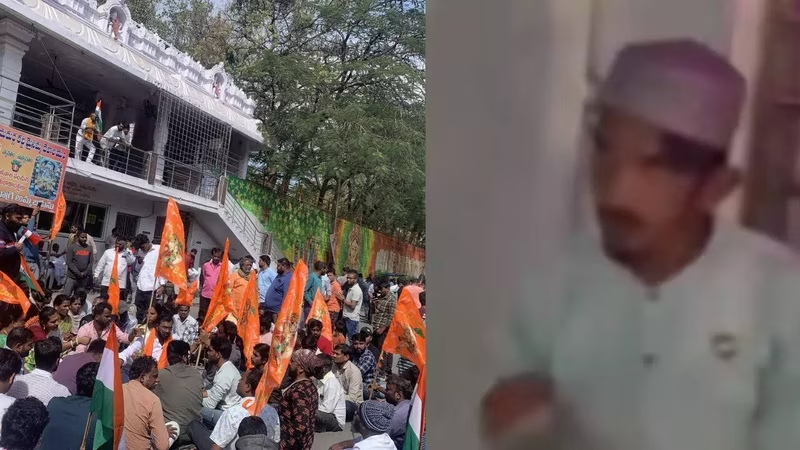
A recent incident of alleged sacrilege at a temple in Hyderabad has sent shockwaves through the city, triggering violent protests and a fierce political battle. The core of the controversy? A 26-year-old man from Karnataka who was reportedly beaten by an enraged mob and subsequently arrested for committing indecent acts within the sacred premises of the Katta Maisamma temple. This Hyderabad temple desecration case has become a flashpoint for larger debates on law and order, religious sensitivity, and political accountability in Telangana.
Table of Contents
- The Incident: What Happened at Katta Maisamma Temple?
- Legal Action: Charges Under the New Bharatiya Nyaya Sanhita
- Political Fallout: BJP Protests and Accusations of Appeasement
- A Pattern of Sacrilege? Concerns Over Temple Security
- Conclusion: A City on Edge
- Sources
The Incident: What Happened at Katta Maisamma Temple?
The tranquility of the Katta Maisamma temple in Safilguda, Hyderabad, was shattered when the accused, identified as a 26-year-old man from Karnataka, allegedly entered the temple premises and committed an act of profound disrespect. According to police reports and eyewitness accounts, the man was found to have urinated within the temple complex—an act considered a grave desecration in Hinduism .
The discovery of his actions led to an immediate and furious reaction from local devotees. An enraged mob apprehended the man and physically assaulted him before the police could intervene. The swift and brutal public response underscores the deep emotional and spiritual connection the community has with its places of worship. The accused was later formally arrested and is now in police custody, facing serious legal consequences for his actions.
Legal Action: Charges Under the New Bharatiya Nyaya Sanhita
In a significant development, the Hyderabad police have registered a case against the accused under the newly implemented Bharatiya Nyaya Sanhita (BNS), which replaced the old Indian Penal Code. The specific sections invoked are crucial to understanding the gravity of the offense in the eyes of the law.
The primary charges fall under:
- Section 298 of the BNS: This section deals with “Injuring or defiling a place of worship with intent to insult the religion of any class.” It covers acts of destruction, damage, or defilement of a sacred site [[16], [19]].
- Section 299 of the BNS: This section addresses “Deliberate and malicious acts intended to outrage religious feelings of any class by insulting its religion or religious beliefs.” This is a broader charge that captures the intent to cause communal disharmony and hurt religious sentiments [[15], [20]].
These provisions reflect a modern legal framework designed to protect religious sanctity and maintain social peace. The application of the BNS in this high-profile case sets a precedent for how such sensitive matters will be handled going forward.
Hyderabad temple desecration: Political Fallout and BJP’s Fierce Response
The incident has been seized upon by the opposition Bharatiya Janata Party (BJP) as a symbol of the ruling Congress government’s alleged failure to maintain law and order and protect the interests of the Hindu majority. Telangana BJP President N. Ramchander Rao visited the temple site personally and delivered a scathing condemnation of the event.
Rao described the act as “blasphemous” and went so far as to call for an “encounter”—a term often used in India to imply extrajudicial killing—of the accused, highlighting the intense anger within the party ranks [[21], [25]]. He directly accused the Congress-led state government of practicing a policy of “appeasement,” suggesting that their silence and inaction embolden such acts of sacrilege .
This strong rhetoric has galvanized BJP workers and allied Hindu nationalist organizations like the VHP and Bajrang Dal, leading to organized protests across the city. The party is using this incident to build a narrative of a government that is either unwilling or unable to safeguard its citizens’ religious freedoms, a potent political message in the current climate .
A Pattern of Sacrilege? Concerns Over Temple Security
This incident is not isolated. Recent months have seen a disturbing series of alleged acts of vandalism and desecration at various temples in the Hyderabad region, including the Muthyalamma temple and the Sri Hanuman statue [[5], [10]]. These repeated events have created a pervasive sense of insecurity among the Hindu community regarding the safety of their religious sites.
Community leaders and political figures are now demanding a comprehensive review of security protocols around places of worship. The question on everyone’s mind is whether these are random, isolated acts by disturbed individuals or part of a more coordinated effort to incite communal tension. For many residents, the Hyderabad temple desecration at Katta Maisamma is the latest and most brazen example of a worrying trend that authorities must urgently address [INTERNAL_LINK:communal-tensions-in-india].
Conclusion: A City on Edge
The arrest of a man for desecrating the Katta Maisamma temple has done far more than just remove an individual from the streets. It has exposed deep-seated anxieties about religious identity, community safety, and governmental responsibility in Hyderabad. While the legal process will take its course under the new BNS, the political and social ramifications are already being felt. The BJP’s aggressive stance and the public outcry signal that this issue is far from resolved. The state government now faces immense pressure to not only deliver justice in this specific case but also to reassure its citizens that their sacred spaces are inviolable. The coming weeks will be a critical test of Telangana’s ability to manage this crisis and prevent it from escalating into wider social unrest.
Sources
- Times of India: 26-year-old man beaten, arrested for desecrating Hyderabad temple
- FirstIndia: BJP leader Madhavi Latha detained during protest over alleged vandalism of Muthyalamma Temple
- Bharatiya Nyaya Sanhita, 2023: Sections 298 & 299 on offences relating to religion.
- Various news reports on BJP Telangana President N. Ramchander Rao’s statements [[21], [24], [25]].